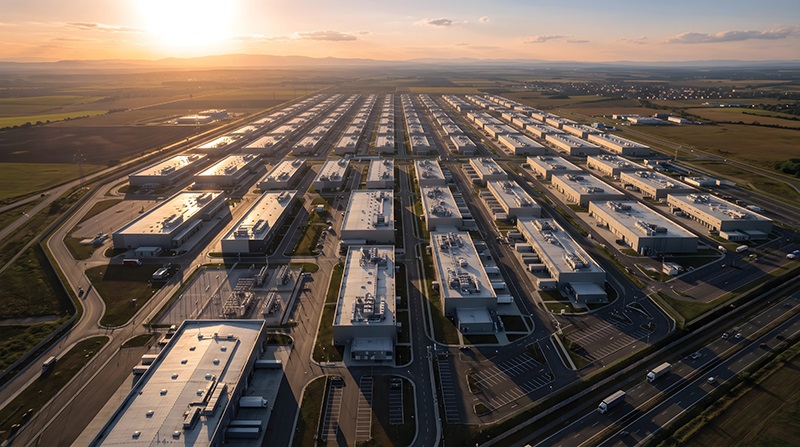
Recent Goldman Sachs research regarding the anticipated power demand of U.S. data centers provides some eye-popping numbers. The research indicates the power demand, driven primarily by artificial intelligence (A.I.), is expected to jump from an estimated 41 gigawatts (GW) this year to a whopping 66 GW in 2027, more than double the amount of 31 GW in 2025.
Construction completion is an angle contractors should be interested in. The research said that just 72% of data centers to be completed within the subsequent four quarters went online as scheduled.
“The further out a project is scheduled for activation, the less likely it is to be completed as planned,” according to the research. “Supply chain and labor shortages remain the most common causes of delay.”
Research from the Regional Plan Association shows that this could mean opportunities for contractors with the manpower and wherewithal to tackle the power, cooling and lighting needs of developing the hyperscale data centers that can reach over 1 million square feet.
Supporting cooling requirements
Eaton, Beachwood, Ohio, referencing data from CBRE, reports that 70% of new data centers are driven by A.I. However, more than 90% of data center operators say there is a shortage of experienced construction teams. That’s where ECs must be on point.
“Electrical contractors need to understand how things work together on a system level,” said Dan Carnovale, director of Eaton Experience Centers in Pittsburgh and Houston. “At the outset of a project, electricians need to know the power requirements, load profiles and on-site power sources. Plus, electrical contractors may need to support liquid cooling requirements, which may involve different trades.”
Jorge Lis, global data center segment manager at ABB, Cary, N.C., said data center water consumption refers to net water use from blue sources, such as surface and groundwater, and gray sources like treated wastewater, excluding discharged water.
Variable-speed drives are crucial for precisely controlling cooling compressor, pump and fan motors. They reduce “energy consumption typically by up to 30% while protecting equipment from electrical and mechanical stress,” Lis said. “These drives provide the protection and reliability needed to keep cooling systems running 24/7.”
That last part is important because downtime can cost an average of $5,600 a minute. But there’s more. Lis said these drives are exceptionally efficient at reducing energy and water consumption in data centers. Cooling systems rarely operate at full load, so speed control is essential for maintaining efficiency across operating conditions.
“Reduced pump energy lowers cooling tower demand and evaporation losses, while lower electricity consumption reduces indirect water usage,” he said.
Then, particularly on the HVAC side, there are more advanced variable-speed drives using ultra-low harmonics that can improve cooling process and power network efficiencies by eliminating reactive power content. One example is ABB’s ACH580 series drives, which offer wall-mounted and cabinet-built HVAC drives, including ultra-low harmonic variants.
Eaton’s variable-speed drive portfolio ranges from low-voltage PowerXL DH1 and DG1 drives for pumps and fans to SC9000 medium-voltage drives used on large cooling system motors. In data centers, such technology helps match motor output to real-time cooling requirements, improving the efficiency of pumps, fans and other cooling infrastructure, rather than running at full speed continuously.
Lighting and lighting control
According to Brendon Van Campen, vice president of sales for Coopersburg, Pa.-based Lutron’s North American commercial business, data centers are always running. Cold and hot aisles require lighting and lighting controls specifically rated for the operating environment and must be designed to maximize efficiency, minimize maintenance and ensure safety.
For example, in a warehouse-style data center, lighting and controls usually focus on code compliance and basic on/off functionality, often using occupancy or vacancy sensing. But larger multibuilding or campus data centers might incorporate showrooms, offices and meeting spaces where advanced lighting controls, automated shading systems and employee comfort are prioritized. For these spaces, products such as Lutron’s Athena or Vive wireless systems provide automated and personal control, advanced occupancy and vacancy sensing, and shade control to minimize glare.
“Contractors should prioritize manufacturer coordination early in the project, especially with IT, mechanical and facilities teams, since data center construction schedules are often highly compressed,” Van Campen said. “Data centers are frequently built in phases or undergo rapid changes in capacity, so it’s important to design the space and building systems with scalability and expansion in mind.”
There’s something else, which ties back to the CBRE research numbers. Van Campen said that demand for skilled labor and installation expertise continues to outpace supply.
“Control solutions that improve energy efficiency, simplify installation, programming and integration, and reduce disruption—including wireless technologies for some applications—can help accelerate deployment and minimize downtime,” he said. “The electrical contracting firms best positioned for success will be those that invest in recruiting, training and retaining skilled talent.”
Tammy Salvatore, senior mission critical national program manager for Acuity Brands Lighting, Decatur, Ga., said contractors should be aware of the ambient temperatures and operational use of data centers’ spaces to ensure lighting and controls are configured to match real-world operating conditions.
For example, linear solutions such as Acuity’s CLX LED strip light and MLX linear low bay help direct light onto the server racks, while high-bay options, including the Compact Pro Industrial LED high bay, I-BEAM IBG and REBL industrial LED round high bay, offer flexibility in terms of factor and coverage.
Beyond the data hall, Acuity’s innovation and architectural brands, including Mark, Eureka, Gotham, Luminis and a-Light, support customer-facing and administrative spaces where visual comfort and design are important.
“Clear communication early in the process is also critical,” Salvatore said. “Contractors should identify and share any structural ceiling grid specifications with their lighting representative to help ensure fixtures are properly designed and sized for the application. These grid systems vary by manufacturer and configuration, and they directly impact fixture dimensions, including the troffer housing and lens.
“It’s equally important to communicate anticipated product delivery timelines. When contractors provide visibility into when materials are needed on-site, Acuity Brands can better support project schedules and coordinate delivery of the lighting and controls package accordingly,” she said.
Where are data centers headed?
Van Campen said that there is a lot to do for everyone involved in building data centers, especially electrical contractors.
“As the world continues to embrace A.I.-driven solutions, the demand for more data centers and greater capacity continues to grow,” he said. “We are already seeing the impact in many markets on an already limited electrical labor force being stretched further, and growth is expected to remain strong through the remainder of 2026, driven largely by A.I. workloads, cloud-connected system expansion and increasing digital infrastructure demands.”
Thus, the stakes are high, especially when the customers are hyperscale giants such as Meta, Google, Amazon, Microsoft and OpenAI.
“Electrical contractors are on the front lines of building today’s A.I. data centers, and the requirements for power density, speed and precision are higher than ever,” Carnovale said.
stock.adobe.com/Iryna
About The Author

VOSS is a freelance writer based in the Chicago area and has worked extensively in the low- and high-voltage areas of the electrical industry. Contact him at [email protected].