
According to data released in May 2026, nearly half of all construction starts were estimated to be worth more than $1 billion. Data centers led megaprojects, but other commercial, industrial and civil projects made a mark, too.
Michael Guckes, chief economist for ConstructConnect, Cincinnati, and Eric Gaus, chief economist for Dodge Construction Network, Boston, both recognize the outsized effect megaprojects contribute to construction growth.
“In June 2025 through May 2026, 47% of megaprojects … were commercial projects,” Guckes said. “These projects can include hotels, data centers, large traditional offices, sports arenas, convention centers and transportation terminals. And yes, 44% of that 47% were data centers. Digging into the numbers, however, of that 3% that were not data centers, 22% fell into civil construction and heavy engineering. Following that, you had industrial [large manufacturing facilities], which represented 17%.”
To give some perspective as to how megaprojects have evolved and grown, Gaus explained how Dodge tracked such projects monthly between 2016 and 2018. The cutoff of what qualified as a megaproject was initially $500 million. That shifted in short order to closer to $650 million. Today, the cutoff is popularly $1 billion.
“There are tons of megaprojects today that are now several billions of dollars, but there are plenty of projects that qualify while under $1 billion if you factor in inflation [a 10% increase annually]. Today, we see a lot more megaprojects,” he said.
Gaus shared there was a little bit of a lull in megaproject starts, but they have been coming back. Data centers are still extremely strong, including in planning, according to the Dodge Momentum Index.
“I think one of the larger problems are costs are going up like crazy; that is bleeding into other places like healthcare. Because there is so much money flooding into data centers, they are willing to just pay whatever the price is to get stuff in,” he said. “It is expensive to try and get materials and labor. And if I look at things like healthcare, the cost per square foot of healthcare facilities is going up quite a bit.”
BSA Health System, a U.S. healthcare architecture firm based in Amarillo, Texas, places costs of large tertiary hospitals (500 beds) as high as $800 per square foot. Data centers can range based on size from as much as $600 to over $1,000 per square inch, according to Kisaco Research.
Gaus felt producers ate many of the tariffs. “There was a lot more shifting of supply chains to get around the tariffs,” he said, “I think there was also a lot of companies that were loath to raise prices due to tariffs and say so because of administration blowback.”
A boom defined
In 2025, Dodge Construction Network issued its report, “The Megaproject Boom Defines the Decade.” Gaus said its findings remain relevant in 2026. The report states the total value of megaproject construction starts increased more than 200% in recent years. Underlying drivers have included federal programs including the Infrastructure Investment and Jobs Act, the CHIPS and Science Act and the Inflation Reduction Act. Pandemic supply chain disruptions helped increase demand for high-tech manufacturing; expansion projects due to aging infrastructure played a role, as did the upcoming federal funds expiration in 2027. Data centers represent the lion’s share of project activity and continue to rapidly expand due to A.I. development. Conversely, smaller data centers increased in number (e.g., edge data centers).
Megaprojects can also be found in U.S. manufacturing, including semiconductor production in states such as Arizona, Ohio, Georgia and Texas. Battery and semiconductor megaprojects totaling at least $77 billion (at the time of the report) are concentrated in the Great Lakes and Southeast corridors, forming the “Battery Belt.” Arizona, however, is the semiconductor hub. Reshoring has played a positive role in semiconductor and battery growth. Texas is home to the biggest diversity of megaprojects.
Meanwhile, despite the high investment in megaprojects, issues including water use and power availability could crimp megaprojects. In addition, megaprojects require 10,000 workers at peak. Skilled workers are in short supply, delaying and raising costs.
Longer timelines
Gaus said that when megaprojects hit as you track sectors, you are not sure when they are going to start.
“So, you get these just big spikes in your forecast,” he said. “Data centers are tricky. If they are built in stages, do you track by stage? One example is OpenAI’s Stargate Project data center [an initial investment of $100 billion and the first major site in Abilene, Texas]. And some data centers are speculative and not breaking ground for two years. It is silly to say there’s $100 billion worth of action now when only a small portion of that is starting. We tend to take those hyperscale projects and chunk them down into smaller projects. Even those chunks tend to fit into that megaproject category because they are so large.”
ConstructConnect individually monitors large data centers (e.g., Project Kestrel, a $100 billion data center campus development in Kansas City, Mo.) that have construction spread over time.
Gaus said oversized projects could also be large semiconductor or battery facilities.
“In general, initial data center work breaks ground closer to a year and a half,” he said. “The same for manufacturing. Large multifamily could be two years.”
Megaprojects across sectors
Guckes cited several recent big industrial projects that surpassed the $1 billion mark this year or in late 2025, representing a diversity of companies. They include CF Industries Project Blue Point in Louisiana. This low-carbon ammonia production facility is a $2 billion project that broke ground in April in partnership with JERA Co. Inc., Japan’s largest energy company, and Mitsui & Co. Ltd., a global investment and trading company.
A $1.2 billion Daisy Brand dairy manufacturing plant in Iowa broke ground in March. Meanwhile, Green Bay Packaging invested $1 billion to modernize and expand its manufacturing facility in Morrilton, Ark. Another expansion project, Boeing South Carolina in North Charleston, broke ground with plans to manufacture 10 of its 787 Dreamliner planes on a monthly basis to meet demand. It represents a $1 billion investment. In 2025 alone, 15 hospital projects, each exceeding $1 billion, broke ground across the country.
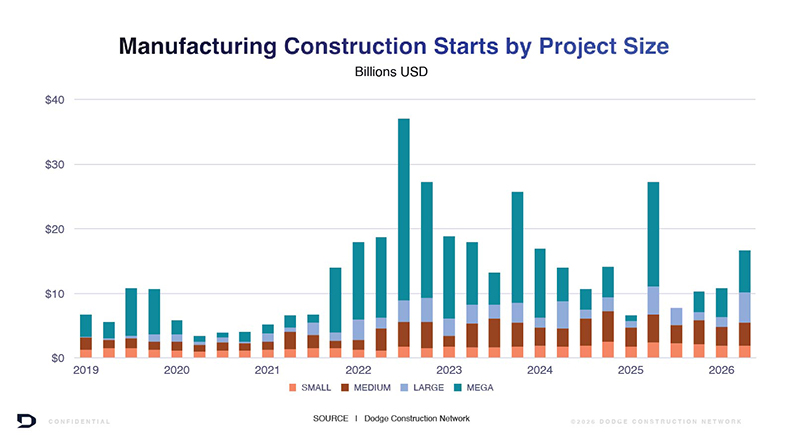
Figure 1
Gaus shared manufacturing has slowed down a bit, as large semiconductor plants are currently more in the planning stage. Megaprojects still comprise a significant portion of this sector, however (see Figure 1).
“I think we’re building an ecosystem of knowledge around building chips,” he said.
“Today’s manufacturing is no longer a world of simple widgets,” Guckes said. “The stakes are higher. The fixed infrastructure is more costly to get advanced manufacturing facilities up and running.”
In overall nonresidential construction, Guckes is seeing strong growth in 2026.
“We’ve jumped out of the gate with year-to-date spending up to double digits for nonresidential construction, building off a strong 2025,” he said. “At the same time, we need to be sensitive to the struggle to grow our construction labor force. Nonetheless, construction employment is growing at almost three times the pace of nonfarm employment. That says a lot about just the sheer demand, the absolute [need] for more labor in construction.”
Gaus added that, while there is a lack of labor expertise to staff the building of today’s manufacturing plants, electricians with their skill set and training might be best positioned, especially with data centers. MEP work is the largest cost in megaprojects.
The elephant taking up several rooms
ConstructConnect reported that May 2026 spending for U.S. data center construction totaled $7.9 billion, ranking the eighth-highest month on record (see Figure 2). Year-to-date spending stood at $58.1 billion, more than four times the record level set over the same period in 2025. Over 12 months, Illinois, Louisiana, North Carolina, Virginia and Texas have captured 60% of all new data center starts spending.
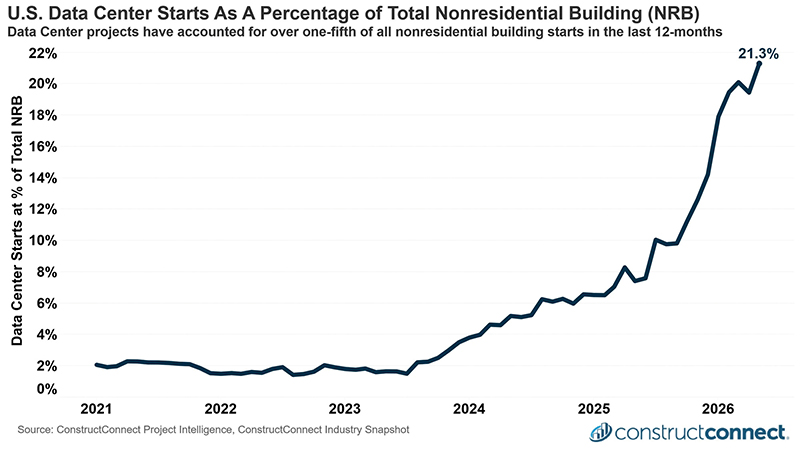
Figure 2
The larger campus-sized data center properties typically support a hyperscale or large-scale cloud service requiring vast computing, storage and networking resources using interconnected servers and software.
Such campuses can rapidly scale up or down to meet the demands of millions or billions of users. Some connect to other data centers globally. In either case, servers can increase into thousands. One key sector that benefits is power infrastructure needed to serve the increased demands of data centers.
“A very large data center, say $10 billion, brings unique needs, especially if you’re going to put it in a location that is a tertiary market, for example a rural location,” Guckes said. “You’re bringing in people from all over, all these electricians [and] all these other construction experts. There is not enough existing infrastructure there to feed and house them. You must build your own little construction camp on-site. Some firms find a plot of flat land they can cover in gravel and set up lots of RVs [and] lots of trailers for crews to be fed and sheltered. The Stargate data center project is one example of this.”
There is also an interesting challenge when it comes to financing, according to Gaus. Data center developers might cite multiple locations for one deployment of capital to navigate community pushback or other challenges that could stall one project, so developers list several.
“That’s a different kind of cost, but it is still a cost that makes it hard for maintaining strong growth,” Gaus said. “Nonetheless, there has been a strong data center ramp-up over the last years. Two out of the last three years has shown over 100% growth. Our conservative forecast is an additional 25% growth in 2026.”
ConstructConnect reported in July 100 data center projects in various stages of preconstruction, some of which could be canceled. Dodge’s June 2026 Momentum Index saw a 2% contraction due to some slowing in data center planning.
“Data center activity continued to drive the index,” said Sarah Martin, director of economic research at Dodge.
Encouragingly, she said nearly every other sector saw growth in planning activity.

stock.adobe.com/sabelskaya, ConstructConnect
About The Author

GAVIN, Gavo Communications, is a LEED Green Associate providing marketing services for the energy, construction and urban planning industries. He can be reached at [email protected].