A good friend of mine recently told me a story that, unfortunately, is all too common. A fire alarm contractor was counting the number of smoke detectors he thought should be on a project, and it didn’t quite equal what my friend had given him in his bid. So, they went through their list of detectors and locations and compared it to the contractor’s takeoff.
On the second floor, the elevator opened on either side, one into the corridor and the other into a small function space. It turns out that the contractor had provided one smoke detector for recall in the corridor of the second floor within 21 feet of the elevator door. When he was questioned about his decision to leave one door unprotected, he said, “For recall, you only need one smoke detector per floor. What else do I need?” My friend explained the purpose of elevator recall and the reason for the second smoke detector, which is installed where the elevator opens on two sides. My friend hasn’t heard from the contractor since. Do you see the issue? Where did the contractor get his interpretation that he only needed one smoke detector for the elevator recall, even though the elevator opens on two sides? Do you think eliminating one smoke detector will cost him the job? I seriously doubt it, but I am concerned that a fire official reviewing the plan might miss the mistake.
NFPA 72, National Fire Alarm and Signaling Code, references the ASME A17.1/CSA B44 (2022) Elevator Code. In its Section 2.27.3.2, Phase I Emergency Recall Operation by Fire Alarm Initiating Devices, it states in part, “fire alarm initiating devices used to initiate Phase I Emergency Recall Operation shall be installed in conformance with the requirements of NFPA 72 and shall be located at each elevator lobby served by the elevator …”
Clearly, the intent of the codes is to protect each floor where the elevator opens into a lobby. In the above example, the contractor apparently chose not to call the opening into the function space a lobby to support his reasoning, but he is wrong.
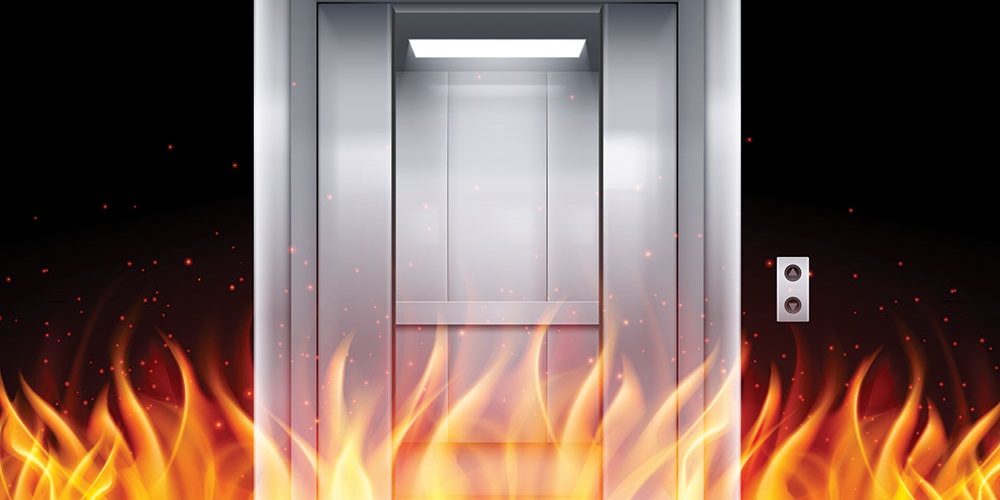
The basic question is, why do we recall elevators when a lobby smoke detector senses smoke? We do not want the elevator to open its doors in a smoky area and have the smoke activate the door-opening device, thereby keeping the doors open to the fire area and exposing passengers in the elevator to the fire with fatal results. This scenario has happened in the past, so now there are requirements to follow.
As I have stated many times, there are more codes involved in our profession than just the National Fire Alarm and Signaling Code. Many contractors just beginning to install fire alarm systems make the mistake of assuming that having a copy of NFPA 72 is all they need to break into the business. But experienced fire alarm contractors know that, at a minimum, one needs the National Electrical Code (NFPA 70), the building code enforced in your jurisdiction and any local fire alarm code specific to your jurisdiction.
What most people do not understand is that all codes referenced by the building code are considered law. That, in turn, means that all codes referenced by NFPA 72 are also law and must be followed. In the case above, that includes the ASME A17 Elevator Code. If anyone believes that NFPA 72 is unclear about any requirements, they must review the other referenced codes to ensure they do the right thing. The most stringent requirement always prevails. Creating your own interpretation of what you think any code requirement means is simply looking for problems. Most AHJs will discover your mistake, and it will then be a costly affair to remedy the misinterpretation.
Below are some additional insights into the code requirements for elevator recall.
In facilities without a required building fire alarm system, fire alarm initiating devices used to initiate Elevator Phase I Emergency Recall Operation must still be connected to either a nonrequired building fire alarm system or a dedicated function fire alarm control unit, and the “dedicated function fire alarm control unit” must be identified as the “elevator recall control and supervisory control unit” in the FACU and the record drawings.
Unless recall is performed using an automatic sprinkler waterflow switch or required differently by the AHJ, only the elevator lobby, elevator hoistway, elevator machine room, elevator machinery space, elevator control room and elevator control space smoke detectors or other automatic fire detection as permitted by the code must be used to initiate Elevator Phase I Emergency Recall Operation.
The code allows a waterflow switch to initiate Elevator Phase I Emergency Recall Operation upon activation of a sprinkler installed at the bottom of the elevator hoistway (the elevator pit), provided the waterflow switch and pit sprinkler are installed on a separately valved sprinkler line dedicated solely for protecting the elevator pit.
Elevator control is one of the many emergency control function interfaces contained in Chapter 21 of the National Fire Alarm and Signaling Code. You are cautioned to always read the entire code to ensure that the design and installation are code compliant.
About The Author

MOORE, PE, is a licensed professional fire protection engineer, and located in Jamestown, R.I. He is the editor of five editions of the National Fire Alarm Code Handbook. He authored, “Designing Mass Notification Systems – A Pathway to Effective Communications.” He is a principal member of the NFPA 72 Correlating Committee and former chair, now principal member, of the Emergency Communications System Technical Committee. He can be reached at [email protected].