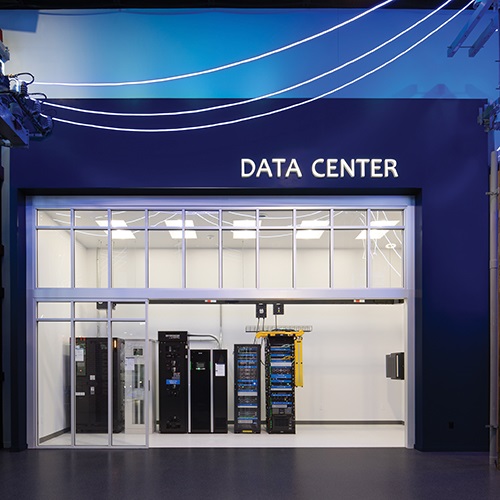
Approximately 67% of the new crop of data centers will be in rural areas, with 39% of new facilities in counties that currently have none, the organization says. You’ll see many of those facilities popping up in the Midwest and South.
Much of this growth is driven by artificial intelligence’s (A.I.) power and computing needs. And while those numbers seem substantial, they are corroborated by electrical product manufacturers, which see rapid growth year over year for at least the rest of this decade.
John DeBoer, vice president of the data center vertical for North America for Siemens, Peachtree Corners, Ga., said the target for data center construction in the United States over the next three years is 100 GW.
“And to put that in context, that is roughly equal to building 10 New York City’s worth of power equipment over the next three years,” he said.
That’s a lot. DeBoer and his industry counterparts feel electrical contractors are going to play big roles in getting all that work done.
Modular approach, dedicated manufacturing
DeBoer said that the speed major A.I. players such as Meta, Google, Amazon and others need to build data centers is requiring more modular equipment, which has spurred development of dedicated data center factories to craft those pieces. In turn, that equipment can then be installed on-site faster, often by an electrical contractor.
“Those are large modules that have to come together to be integrated,” he said. “Data centers are secure warehouses in some respect, but it is a physical building. If the target is local work where the data center is going up, building fit-out and assembly of modules is a massive scope of effort.”
Manav Patel, vice president of strategy and transformation for low-voltage business at Schneider Electric, Boston, said his company is building its own manufacturing facilities to expedite data center development, and a lot of that work is modular.
He said Schneider Electric’s low-voltage switchgear and many other types of equipment are “packaged” in a prefabricated and pre-tested solution called an Electric House Solution, or Ehouse, which is then tested and commissioned as a module and shipped to a work site.
“That is what we call prefabricated modular data centers,” he said. “That is part of our strategy to help the industry to build data centers faster. [There are] constraints on time to market and shortage of skilled labor.”
From there, these modules and their inner components, along with a host of other products crucial to data centers, such as QED-2 and QED-6 switchboards, ASCO 7000 Series power transfer switches and Galaxy V Series three-phase UPS, are monitored through the company’s EcoStruxture digital platform that melds operational components with IT. That allows data center management to have a continuous 30,000-foot view of operations, automation and energy use.
Dan Carnovale, director of Eaton Experience Centers, agreed with Patel that speed is key.
“We’re helping customers build out faster and expedite startup and commissioning with engineered-to-order modular systems through our Fibrebond business,” he said. “That said, there is a vast opportunity and need for skilled electricians to help build out more data center capacity.”
DeBoer added that with 100 gigawatts (GW) of power needed for data centers in the next three years, there should be abundant work for contractors, depending “on the type of contractor that someone is and the role they want to play,” he said. “There are a lot of roles to play in this world. How can I possibly put 100 to 200 megawatts in a building in the next six months? In general, they try to do 80% of that work off-site if they can. Those are large modules that have to come together to be integrated. There is work for contractors there, and there is building fit-out.”
The shift to DC power
Another twist in the data center equation is the ongoing shift to higher-power DC architecture, Carnovale said.
“We see the shift to DC power distribution as a hybrid, modular and staged-in adoption that depends on the size, deployment specifics and customer requirements,” he said. “We’re advancing the needed technologies and working alongside the industry on the needed codes and standards.”
For example, he said Eaton’s medium-voltage solid-state transformer technology can provide 800V DC direct-to-rack from incoming 13.8-kilovolt (kV) AC power.
Jorge Lis, global segment leader for data centers at ABB, Cary, N.C., said the company is investing 40% of its scientific research in electrification into technologies critical to next-gen data centers, including advanced electrical architectures such as DC distribution systems, protection devices and cooling efficiency.
“The protection of critical loads in DC is essential for A.I. data centers, as it ensures uninterrupted, scalable and redundant power delivery to mission-critical computing infrastructure, preventing costly downtime and data loss while supporting the continuous growth of A.I. workloads,” Lis said. “This commitment ensures that contractors building A.I. data centers today are working with a partner actively shaping the industry’s future.”
ABB gear for medium-voltage primary distribution includes arc-resistant SafeGear and non-arc-resistant Advance air-insulated switchgear, which secures power distribution up to 38 kV. For gas-insulated secondary distribution, there is SafePlus switchgear and REC640 protection relays for grid monitoring and control.
On the low-voltage side, the ReliaGear SB switchboard is complemented by the SACE Emax 3 air circuit breaker, which offers arc-flash protection and predictive maintenance to critical systems.
Manufacturer education and training
No matter the contractor, education about data center needs, especially with the shift to DC power structure and on-site power sources, is going to be crucial going forward, Carnovale said.
“These structural shifts are intensifying the skills gap,” he said. “Electricians need to understand the implications of a bring-your-own-power approach, redundant sources and the shift to high-power DC systems.
“Now, everyday electricians working on data center projects will need specialized training for medium-voltage systems. With higher-power systems, additional training and understanding of arc flash and safety is paramount,” Carnovale said.
For Eaton, training can be acquired through its experience centers in Houston, Pittsburgh and St. Louis. There, contractors can participate in live demonstrations, access hands-on training courses and learn about the latest power management technologies.
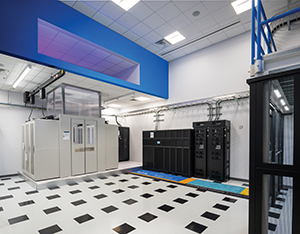
Eaton Experience Centers provide practical training
on data center installation, safety, commissioning and more.
Carnovale said the experience centers provide training on installation, safety, commissioning and emerging architectures, such as high-density and 800V DC systems.
Lis said his company’s field application engineers collaborate during design and installation and provide product selection guidance, grid-to-rack coordination and job site support for complex data center systems. Training on products and commissioning procedures is available through ABB’s partner program.
Patel said that since “everyone wants to build data centers fast and cost-effective, contractors are a big part of our ecosystem. We cannot manufacture anything without our contractor partners,” he said. “Schneider Electric starts to work with electrical contractors and end-users from the design stage to commissioning to maintain in stages. It’s not a one and done thing. They co-design some of these things.”
The future of data centers
What of the future beyond this decade?
“If you look at forecasts for all the large internet giants, everyone is spending tremendous amount of money on building data centers for A.I.,” Patel said. “This market is going to explode. These equations need to be solved for scalability and getting time to market. All solutions need to scale super-fast and need to hit the ground running as soon as possible.”
DeBoer added that contractors will be on the front lines of what happens next, which will likely make global history.
“At least from my observation, it’s the start of the next Industrial Revolution,” he said. “This is the buildout of the next generation of factories. Where, how, when, can I do this?”
This is the first of a two-part series about data centers and how they will affect electrical contractors. Part 2 in the October issue will delve into cooling, water use and lighting control.
Eaton
About The Author

VOSS is a freelance writer based in the Chicago area and has worked extensively in the low- and high-voltage areas of the electrical industry. Contact him at [email protected].