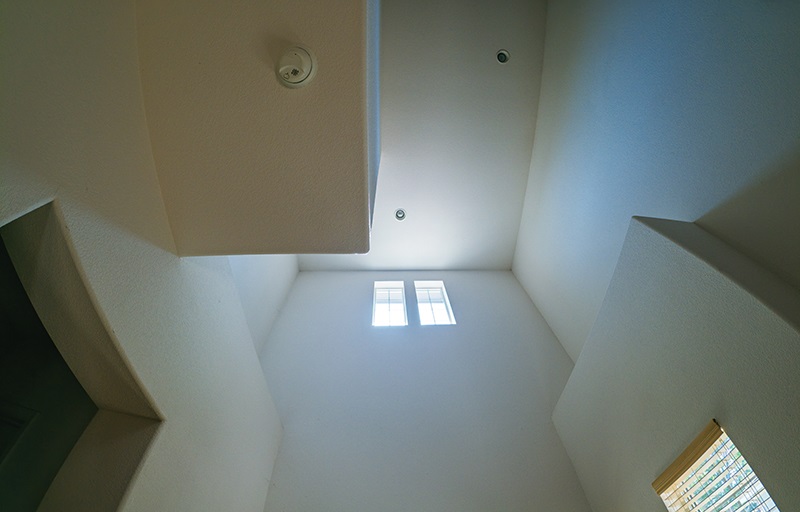
High-ceilinged spaces, such as warehouses, atriums, manufacturing plants and exhibition halls, are among the most challenging environments for reliable spot-type smoke detection. While high ceilings offer architectural and operational advantages, they also introduce complex fire-detection dynamics that standard system designs may not adequately address.
Why it’s complicated
1. Increased detection time: The higher the ceiling, the longer it takes for smoke to reach ceiling-mounted smoke detectors. In fast-growing fires, every second counts, and even a short delay can significantly increase the risk to life and property. Air movement from HVAC systems, open doors or industrial processes can further disperse smoke, slowing the buildup of smoke concentration near ceiling-mounted smoke detectors.
2. Smoke stratification: In tall spaces, rising smoke can cool as it moves upward. When this happens, it may stop rising before reaching ceiling-mounted detectors, a phenomenon called stratification. Instead of accumulating at the ceiling, smoke forms a horizontal layer at a lower level. Traditional spot-type smoke detectors mounted on the ceiling may never activate in time, delaying response during the early stages of a fire.
3. Environmental factors: High-ceilinged environments often present additional challenges:
- Dust and airborne particles
- Temperature fluctuations
- High air velocity from ventilation systems
- Obstructions such as racking or structural beams
These conditions can cause nuisance alarms, contamination or reduced detector sensitivity over time.
4. Maintenance and accessibility: Ceiling heights of 10, 15 or even 30 feet pose practical challenges for inspection, testing and maintenance. Specialized equipment (lifts or scaffolding) increases costs and causes operational disruption. Design decisions must consider performance and long-term serviceability.
Addressing these challenges requires a strategic approach and, often, a combination of technologies.
Beam smoke detectors
Beam smoke detectors transmit an infrared beam across large open areas. They are ideal for warehouses and atriums where spot-type detectors may be impractical. They offer advantages over spot-type detectors, including wide coverage, fewer required devices and an effectiveness in large, open areas.
Aspirating smoke detection (ASD)
ASD systems continuously draw air samples through a network of pipes to a highly sensitive detection unit. Their advantages include very early warning detection, flexible pipe placement across multiple levels and easier maintenance at accessible heights.
This approach is particularly effective in environments where early intervention is critical. In very tall spaces, installing detection at multiple heights helps mitigate stratification risks. Midlevel detection ensures that smoke layers are detected even if they do not reach the ceiling. Because the sampling pipes can be run along walls, ceilings and intermediate structural levels, ASD systems avoid the risk of smoke stratification. Their early warning makes them well suited to high-value or critical infrastructure spaces. This approach is also useful in rack storage environments.
Video fire detection (VFD)
VFD, explicitly recognized in NFPA 72, the National Fire Alarm and Signaling Code, uses optical cameras and A.I.-based algorithms to “see” smoke or flames in the visual field. This system is ideal for large atriums or spaces where installing or maintaining physical detectors is impossible, providing instant visual verification of a fire hazard.
Because simple prescriptive rules—such as the standard 30-foot spacing for typical rooms—do not apply to complex, tall environments, NFPA 72 recommends an engineering review for ceilings above 30–40 feet. Be sure to check NFPA 72, Section 17.7.4.1.1 and its annex for more information.
Without the right technology and system design, smoke detection may be delayed when it matters most. By understanding airflow dynamics, environmental challenges and appropriate detection technologies, fire safety professionals can deliver systems that respond quickly, reliably and effectively. You must be confident in your design’s ability to detect smoke adequately during the building’s normal operations.
stock.adobe.com/Cam
About The Author

MOORE, PE, is a licensed professional fire protection engineer, and located in Jamestown, R.I. He is the editor of five editions of the National Fire Alarm Code Handbook. He authored, “Designing Mass Notification Systems – A Pathway to Effective Communications.” He is a principal member of the NFPA 72 Correlating Committee and former chair, now principal member, of the Emergency Communications System Technical Committee. He can be reached at [email protected].