I often receive questions regarding what would be the appropriate detector for a particular application. Deciding on the detector first is a little bit like putting the cart before the horse. To answer this question, you first need to start with the detector’s purpose—is it a life safety or property protection application?
Let’s talk early warning
For example, when talking about life safety, we almost always want the earliest possible warning to occupants so they have enough time to exit to safety. This typically means using some form of smoke detection.
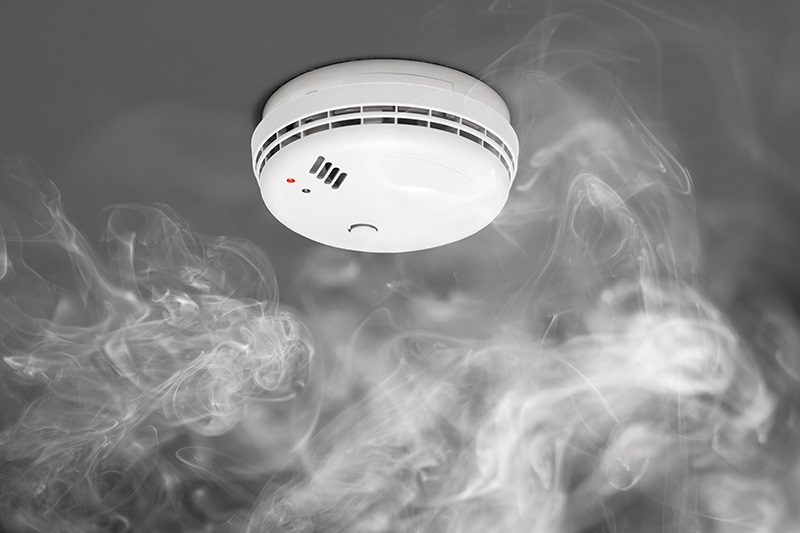
Let’s assume we will use spot-type smoke detection. Most designers do not understand how a fire develops and what outside forces affect smoke as it rises. In the basic sense of detection, smoke must get to the detector in sufficient quantity to ensure detection.
Therein lies what confounds most designers and contractors: how does smoke rise from a fire? The heat of the fire brings the smoke to the detector. What outside forces affect that process?
If the airflow from the HVAC system is blowing at the detector, it will dilute the smoke concentration. If the heat at the ceiling is greater than the fire’s heat, there will be a delay in the smoke breaking through the heat barrier until the fire gets hotter (i.e., larger). If the ceiling height is more than the typical 10–12 feet, it will take a larger fire and longer time for the smoke to get to the ceiling.
Do not use spot-type smoke detectors on ceilings higher than 15 feet. You will need to evaluate the space to determine what type of smoke detector will work.
If the goal is early warning, we need to determine how much time it will take for occupant evacuation and balance that information against the expected detection time. Knowing this might help in making the right choice for the smoke detection process.
Next, we could discuss spacing. The National Fire Alarm and Signaling Code, NFPA 72, requires several factors to be considered when installing smoke detectors. First, the smoke detection design documentation must state the system’s required performance objective. Second, there must be an evaluation of potential ambient sources of smoke, moisture, dust or fumes and electrical or mechanical influences, and “the performance characteristics of the detector and the areas into which the detectors are to be installed to prevent nuisance and unintentional alarms or improper operation after installation.”
Where a prescriptive design is provided, this requirement is fulfilled by stating in the documentation that the design conforms to the prescriptive provisions of NFPA 72. Section 17.7.4.1.2 states that, “The design shall account for the contribution of the following factors in predicting detector response to the anticipated fires to which the system is intended to respond:
“(1) Ceiling shape and surface
“(2) Ceiling height
“(3) Configuration of contents in the protected area
“(4) Combustion characteristics and probable equivalence ratio of the anticipated fires involving the fuel loads within the protected area
“(5) Compartment ventilation
“(6) Ambient temperature, pressure, altitude, humidity, and atmosphere.”
All spot-type smoke detectors must be located on the ceiling or on a sidewall between the ceiling and 12 inches down from the ceiling to the top of the detector. Figure A.17.6.3.1.3.1 provides an illustration of acceptable spacing.
(For you old-timers, research has proven there is no dead air space as was thought. That still applies to heat detectors.)
New requirements for spacing of spot-type smoke detectors can be found in Section 17.7.4.2, which states, “In the absence of specific performance-based design criteria, detectors on ceilings up to 40 feet in height shall be spaced in accordance with either of the following:
“(1) The detectors shall comply with the following:
- “(a) The distance between detectors shall not exceed a nominal spacing of 30 ft (9.1 m).
- “(b) There shall be detectors within a distance of one-half the nominal spacing, measured at right angles from all walls or partitions extending upward to within the top 15 percent of the ceiling height.
“(2) All points on the ceiling shall have a detector within a distance equal to or less than 0.7 times the nominal 30 ft (9.1 m) spacing (0.7S).”
Aerosol and particulate matter influences should be minimized on detector locations. Similarly, the influences of electrical and mechanical factors should be minimized. NFPA 72 Table A, 17.7.1.10(a) and (b) provide further clarification.
While it might not be possible to isolate environmental factors totally, an awareness of these factors during system layout and design favorably affects detector performance.
Hopefully, you see why more smoke detectors must be closer to the potential fire for early warning. Installing one smoke detector will not meet a life safety design goal. Read NFPA 72, Chapter 17 section and annex material on smoke detection placement and then move forward with your design.
stock.adobe.com/nikkytok
About The Author

MOORE, PE, is a licensed professional fire protection engineer, and located in Jamestown, R.I. He is the editor of five editions of the National Fire Alarm Code Handbook. He authored, “Designing Mass Notification Systems – A Pathway to Effective Communications.” He is a principal member of the NFPA 72 Correlating Committee and former chair, now principal member, of the Emergency Communications System Technical Committee. He can be reached at [email protected].