As NECA CEO David Long said in his letter in the March 2026 issue of Electrical Contractor magazine, “The electrical construction industry is entering one of the most opportunity-rich periods in its history … Technology, infrastructure investment and private capital are converging in ways that are driving unprecedented demand for electrical expertise.”
A Tsunami of Steady Work
It’s no exaggeration to say that a tsunami of work awaits line and specialty contractors equipped to serve the utility industry and growing numbers of commercial customers opting to construct their own power generation facilities.
Last year, net generation of U.S. electricity—4.43 thousand Terawatt-hours—surpassed 2024’s all-time record-breaking figure by 2.8%, according to the U.S. Energy Information Agency (EIA). This growth trend is expected to continue through 2027 and is spurred by the commercial sector and data centers.
For this year alone, EIA predicts power plant developers and operators will add 86 gigawatts of new utility-scale generating capacity to the U.S. power grid, half of which will be solar.
And although data centers are raising concerns about quality of life and electricity costs, their arrival is likely to remain undaunted—even as states begin to require data center developers and owners to shoulder construction costs for building power generation facilities.
Along those lines, to help curb rising energy rates for consumers and build out infrastructure, the U.S. Department of Energy (DOE) offered a $26.5 billion low-interest loan last February to subsidiaries of Southern Co., a holding company for utilities in the South.
And looking to spur new sources of non-carbon-emitting power generation, the DOE is supporting research and development of small modular reactors from 50–300 megawatts. These are said by some to be operationally safer than nuclear plants of the past. Their expected arrival promises more power generation, transmission and substation work.
“I can say we expect nuclear power is coming and will create more work for our contractors,” said Kevin Moran, executive director of the American Line Builders chapter of NECA.
Earlier this year, Illinois lifted a long-standing moratorium on the construction of nuclear plants. This may seem surprising, given that Illinois, along with Maryland, New Jersey, New York and Pennsylvania, were identified by EIA as states where energy demand declined in the commercial sector from 2019 to 2023. But there’s also the push to retire coal-fired power generation.
States EIA identified with the highest growth in demand were Arizona, Florida, Nevada, North Dakota, Oklahoma, Oregon, South Carolina, Texas and Virginia.
Demand for Uninterrupted Power
Whether energy demands are increasing or declining in certain states, utilities and commercial customers across the nation seem to be investing in grid infrastructure and for good reason.
ComEd, based in Illinois, partnered with Lawrence Berkeley National Laboratory to create the lab’s Interruption Cost Estimate calculator and Power Outage Economics Tool to help local stakeholders estimate the costs of widespread power interruptions in both the short and long term, according to a June 16, 2025, Berkeley Lab press release.
The calculator is based on surveys of impacts to homes and businesses in Illinois and Indiana, applying subsequent modeling.
The project found that widespread extended power outages take a heavy toll on gross domestic product (GDP) within utility service areas. Power interruptions of one day reduced GDP by $1.8 billion. An outage lasting 14 days, according to modeling, could reduce GDP by $15.2 billion.
The utility-national lab collaboration is just one study substantiating the broad need for grid infrastructure expansion and improvement. Taking on opportunities related to that need are ArchKey Solutions, Fenton, Mo., and New River Electrical Corp., Cloverdale, Va.
ArchKey Solutions
With $2.5 billion in revenue and approximately 5,000 employees, ArchKey Solutions is one of the largest privately held specialty trade installation and integrated facilities services companies in the United States. In addition to designing, building and maintaining electrical and specialty systems nationwide, ArchKey specializes in power generation, transmission, substation and mission critical infrastructure.
“We continue to support core markets like healthcare and industrial facilities, but the expansion of data centers is accelerating a renewed emphasis on power generation,” said Chuck Chambers, vice president of preconstruction for ArchKey Solutions’ Power & Industrial Group. “The real challenge is scaling the right resources, from engineering and custom solutions to skilled craft labor and program management, to deliver at the pace the market now requires.”
Beyond retrofitting retired coal plants with natural gas, ArchKey Solutions delivers power generation solutions for data centers—from diesel turbines and jet engine technology to fully integrated controls and automation systems. The idea is to support smarter, more resilient energy infrastructure.
The company has also designed and installed utility scale solar farms in California and rooftop solar systems for commercial facilities along the East Coast.
“There’s unprecedented demand for power right now— driven by the push to retire coal plants and the rapid growth of A.I. and data centers, which require enormous amounts of energy,” Chambers said.
ArchKey Solutions works with partners across the U.S., including in California, Indiana, Missouri, Ohio, Pennsylvania and Texas, and along the East Coast.
Ed Green, project director for ArchKey Solutions’ Power & Industrial Group, works closely with Chambers and oversees projects involving gas turbines and battery energy storage systems (BESS).
“These projects typically include underground duct banks and cabling, rigging, setting and terminations, along with substation construction, switchgear installation and connections into switchyards,” Green said.
Within ArchKey Solutions is ArchKey Sachs’ Line Construction Division, based in Fenton, Mo., which specializes in substation work for utilities, commercial enterprises and data center projects.
“As a part of ArchKey’s nationwide network of regional teams supporting power generation, transmission and substations, we’re seeing steady growth,” said Jimmy Cowart, operations manager for ArchKey Sachs. “Substation projects tied to solar, in particular, have become an important new avenue for us.”
To further expand its substation capabilities, ArchKey Solutions acquired New Castle, Pa.-based contractor Bruce & Merrilees in 2025, now operating as ArchKey Bruce & Merrilees. It also specializes in substations and power generation.
“Our goal is to grow together,” Cowart said. “We have ambitious plans and a lot of optimism about where this business can go between now and 2030.”
New River Electrical Corp.
Also operating with optimism and ambitious goals in the current business climate is New River Electrical, a $1 billion-a-year-grossing line contractor with 2,300 employees.
New River is expanding its reach beyond the mid-Atlantic states and East Coast to Arizona, California, Texas and the Pacific Northwest.
The company got its start more than 70 years ago doing substation work. Its substation group remains its largest service offering while supporting large-scale transmission, distribution, telecommunications and industrial projects.
New River serves investor-owned utilities, electrical cooperatives, municipalities and a growing contingent of renewable developers and data center hyperscalers.
“Across the country, we’ve seen significant demand for our substation services,” said Jake Grice, executive vice president of operations for New River’s Granville, Ohio, campus and former vice president of the company’s Overhead Line Division. “In Texas, we’re also seeing significant transmission line opportunities ranging from small station cut-ins to large-scale, multiyear projects.”
Overhead transmission and distribution make up New River’s second-largest service offering. Additional capabilities include underground transmission, underground distribution, industrial and telecommunications.
“All of these areas are growing rapidly because a lot of customers want full-service contractors and turnkey projects,” said Gregory Gibbs, executive vice president of operations for New River’s Cloverdale, Va., campus.
Much like other line contractors, New River is seeing exponentially larger projects and compressed timelines. A substation project for an investor-owned utility interconnection that would have taken 18–24 months is now happening in 9–12 months.
“You will definitely see compressed project schedules,” Grice said. “Historically, there has been greater focus on controlling costs. Today, schedule is the primary project driver. Owners and developers are spending more to complete projects quickly.”
“State-level public utility boards are trying to protect customers from paying high energy bills by pushing data center developers to pay for or share in the cost of new power generation and grid infrastructure,” Gibbs said. “And with data center ‘speed to power’ as the top priority, they seem to be happy to do that.”
Regardless of the willingness of customers to pay more to make projects progress more quickly, being expected to accomplish more in a shorter amount of time and with limited staffing poses challenges for contractors. But New River has developed coping strategies.
“One key to our success has been the integration and overlap of the engineering, procurement and construction phases of the project,” Gibbs said. “We’re saving time by running the engineering, procurement and constructability planning in parallel.”
“Running these services in tandem gives time back to our construction team and ensures we safely execute our work,” Grice added.
Other growing segments of regular work for New River include EHV infrastructure projects, transmission infrastructure upgrades and distribution programs aimed at improving system performance.
Adding weight to the growing workload, storm response can affect the progress of regular work. Though New River considers storm restoration an important service and has a history of sending crews to affected areas, they also seem to appreciate that utilities can be cooperative and flexible.
“Utilities and contractors are very focused on the manpower needed to support our booming industry,” Grice said. “Extended schedules and partnership contracts are among the solutions being deployed.”
Utilities are also more forthcoming about work plans than in the past, Grice said, adding that they are assigning work months or years in advance to promote consistent staffing, greater efficiencies, reduced costs and increased safety.
This is good, because the overarching challenge remains.
“There’s more work than labor to get it done,” Grice said.
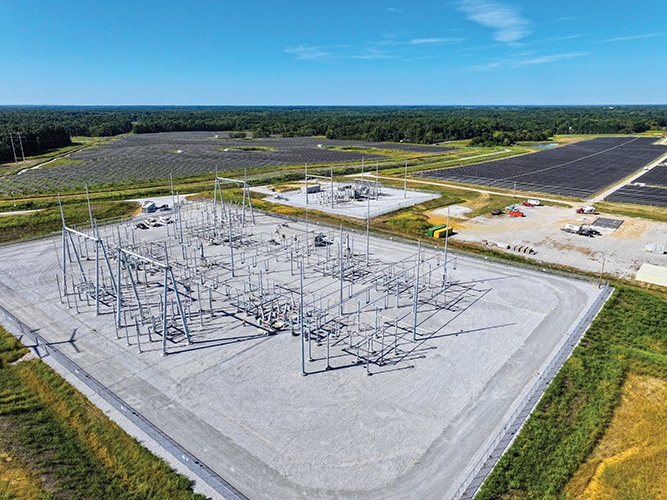
Header image: Serving the utility industry and commercial customers, ArchKey Sachs builds high-voltage interconnect switchyards and collector substations for solar PV generation facilities like this one in Illinois. ArchKey Technologies performs related fiber splicing and tests. Both operations are affiliated with ArchKey Solutions.
ArchKey Sachs
About The Author
.jpg?sfvrsn=a64b988b_1)
DeGrane is a Chicago-based freelance writer. She has covered electrical contracting, renewable energy, senior living and other industries with articles published in the Chicago Tribune, New York Times and trade publications. Reach her at [email protected].