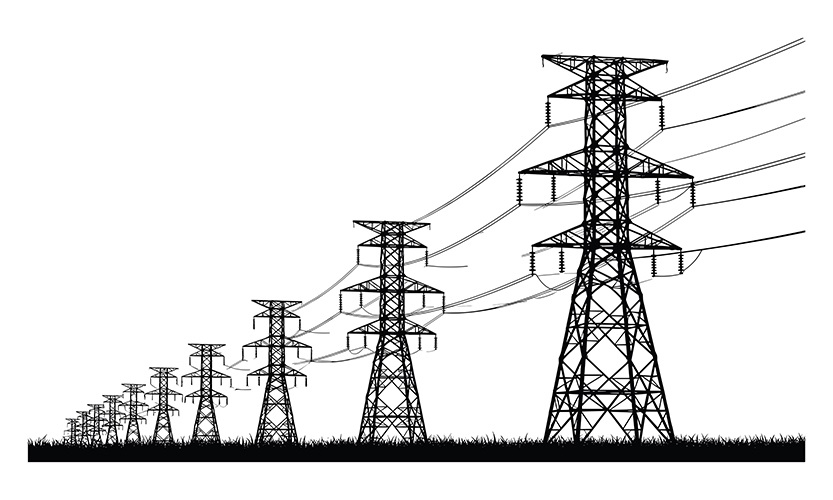
The U.S. transmission system is designed with the worst case in mind. The operator’s goal is to ensure power systems have adequate supplies and capacity to serve all customers, no matter the weather. In other words, equipment is sized to support power needs for the hottest (or, sometimes, coldest) 60 minutes of the year, even if that means wires are otherwise underused. Recently, federal regulators have begun pushing operators to take real-time weather conditions into account when determining just how much power their systems can safely accommodate.
In March, the nation’s largest grid operator began adjusting its carrying-capacity limits based on hourly updated ambient temperature readings and 10-day-ahead forecasts, potentially allowing 15%–40% more kilowatts on its lines. The move is a first step to true real-time flexibility and could aid utilities’ efforts to support rapidly increasing demand from data center deployment.
Taking the temperature
Today, for most system operators, transmission line ratings change, at most, twice a year, reflecting summer and winter weather. This means that independent system operators, regional transmission operators and the utilities that manage their own networks establish maximum line capacities based on assumed temperatures, along with wind speeds and humidities, during those six-month periods. These static line ratings reflect the highest temperature and lowest wind conditions equipment might face during the seasonal period, based on historical averages.
While this approach helps ensure lines won’t be overstressed, it also leaves a lot of potential carrying capacity through the rest of the year when those worst-case conditions aren’t in effect.
Take North America’s western regional grid, the Western Electric Coordinating Council, for example. This system stretches from New Mexico up to Alberta, Canada, and west to the Pacific Ocean. Stanford University researchers found that, even during the 90 hours a year when electricity demand is highest, regional utilities used only 18%–52% of their transmission line capacity, with most clustered around 30%. The team also looked at transformer use, because this equipment can face greater stress during peak demand and in normal operation. They found that most utilities clustered around 45% of capacity during peak conditions.
In 2021, recognizing the opportunity for boosting power transmission without adding new wires, the Federal Energy Regulatory Commission (FERC) passed its Order 881, directing transmission owners to use something closer to real-time data to establish capacity limits. This directive takes the first step in requiring networks to base line capacity on real-time conditions, instead of static limits that only change twice a year.
Ambient-adjusted ratings (AARs) are the new standard. This approach uses current air temperatures and 10-day forecasts to calculate hourly capacity limits. These ratings factor into the day-ahead and real-time energy and ancillary service markets, potentially lowering energy costs.
By enabling lines to carry more electricity, utilities could have more opportunity to call on less expensive, but remote, renewable generation during high-demand periods, instead of more expensive, locally based natural gas, coal and oil peaker units. Ampacimon, a grid technology company in Cumming, Ga., providing AAR-related services, estimates the approach could increase line capacity by 15%–40% compared to traditional SLR methods.
There is a caveat to consider: AARs can decrease line capacity when temperatures are very hot, but this is good. Static ratings can understate risks during these times, leaving equipment at risk of overheating.
Looking forward
FERC initially required AAR adoption by July 2025, but transmission operators are only now incorporating the new standard. They’ve argued the extra time was needed to adapt their power auctions to this new, more complicated market.
In March, PJM, the nation’s largest system manager, became the first to fully incorporate new hourly adjusted ratings, anticipating a 15%–40% increase in carrying capacity. The Southwest Power Pool, New England Independent System Operator and California Independent System Operator have announced plans to make the move by the end of 2026.
However, the Midcontinent Independent System Operator and New York Independent System Operator say it will be the end of 2028 before their transitions will be complete.
FERC is already looking forward to a less-static future. In June 2024, it issued an advance notice of proposed rulemaking focused on dynamic line ratings (DLRs). DLRs move a step beyond AARs by incorporating data on wind speed and direction in calculating a line’s carrying capacity, and the data is updated every 10–15 minutes, instead of hourly. Wind can help cool lines, and more frequent measurements can help operators understand real-time conditions.
A pilot DLR effort by Pennsylvania Power & Light cut congestion costs by $64 million on just one line. Over the three lines included in the project, the utility saw an increase of normal line ratings of 17% versus an equivalent AAR installation, according to Idaho National Laboratory figures.
stock.adobe.com / ziarul
About The Author

ROSS has covered building and energy technologies and electric-utility business issues for more than 25 years. Contact him at [email protected].