This is the final article in the series where I answer some of the frequently asked questions I receive from emails and various IEEE 1584 and NFPA 70E classes.
Read part 1 and part 2 of the series now.
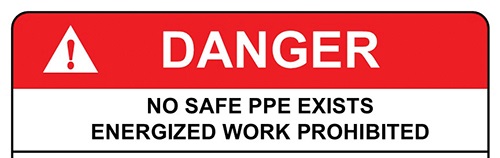
‘DANGER: NO SAFE PPE EXISTS’
Why do some arc flash labels state “DANGER—NO SAFE PPE EXISTS”? This often appears when the calculated incident energy exceeds 40 calories/centimeter² (cal/cm²).
This wording stems from two historical factors. When NFPA 70E first introduced hazard/risk category tables (now known as PPE categories) in the 2000 edition, the maximum rating of commercially available arc-rated PPE was 40 cal/cm². An informational note was also added advising that equipment should be de-energized if the calculated incident energy exceeded 40 cal/cm².
This note fueled an urban legend suggesting that incident energy above 40 cal/cm² would create blast pressures capable of causing fatal injuries, regardless of the PPE worn. This is incorrect.
Arc blast pressure is primarily influenced by short-circuit current and the rate of energy delivery—not the total incident energy value. This note was ultimately removed in the 2018 edition. Regardless of the calculated incident energy, the first priority of electrical safety should be to eliminate the hazard by establishing an electrically safe work condition.
2-second arc duration?
I have heard that an arc flash cannot last longer than 2 seconds. Is this correct?
No. The statement comes from IEEE 1584-2018: “2 s usually is a reasonable assumption for the arc duration.” This language applies when a protective device would take longer than 2 seconds to clear the arc flash. If it is reasonable for a worker to jump out of the way, the arc duration may be capped at 2 seconds for calculation purposes. It does not mean an arc will be limited to 2 seconds; it means the person will not be there after 2 seconds. Engineering judgment is essential when using 2 seconds.
Units on labels
Some labels list the arc flash boundary in inches, others in millimeters, meters or feet, with decimals such as 3.4 feet. The IEEE 1584 equations also use joules/centimeter² (J/cm²) for incident energy while PPE is rated in cal/cm². Why is there inconsistency?
IEEE 1584 calculations use millimeters for the arc flash boundary because the standard requires the metric system. Arc-flash software then converts this distance into inches, feet or meters depending on the user’s preference.
A similar issue occurs with incident energy. To meet metric requirements, IEEE 1584 equations for incident energy are in J/cm², where a joule equals one watt-second. However, PPE is rated in cal/cm², so the software converts incident energy to cal/cm².
Global hazards
Is the arc flash hazard a global issue?
Yes. Although some view IEEE 1584 and NFPA 70E as “American standards,” electrical hazards do not respect geographic borders or locations. Arc flash risks exist everywhere electrical systems operate. These standards are recognized internationally as best practice guidance, which is why I regularly travel worldwide teaching IEEE 1584 and NFPA 70E.
Arc flash calculations above 15 kV
We have a 34.5-kilovolt (kV) electrical distribution system. Can we use IEEE 1584?
No. The range of validity of the IEEE 1584 equations is 208V through 15 kV, so the standard does not address voltages above this limit. The 2002 edition noted that theoretical methods could be applied, which implied the use of alternative models such as the very conservative Lee method. The 2018 edition does not reference these alternatives. However, there are several commercial programs for higher voltages.
Label colors
Most arc flash labels appear with the word “warning” on an orange background. However, I occasionally see red and even green labels. What color is correct?
It depends. The ANSI Z535 series for safety signs and tags defines three colors and signal words used to alert people to personal injury hazards if the hazard is not avoided. Yellow/Caution indicates a potential for minor or moderate injury. Orange/Warning indicates a hazard that could result in serious injury or death. Red/Danger indicates a hazard that will result in serious injury or death. Although arc flash hazards can be fatal, industry practice has informally standardized on Orange/Warning for most arc flash labels, reserving Red/Danger for extreme conditions.
Green is not a standard ANSI Z535 color. Some software allows custom color schemes, so green may appear when incident energy is below 1.2 cal/cm². Using the incorrect color green can imply the condition is “safe,” but it should not be interpreted as hazard-free due to the presence of shock hazards and some degree of incident energy. ANSI Z535 colors and words should be used.
Note: This is the opinion of the author and not an official position of any standards organization.
Brainfiller Inc.
About The Author

PHILLIPS, P.E., is founder of brainfiller.com and provides training globally. He is Vice-Chair of IEEE 1584 Arc Flash Working Group, International Chair of IEC TC78 Live Working Standards and Technical Committee Member of NFPA 70E. He can be reached at [email protected].