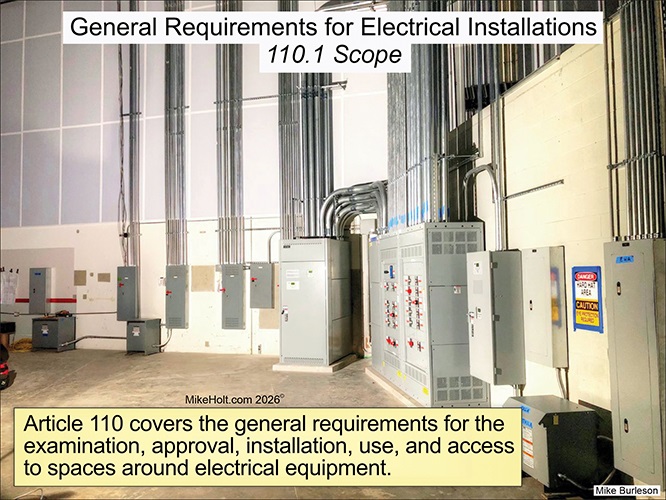
Article 110 of the National Electrical Code covers the general requirements for the examination, approval, installation and use of electrical equipment, plus the spaces around it. These requirements apply to all installations, except as amended elsewhere in the code.
Instructions
You must install equipment per manufacturer’s instructions [see Section 110.3(B)]. But what if the manufacturer’s instructions conflict with the NEC? A manufacturer’s installation instructions cannot conflict with the NEC requirements. The instructions can exceed the NEC (where specified by the manufacturer), but you can never reduce the code requirements.
Ratings
Circuit breakers and fuses must have an interrupting rating at least as great as the available fault current at the line terminals of the equipment (110.9). Equipment must have a short-circuit current rating of at least that of the available fault current (110.10).
Physical protection
Equipment must not be subjected to corrosive gases, fumes, vapors, liquids or other substances that can have a deteriorating effect on conductors and equipment.
Equipment that is not identified for outdoor use or is identified for indoor use or installation in NEMA enclosure types 1, 2, 5, 12, 12K or 13 must be protected against the weather during construction.
In locations where electrical equipment is likely to be exposed to physical damage, enclosures or guards must be arranged and strong enough to prevent damage [110.27(B)].
Mechanical execution
The NEC requires you to install electrical equipment in a professional and skillful manner (110.12). This is vague as stated, and aside from providing a few minor specifics (e.g., don’t leave unused openings, avoid internal contamination by foreign material, firmly secure to the surface), the NEC doesn’t go into further detail.
The basic idea of good workmanship is that finished work should look like someone did the job with pride and a sense of professionalism. Neatness, precision and attention to detail are some of the key characteristics.
Traditionally, a journeyman passes this knowledge on to an apprentice—thus the phrase “a journeyman’s job” to describe good workmanship. However, since that knowledge can be incomplete, the NECA 1 Standard (also known as NEIS-1, Standard for Good Workmanship) is a must-have for meeting the good workmanship requirement.
Electrical connections
Conductor terminals and splicing connectors must be identified, installed and used for the conductor material (copper, aluminum or copper-clad aluminum) per the manufacturer’s instructions [110.3(B)].
- Conductor connections to terminals must be mechanically secure using pressure connectors [110.14(A)].
- A terminal is suitable for only one conductor, unless the terminal is identified for more than one conductor.
- Any device used to splice conductors must be identified for the purpose [110.14(B)].
- All splices, joints and free ends of conductors must be covered with an insulation equivalent to that of the conductors or an identified insulating device. The free ends of conductors must be insulated to prevent any exposed end from touching energized parts.
When terminating conductors, tighten per the torque values indicated on the equipment or in the instructions. Tightening beyond the indicated value will create a weaker connection and may cause excessive heating of connectors or equipment terminals.
In the absence of manufacturers’ torque requirements for torque values, see Annex I or UL Standard 486A-486B, Standard for Safety—Wire Connectors.
Markings
Field markings cannot be handwritten. They must be permanently affixed to the equipment and durable enough to withstand the environment (110.21).
In other than dwelling units:
- A permanent arc-flash marking must be applied to service and feeder equipment such as switchboards, enclosed panelboards and meter socket enclosures (110.16).
- Each disconnect must be marked to indicate its purpose unless located and arranged so the purpose is evident [110.22(A)].
- The disconnect marking must include the identification and location of the circuit source unless the identification and location of the circuit source are evident. (This also applies to dwellings with more than two units.)
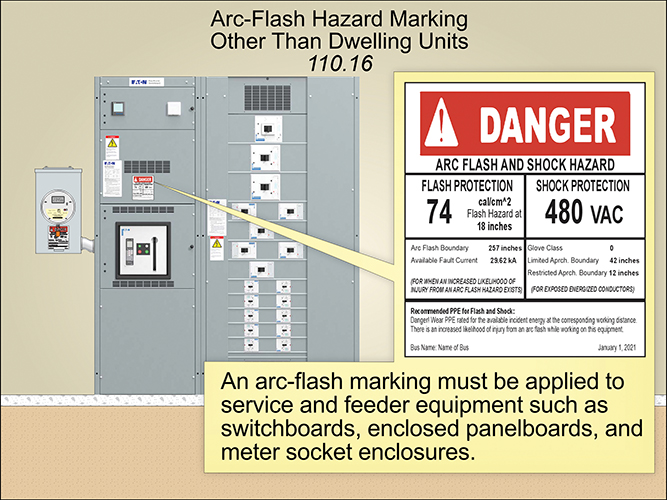
Service disconnects must be field-marked per NEC 110.21(B) with the available fault current on the line side of the service disconnect and with the date the fault current calculation was performed [110.24(A)]. The available fault current calculation must be documented and available to those who are authorized to design, install, inspect, maintain or operate the system.
When modifications to the electrical system affect the available fault current at the service, the available fault current must be recalculated to ensure the service equipment ratings are sufficient. The required field markings in 110.24(A) must be adjusted to reflect the new level of available fault current [110.24(B)].
Working space
Access to and egress from working space must permit the safe operation and maintenance of equipment (110.26).
Open equipment doors cannot impede access to, or egress from, the working space. Access or egress to working space is considered impeded if one or more simultaneously opened equipment doors restrict working space access to less than 24 inches wide and 6½ feet high when such doors are opened 90 degrees.
Equipment likely to be examined or worked on while energized must have working space provided per 110.26(A)(1), (2), (3) and (4). For example, the depth of working space cannot be less than the distances in Table 110.26(A)(1). The depth of the working space must be measured from the enclosure front cover.
Where equipment is likely to be examined or worked on while energized and is above a suspended ceiling or crawl space, all the conditions of 110.26(A)(4) apply. For example, the working space must permit equipment doors to open 90 degrees. At least one entrance is required to give access to and egress from the working space [110.24(C)(1)]. For equipment containing overcurrent protection devices, switching devices or control devices, an entrance to and egress from the required working space must be at least 24 inches wide and 6½ feet high at each end of the working space [110.24(C)(1)]. This requirement applies to either of the following:
- Where feeder equipment is rated 1,200A or more and is more than 6 feet wide
- Where the building disconnect [225.33(A)] or the service disconnect [230.71(B)] has a combined ampere rating of 1,200A or more, and the combined width is over 6 feet
A single entrance for access to and egress from the required working space is permitted if either:
- The location permits continuous and unobstructed egress, or
- The required working space depth is doubled, and the equipment is no closer than the minimum distance required by Section 110.26(A)(1).
Where equipment rated 800A or more contains overcurrent protection devices, switching devices or control devices, and there are personnel doors intended for entrance to and egress from the working space less than 25 feet from the nearest edge of the working space, the doors must open at least 90 degrees in the direction of egress. They also must be equipped with listed panic or fire exit hardware [110.26(C)(3)].
Illumination
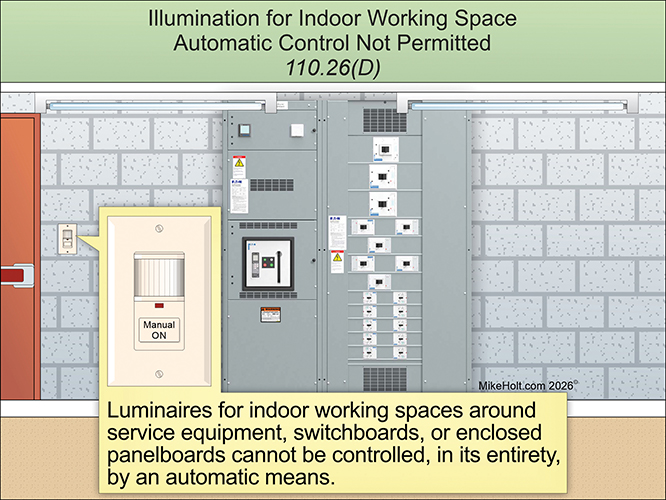
Illumination is required for indoor working spaces about service equipment, switchboards or enclosed panelboards [110.24(D)]. This illumination cannot be totally controlled by automatic means.
Dedicated space
Service equipment, switchboards and enclosed panelboards must have dedicated electrical equipment space and be protected from damage [110.26(E)].
For indoor equipment, this space must comply with 110.26(E)(1)(1)(a) through (d). For example, sprinkler piping is not permitted within the dedicated space.
For outdoor equipment, this space must comply with 110.24(E)(2)(1)(a) through (c). For example, it must be protected from accidental contact by unauthorized personnel and vehicular traffic.
Avoiding general mistakes
We have covered most, but not all, of the general requirements. While Article 110 can seem like it presents an overwhelming amount of detail, the requirements boil down to using the right equipment, installing it with good workmanship, allowing sufficient working space and applying some common sense.
Over time, the gist of the general requirements becomes second nature. The upside of this is that you can almost autopilot the general requirements. The downside is that, eventually, running on autopilot may leave a trail of code violations behind you.
To get the details consistently right, it is important to periodically review the NEC’s general requirements rather than relying on memory.
Mike Holt Enterprises
About The Author

HOLT is a National Electrical Code expert, author and educator with more than 50 years of experience in the electrical industry. He started his career as an apprentice and became a master electrician, electrical inspector, contractor, instructor and publisher. He has written hundreds of electrical training books used nationwide through MikeHolt.com. He can be reached at [email protected].