Continuing on from last time, let’s go over a few more answers to some frequently asked questions I’ve received in emails and my various IEEE 1584 and NFPA 70E classes.
Arc flash boundary = safe?
Since arc flash PPE is not required outside the arc flash boundary, does that mean this is a safe place to stand?
I wouldn’t! Nowhere in NFPA 70E or IEEE 1584 does it state the arc flash boundary defines a safe area. IEEE 1584 defines the arc flash boundary as a “distance from a prospective arc source at which the incident energy is calculated to be 1.2 calories/centimeter2.” NFPA 70E has a similar definition.
The 1.2 cal/cm2 threshold is the generally accepted value of incident energy where the onset of a second-degree burn may occur. But burn injury isn’t the only hazard. An arc flash can also produce flying projectiles and debris, blinding ultraviolet light, sound pressure and other secondary hazards.
My view is that if someone is not wearing properly rated PPE, they have no business in the area. Don’t split hairs over an exact calculated distance (e.g., 4.3 feet versus 4.8 feet). The safest approach is simple: stay out of the area unless properly protected!
50-Hz systems
Is IEEE 1584 valid for 50-Hertz (Hz) systems?
Yes. I am often asked this question while speaking at international events. Outside of North America and a handful of other locations, most of the world uses 50-Hz power. The IEEE 1584 equations can be used for 50- and 60-Hz systems, as they are based on time in milliseconds (ms) and are independent of frequency.
For perspective: One electrical cycle at 60 Hz is 1/60 second, which equals 0.0167 seconds or 16.7 ms. For a 50-Hz system, this would be 0.02 seconds or 20 ms.
400 Hz?
Can IEEE 1584 be used for 400-Hz systems such as aircraft and military equipment?
No. Systems operating at 400 Hz are typically used in those cases because it allows for significantly smaller, lighter and more powerful electrical components such as motors and transformers compared to 50- and 60-Hz systems. IEEE 1584 states the model is applicable for 50- and 60-Hz systems.
DC systems
Can IEEE 1584 be used for DC system arc flash calculations?
No. The IEEE 1584 model does not address DC systems. However, the 2018 IEEE 1584 Standard and the 2024 edition of NFPA 70E reference several technical papers addressing DC arc flash.
Incident energy and decimal places
I see many arc flash labels showing incident energy with two decimal places. How many should be used?
Mathematically, you can use as many as you like. But keep in mind, IEEE 1584 refers to “estimated” incident energy. An exact calculation is unrealistic due to factors that can affect the actual incident energy exposure. For a specific arc flash event, exactly where in the equipment did the arc flash occur? What was the electrode gap at the specific location and other system-specific factors? For practical purposes, one decimal place is common. More precision gives the illusion of more accuracy, but that may not reflect reality.
Large incident energy
Why is the calculated incident energy at the service entrance equipment so high?
The most common reason is typically a long arc duration. The longer the duration, the higher the incident energy.
Arc duration is normally defined by the time it takes an upstream overcurrent protective device to operate. If the main device inside the service equipment is not isolated in a separate location unaffected by the arc, the calculation would be based on the next device upstream—which is often the utility company’s protective device.
That protective device may be located on the primary side of the utility transformer, and they are not known for operating quickly. They’re intentionally selected or set with a significant time delay to accommodate the transformer magnetizing inrush current.
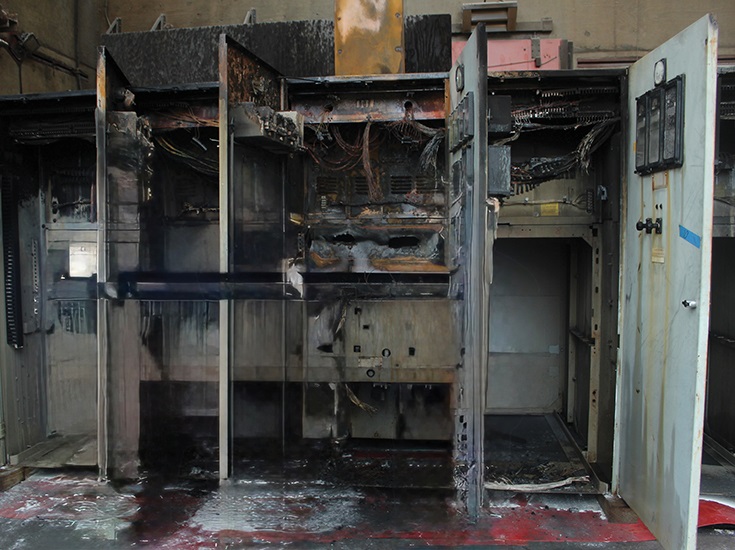
During one of my arc flash tests involving 15-kilovolt switchgear, the arc flash was initiated in the middle section. In the photo above, you can see the severe damage to the adjacent sections, demonstrating how an arc flash can propagate beyond the initial compartment.
The safest approach for this situation is to establish an electrically safe condition, as outlined in NFPA 70E 120.6, Process for Establishing and Verifying an Electrically Safe Work Condition. For testing the absence of voltage when the estimated incident energy exceeds the arc rating of commercially available arc-rated PPE, NFPA 70E provides a list of risk-reduction methods.
Note: This is the opinion of the author and does not represent an official position of any standards organization.
Header image: An arc flash can propagate beyond the initial location.
brainfiller inc.
About The Author

PHILLIPS, P.E., is founder of brainfiller.com and provides training globally. He is Vice-Chair of IEEE 1584 Arc Flash Working Group, International Chair of IEC TC78 Live Working Standards and Technical Committee Member of NFPA 70E. He can be reached at [email protected].