Located 52 miles northeast of Las Vegas in Moapa, Nev., and named after the former president of Southern Nevada Power (now known as Nevada Energy), the Reid Gardner Generating Station was constructed on 480 acres in the early 1960s and became operational in 1965. Decades later, after becoming known as America’s “dirtiest coal plant”—one that emitted an estimated 5 million tons of carbon pollution annually—the original 557-megawatt (MW) coal-fired electricity-producing facility was shut down in phases beginning in 2014 and then was demolished in 2019–2020.
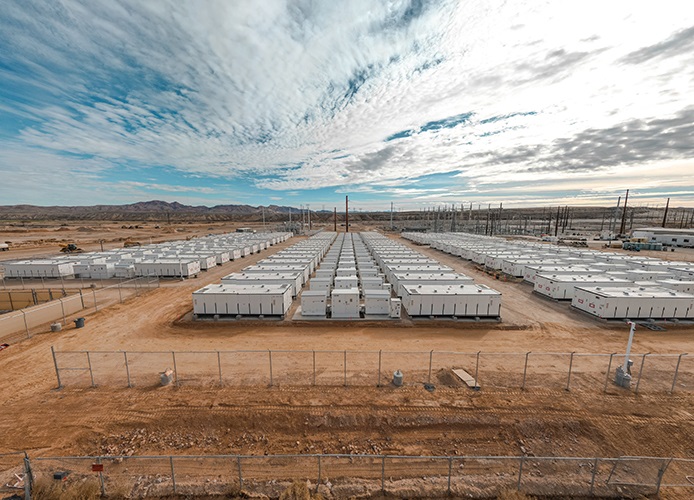
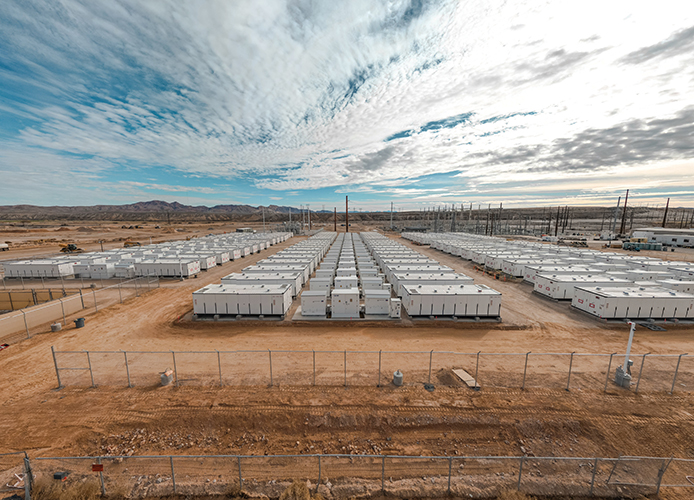
In 2023–2024, BEI Construction Inc., Alameda, Calif., helped redevelop 6 acres of the site to house a high-performing 220-MW/440-megawatt-hour (MWh) battery energy storage system (BESS) designed to efficiently store energy, dispatch power to the electric grid and enhance the grid’s resiliency. Since the new facility—known as the Reid Gardner Battery Energy Storage System—officially came online in spring 2024, Nevada Energy and its more than 1.5 million customers are poised to enjoy cleaner, more reliable and more cost-effective renewable power for generations.
Shining a light on energy storage
Founded in the 1980s, “BEI Construction started out as a traditional full-service electrical contracting firm, but as demand for distributed generation and renewable energy grew, we evolved to become a key player in renewable energy construction, with soup-to-nuts engineering procurement construction responsibility for our projects,” said Graeme Kling, director of operations for BEI Construction’s BESS division. “Depending on the number of projects in construction, we typically have anywhere from 200–300 employees across multiple divisions, from low-voltage (e.g., security, audiovisual, etc.) to high-voltage substation work and more, and we bring the totality of our expertise to all of our renewable energy projects.”
According to Kling, BEI was brought into the Reid Gardner project by Swiss-based project developer Energy Vault, a company that provides energy solutions designed to accelerate the transition to renewable energy. The Reid Gardner BESS was BEI’s second project with Energy Vault.
“Energy Vault was the company that provided project owner Nevada Energy with the lithium-ion batteries and power conditioning systems needed for the Reid Gardner Battery Energy Storage System,” Kling said. “We bid on this project in late 2022, were successfully awarded the job and began work in September 2023. It was an extremely challenging project for many reasons, but our partners knew that we were the professionals who would figure it out.”
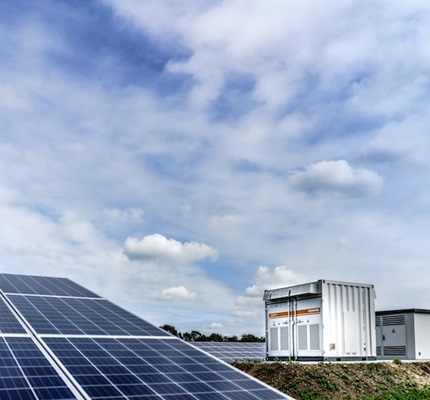
Kling noted that during the nearly one-hour drive between Las Vegas and Reid Gardner, motorists will pass hundreds of acres of photovoltaic panels harnessing the sun’s energy.
 | 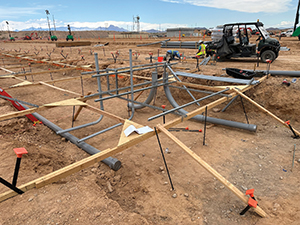 | |
Nevada Energy’s new Reid Gardner | Conduits await placement prior to pouring. |
“PV panels work when the sun is shining, but, if there’s no demand for that power, these systems are typically throttled down so that they don’t put too much power on the grid,” Kling said of the photovoltaic process. “Reid Gardner is indirectly connected to hundreds of megawatts of photovoltaics, but rather than curtail them, we can store the surplus energy in batteries and reinject that power into the grid when it makes sense, often at nighttime when the sun is down. Alternatively, if the grid is unable to meet energy demands even when photovoltaic panels are running on all pistons, a BESS can help add more power to the grid and avoid utilities from having to buy expensive energy from another power supplier.”
He confirmed that all of these capabilities will help Nevada Energy be more responsive and efficient and provide greater resiliency to customers.
A cadre of challenges
With the contract requiring BEI Construction to deliver the final project to the grid in December 2023, Kling confirmed that the accelerated schedule they were on was an epic challenge for their firm.
“To our knowledge, no other firm we knew of had built a 220-MW project in less than four months,” he said. “When we mobilized on-site on Sept. 8, 2023, the old coal plant was gone and our job started with a blank canvas that involved contractors clearing and grubbing the site to get it to rough grade so that we could begin trenching and excavating for concrete foundations. We were basically given a plot of bare land that needed to participate in the grid by Dec. 31, 2023, which required us to quickly develop relationships with local IBEWs to get workers.”
While Energy Vault oversaw the project, prepared the engineering designs and arranged for the civil engineering activities involved, BEI Construction’s scope of work included the structural foundations and all electrical aspects.
“We were also responsible for all crane activities, as we had to crane in 208 batteries, each weighing more than 30 tons, and place them on the foundations,” Kling said.
Though the project involved over 200 BEI crew members at its height, labor shortages abounded.
“Due to a lot of casino and housing development construction happening in Las Vegas, as well as numerous civil and highway projects going on at that time, we found ourselves competing for labor and resources,” Kling said, whose team ended up partnering with trusted subcontractors to help ensure the labor and equipment they needed.
Bringing in 400 yards of concrete each day to form the facility’s foundations on a tight schedule also presented its share of problems. In addition to managing shortages of fly ash, a key ingredient in concrete, “we were hauling loads of concrete over a long distance in a hot environment and working against time to stop the concrete from setting too soon,” Kling said. “We used ice water during the transport to keep the concrete ‘asleep’ at a cooler temperature so that we could extend its life and keep it fresh when we started working with it.”
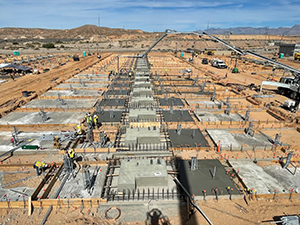
BEI Construction created foundations in many stages,
from excavation and conduit placement to
framing, setting rebar, pouring and finishing.
But with unexpected road closures, car accidents and other hazards delaying the concrete trucks on a regular basis, the team had to work hard and coordinate across multiple trades to enable those deliveries to occur on schedule.
“We identified the critical path of the project, and our crew members worked two 12-hour shifts, six days a week to meet those targets,” Kling said of his team’s hyper-focused approach. “We lived and died by the schedule, which became the recipe for the project.”
That strategy was further challenged, however, by the week-and-a-half of delays the crew experienced due to rain in fall 2023. Furthermore, a last-minute change order required the BEI team to demo out a significant number of concrete foundations they’d already installed and then reform them and install conduit sweeps in new locations.
“It was a gut punch,” Kling said, “but we had to keep moving forward.”
With those delays compressing the already-tight schedule, “we had to get creative about how to perform activities at the end of the project in parallel with other activities that we don’t traditionally do in parallel,” Kling said. “For example, the commissioning process near the end required power from the grid, and we didn’t have power for the auxiliary and communication systems, so we had to improvise.”
After renting 1-MW diesel generators so they could simulate battery charge/discharge cycles, connect to the auxiliary power network and get the facility’s HVAC and communication systems up and running, the BEI team had specialists in supervisory control and data acquisition collaborate with commissioning experts from battery manufacturer BYD, Los Angeles, to connect certain batteries to their power conditioning systems, test them and deem them ready for operation.
“The diesel generator we rented consumed hundreds of gallons of diesel fuel weekly, so we had that being delivered as well, and all of the commissioning activities were happening during the holiday time in December, which further limited our workdays and access to labor,” Kling said.
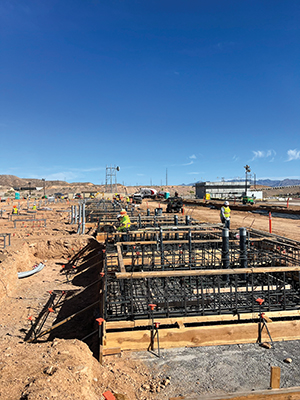
Nevada Energy’s new Reid Gardner
BESS as it neared completion
Helping the industry move forward
Despite the complexity of the job and numerous challenges, BEI Construction successfully delivered the project safely and on time.
“In the end, Nevada Energy was able to charge and discharge that system at its full nameplate capacity of power [220 MW] as they deemed appropriate by Dec. 31, 2023,” Kling said. “It’s a two-hour system, which means that it can discharge 220 MW of power for two hours [440 MWh of energy] until the batteries are empty, at which point they’re recharged by the grid. The system was designed for multiple cycles a day, so this discharge and charge process can occur multiple times daily.”
Kling credits his team’s success to how they attacked challenges and problems.
“Nevada Energy and Energy Vault provided excellent daily representation and oversight on the project, but in a high-stress environment with tight budgets and deadlines and constrained resources, the day-to-day communications may not be easy,” he said. “Amid your client(s), suppliers and subcontractors, you can never lose track of the bigger picture that we’re all here for the same goal. You must always keep your cool and remember that everyone needs to get home safely in one piece and that you’re going to put your name on this project. Your reputation in the industry is only as good as your last project, so you can’t let the struggles of the day hurt the professionalism you must uphold, both upwards as well as downwards to the project managers, foremen, supervisors, and men and women doing the work.”
At the end of the day, “this project has been a tremendous source of pride for us, and we truly felt the bond and appreciation from everyone on our team who worked on it,” Kling said. “A lot of utilities across the United States are looking west at what other utilities in California, Nevada, Arizona and Texas are doing, so we’re excited to have played a part in helping Nevada Energy transition and move forward. We’re not the only company dealing with battery energy storage systems and their challenges, so we’re firmly committed to sharing our trials, tribulations and unique solutions with fellow contractors so that we can all get better and help the utility industry move forward.
“BESS is a small industry, so when you complete a job of this magnitude and complexity, it opens doors,” he said. “We’re excited to keep our guys and gals working and sustain their livelihood and to also give them another project and challenge to successfully complete and hang their hat on.”
BEI CONSTRUCTION Inc. | Energy vault / BEI CONSTRUCTION Inc.
About The Author

BLOOM is a 25-year veteran of the lighting and electrical products industry. Reach her at [email protected].