Battery energy storage systems (BESS) are proliferating and so is the need for cables and cable management systems specifically tailored for these systems. Conventional cabling won’t work properly for BESS because the cables need to be much smaller and more flexible to appropriately fit within BESS electrical houses. Meanwhile, the cables should be easier to pull to reduce labor costs and increase installation speed. Cable management systems for BESS also should be aboveground. It is too cumbersome to trench for underground placement within the confined spaces between BESS units and is unnecessarily costly. Also beneficial: aboveground cables don’t heat up as much because they’re not buried. Cabling and cable management system manufacturers are responding with innovative solutions to meet the needs of BESS operators, including ancillary products to improve cabling efficiency, reliability and performance—all while bringing down the overall cost.
The role of BESS in the U.S. grid
In the United States, BESS is used for a number of purposes, including regulating frequency fluctuations in the grid, managing excess wind and solar generation, and arbitrage—using batteries to “buy low and sell high,” said Chris Namovicz, team leader for electricity, coal and renewables modeling at the U.S. Energy Information Administration. Arbitrage was the largest application reported in the EIA’s last annual survey released in September, with almost half—about 11 of 25 gigawatts—reporting this as their primary use.
“In areas with high penetration of solar generation, there is a strong tendency to suppress wholesale power prices during the daylight hours, while prices during the evening hours remain relatively high,” Namovicz said. “This creates significant arbitrage opportunities to charge during midday and discharge into the evening peak.”
Cable industry, meet BESS
While there are some significant overlaps in the solar and BESS markets, neither is entirely dependent on the other, Namovicz said. Solar is also built in areas without storage, and BESS is built in areas without much solar and for applications that do not overlap with that market.
The cable industry is responding to BESS’s evolving needs. The electrical houses for these systems—or e-houses—are similar to the e-houses within data centers, said Brad Pollard, technical sales manager for the factory automation group of Southwire, Carrollton, Ga.
“E-houses are portable units built by OEMs in their facilities instead of in the field, which increases speed to market,” Pollard said. “Space and flexibility are key in BESS, and that’s because of the shortage of labor and very tight timelines to get these things powered up and ready to go. Southwire is very much focused on how to make cables go into these units easier.”
One of Southwire’s first products to market for a flexible power cable for the BESS industry was diesel locomotive cable, which has been out for years, he said. DLO cable is 2-kV rated and specifically designed for high flexibility—it has a high-flex strand and a flexible jacket.
Southwire recently launched RenewaFLEX, which also has a 2-kV design, Pollard said. It has a somewhat thicker jacket, whereas the DLO has a slightly higher coefficient of friction in the jacket. RenewaFLEX is a little easier to pull. It has a high strand count and is flexible.
Machine FLEX Power is another flexible product that’s typically used for power generation inside of these units, he said.
“We were working with a manufacturer of e-house units that had a need for smaller diameter cables than DLO because the cable’s outer diameter was too large to fit inside their units,” Pollard said. “So we developed the Machine FLEX Power that is roughly 20% smaller than DLO and much easier to pull than the rubber-based DLO. It also has a 600V rating versus the two other products.”
Southwire has used Machine FLEX Power when 2-kV ratings aren’t needed in these smaller units, but it has flexibility for the installer to put these in BESS units more quickly, he said. Each strand is much smaller than typical commercial wire, so it can be bent almost without any effort.
“We also have a multiconductor product within our Machine FLEX tray cable line that’s very flexible, as well as our flexible variable-frequency drive cable line,” Pollard said. “We can also help our customers install these products properly to have the most reliability.”
Southwire developed these products by listening to its BESS customers that needed a more flexible cable, said Bill Fowler, the company’s business development director of EV infrastructure and contractor solutions.
For instance, while DLO cables are flexible, their rubber coating can make them difficult to pull, Fowler said. To address this, Southwire developed a product rated as THHN and XHHW that is just as flexible as DLO.
“Imagine a cable you could tie into a pretzel, whereas previously, people were nearly breaking their arms with pry bars trying to bend stiff feeder cables inside panels,” he said. “These highly flexible cables have truly revolutionized the industry, making installations easier and preventing breakage with insulators on busbars due to stress transferred to the connection.”
Furthermore, BESS units are increasingly replacing diesel generators as backup power for EV charging equipment, including school buses charged at night, Fowler said. These BESS units are like compact shipping containers with batteries and control equipment in tight spaces.
That means for cable, “flexibility is crucial here, and our solutions aim to reduce the number of people required for installations,” he said.
Southwire is the sole manufacturer of high-density polyethylene conduit with wire installed during the extrusion process, Fowler said. The company can also create custom electrical boxes and power whips for prefab systems and bundle cables for installation inside BESS containers. This approach reduces labor requirements and enhances efficiency.

Southwire's RenewaFLEX
Innovations for BESS cable management
“Our BESS units are meticulously engineered, and we can custom- cut, label and place cable runs on single reels, minimizing waste and the space needed for multiple reel setups,” Fowler said. “Additionally, we offer electrical boxes, mounting straps for conduits and connectors, all of which can be kitted together and shipped to contractors in a convenient prefab kit.”
Southwire also invested in BoxPower, Grass Valley, Calif., a company that provides premade BESS containers tailored to customer needs, often equipped with solar panels, Fowler said. These solar-charged units are designed for remote locations with limited grid power, such as Alaska and Canada, and are used for backup clean power in EV charging scenarios.
“Our range includes photovoltaic power cables, allowing us to meet all market demands,” he said.
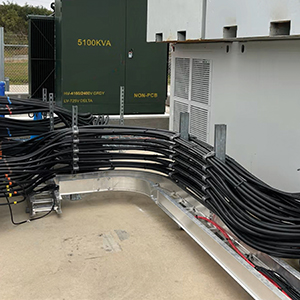
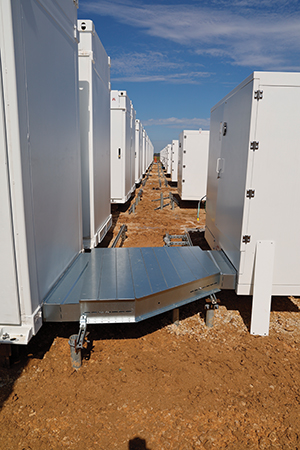
The BESS market is also moving forward with aboveground cable management, said Scott Rand, co-founder and CEO of Affordable Wire Management (AWM), Phoenix.
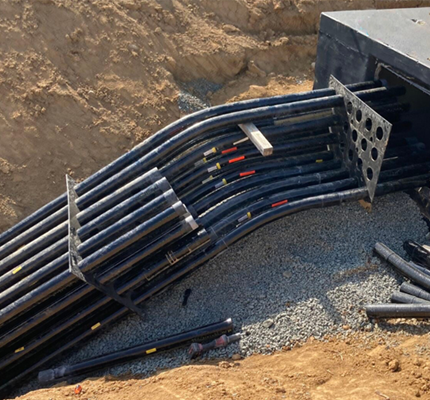
In previous years, especially in BESS projects, a lot of the cabling was trenched or buried in the ground, which led to a few issues, Rand said. One, it’s quite expensive to dig a trench, place the cable in the ground and then refill the trench with dirt or concrete.
Secondly, trenching typically requires heavy machinery, which is problematic in very confined spaces in the battery storage area, he said.
Finally, when cables are underground, they generally heat up more, so cables need to be larger.
“But when you bring things aboveground, you don’t require any heavy machinery and all that trenching cost is removed,” Rand said. “You also have better thermal performance. So, there’s a big trend with installing cables aboveground—and that’s where the need for a cable management solution comes into play.”
AWM was founded in early 2020 with a mission to help accelerate the adoption of clean energy projects by making innovative solutions for aboveground cable management in solar and battery energy storage projects, he said. The company operates primarily in the United States, but it also works on projects around the world, partnering with many of the top solar contractors and the two largest U.S. energy storage integrators and contractors.
“Our value really comes from our product design,” Rand said. “We bring innovative solutions, typically by utilizing high-volume manufacturing techniques and smart design approaches.”
One of the primary goals of AWM’s cable management solutions is to have solutions for all different types of battery designs from different manufacturers, he said.
“Historically, typical cable trays have been used—a large piece of metal that’s usually cut the length of the tray and put into place, and the cables are laid inside,” Rand said. “AWM incorporates a variety of different features into these trays where it can be adjusted in the field in multiple dimensions without fabricating the material like contractors have to do for typical trays.”
The company’s aboveground cable management systems are composed of a few components, he said. They start with the foundation, which will hold the structural weight of the components in the system. Then there is the actual tray or the system that covers the cable. Some of AWM’s solutions are uncovered, eliminating the need for a tray.
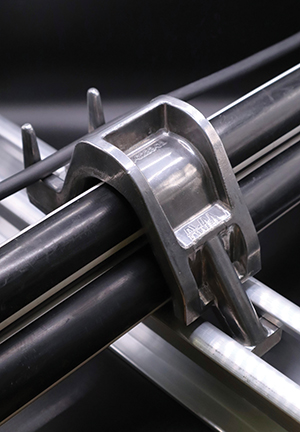
The third component, cleats, are especially important for battery storage, Rand said. Cleats fasten the cables down tightly, so in the event of an electrical fault, the cables are all held together.
“In battery storage projects, if there is an electrical fault, then a large amount of current power will travel through the cable,” Rand said. “If the cables are close to each other, they will repel each other in a really forceful action—and if they aren’t fastened or cleated down, then those forces can blow the cables apart, causing terminations.”
AWM’s cleats are “a little bit different” than others, he said. They are made with a single bolt connection to make the cleat “as strong as it can be and where it needs to be. It’s a highly cost-effective solution.”
For the foundations, the company offers either metal round posts or precast concrete blocks that are custom made for its solution. AWM provides the tray when a covered solution is needed, although an uncovered solution “could be a more optimal way to go,” he said. The company also has a variety of cleats that can be used.
“With our aboveground cable management solutions, we try to incorporate some thermal analysis where we calculate and determine the maximum allowable power that can go through these cables in different cable configurations,” he said.
 |  |  | ||
| AWM's Strata Cleat | AWM's Strata Foundations | AWM's Strata Pack |
“We do this through advanced simulations, and in some of these cleating arrangements, we’ve been looking at more optimal cable arrangements,” Rand said.
With normal cleats, there might be 18 cables and six circuits coming out of the battery container, but with AWM’s cleats it may only require 15 cables and five circuits, he said.
That reduction in circuits is because AWM can arrange its cables in a certain way with a cleat. As such, the company is able to design cleats that can hold the cable down safely and optimize the thermal performance.
“The total cost of battery energy storage is continuing to come down, and part of that is because of innovative cable management and bringing the cable above the ground,” Rand said. “So, we think we’re playing a role there—and we’re excited to see where it goes.”
Affordable Wire Management
About The Author

KUEHNER-HEBERT is a freelance writer based in Running Springs, Calif. She has more than three decades of journalism experience. Reach her at [email protected].