![AdobeStock_189605180 [Converted]](https://www.ecmag.com/images/default-source/articles/september-2026/adobestock_189605180-converted.tmb-art-detail.jpg?Culture=en&sfvrsn=610ff73a_1)
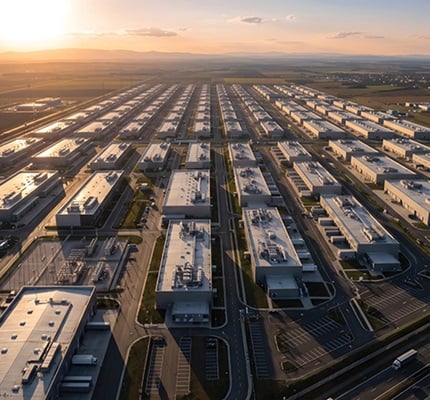
Last month’s column discussed a recent visit I made to a large data center and how it provides guidance for designing and building smart buildings. Data centers are a relatively new development created to facilitate the use and expansion of the internet. Now let’s look at that relationship and how the internet and data centers have developed.
The internet started in the 1960s as ARPANET (the Advanced Research Projects Agency Network), established by the U.S. Department of Defense as a network to connect computers and communicate. The existing telecommunications network was used to connect users.
By the 1980s, commercial users were allowed, and there was an expansion of fiber optic networks being installed.
At first, the use of the internet was limited to email and sharing files. All that changed with the development of the World Wide Web and the commercialization of the internet. By the mid 1990s, the public became aware of the internet and it exploded into a worldwide public network.
In the early days, the internet was not easily accessible. The software to create a website or access the internet was crude and required some effort. I remember programming my first websites using a text editor, writing code in HTML and uploading files to a server to create what was one of the first 30,000 web pages.
The late 1990s were called the “Dot Com” era as companies and people led a virtual gold rush to create websites and find ways to make money by selling things online or offering subscriptions to websites, magazines and newspapers. The Dot Com Bubble eventually burst, but that’s a story for another time.
Despite this setback, the internet continued to grow, driven by new applications such as social media and streaming video. The big increase in internet use meant there was more data being moved around, and it needed somewhere to call home. Thus, the internet data center was developed.
A data center is sort of like a library. There are racks of data storage (books) with servers that know where the data is stored (card catalogs in the old days and computer databases now) and switches that connect servers to storage (aisles between the racks for people to get books). When a request for a web page (book) comes to a server, it connects to the storage through the switches, retrieves the data and sends it off to the user.
An A.I. data center, focused on artificial intelligence, is similar, but it has a large computing facility based on extremely fast computing chips (the types normally used in graphics processors for videos) that generate new data when requested. Think of the A.I. computing process as a lot like the research department of a big city library. Ask a question and someone in the research department will use their resources to find an answer for you.
The term “data center” has also been adopted for any computing facility. After companies adopted personal computers connected on local area networks, they had to create a central facility to store data to share among users. Today, much of that function is cloud-based, which is a virtual computing center hosted in a larger data center. But if a company still has a computer center on their premises, they are likely to call it a data center too.
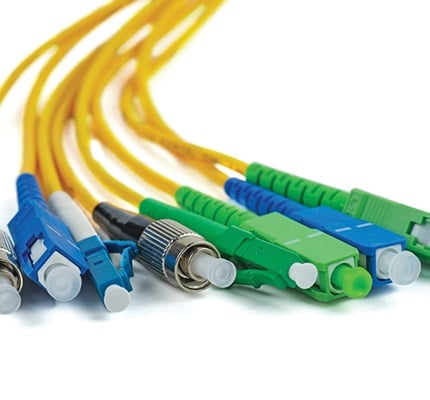
Practically everything discussed here is communicating on fiber optics. The internet is all fiber except for the wireless connections to mobile devices. Data centers are full of cables connecting servers, switches and storage internally, and servers and routers to the outside world. Hyperscale data centers may have hundreds of thousands of connections on fiber.
In big data centers, connections are fiber because speeds are too high for copper wiring. Smaller operations may be using Cat 6A for shorter connections, such as connecting servers to switches in a single rack. To simplify installing fiber optic cabling in data centers, prefabricated cabling systems using high-fiber-count cables and multifiber connectors are often used for simpler installation.
In fiber optics today, data centers are driving technology development. To reduce latency, some are now using hollow-core fiber, which transmits light 50% faster than glass fiber. To increase data density, some are using a single-mode fiber with four cores, quadrupling the data transmission capacity of a single fiber. Connectors with 24 or 32 fibers are being used in prefab cabling and are being tested with multicore fibers to make 96 or 128 connections at once.
We’ll just have to wait and see what’s coming next.
stock.adobe.com/maxutov
About The Author

HAYES is a VDV writer and educator and the president of the Fiber Optic Association. Find him at www.JimHayes.com.