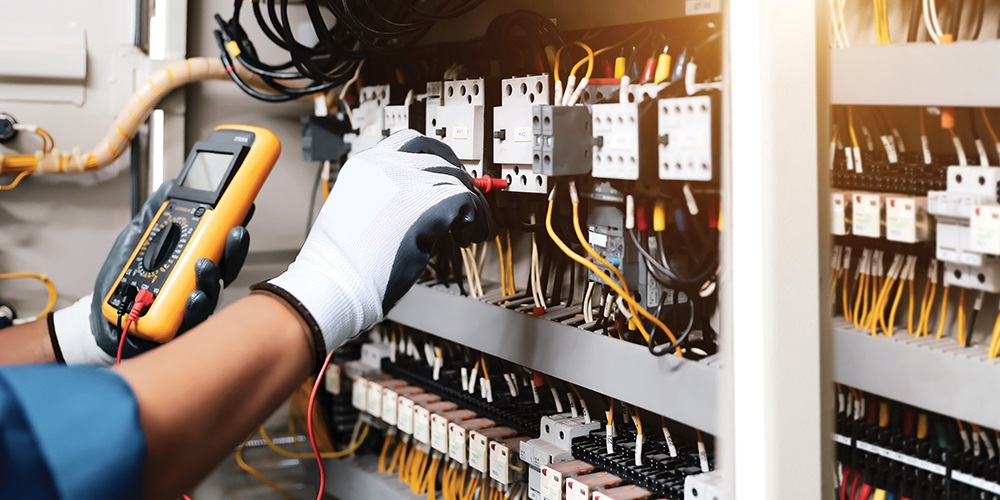
We are firmly in the heart of the National Electrical Code Article 230 requirements for installing services. Last month, we took a look at many of the requirements for service and service-entrance conductors. As we saw, there are several different terms for conductors depending on where they are installed or what they happen to be connected to. This month’s article focuses on where all of the current carried on service conductors will end up: the service equipment.
To understand the term “service equipment,” we need to look at the definition in Article 100. The NEC defines it as being the necessary equipment to serve as the main control and disconnect of electricity from the serving electrical utility. This definition also goes on to mention that this typically consists of circuit breakers or switches and the associated fuses. In other words, the service equipment is meant to be the interface between the premises wiring system and the system that delivers power to the building. It is common to find equipment such as metering equipment on the line side of the service equipment, but it is not intended to serve as the main control and disconnect from the utility and is not considered service equipment. The service connection can be interrupted manually or automatically if the equipment senses that there is a problem.
Service equipment requirements
It is this automatic operation that directs much of the requirements found in Article 230 for service equipment. This will include interrupting rating, minimum size, number of disconnects, location and much more. The first set of rules, which we can easily find in Article 230, relates to the general requirements for service equipment. First off, we find in Section 230.62 that service equipment must be enclosed or otherwise guarded against contact. It helps to remember that service entrance conductors are upstream from any circuit breaker or switch. That means service conductors, busbars, terminations, etc., will be energized, even if the main switch has been turned off (unless de-energized on the utility end). This section even goes on to require that barriers be put in place to ensure that no energized and uninsulated bus or termination is exposed to contact while load-side terminations are being serviced with the service disconnect turned off. This is a critical requirement for the safety of service and maintenance technicians.
There are also several requirements for marking service equipment. First, it needs to be marked by the manufacturer to be suitable for use as service equipment. This typically means that certain provisions are met for allowing connection of the grounding electrode system, equipment grounding conductor or both to the service grounded conductor. The installer needs to know that it is possible with this equipment.
There are also requirements for marking important information such as available fault current and the arc flash label information. The service equipment is essentially the start of the premises wiring system, so it makes sense that this equipment would need to be marked to communicate important information related to the system.
The next big requirement that we encounter in Part V or Article 230 is the requirement to provide services with a means to protect the system from overvoltage condition. Spikes and surges in voltage can lead to equipment damage and risk of fire or injury, the two main items the NEC is trying to protect from. Section 230.67 requires that most occupancies where people spend a lot of time, such as dwellings, dorms, hotels, nursing or limited-care facilities, and similar locations, have surge protection or a surge protective device (SPD). The SPD must be integral to the service equipment or be installed at the service equipment so as to protect the whole occupancy, and it must be capable of discharging a minimum of 10,000A. Since these locations are commonly used, the need for added safety measures is crucial.
Service disconnecting means
Now that we have looked at some general requirements for services, the next section moves forward with those for the service disconnecting means. This can be in the form of circuit breakers or fused switches, but it serves as the main control point. Because of this, the first requirement for the service disconnecting means is location, location, location. This topic might not be as much fun as searching for location when shopping for real estate, but it is just as important.
The NEC breaks this up into one- and two-family dwelling requirements and then for all other locations. For one- and two-family dwelling units, the service disconnect is required to be installed in a readily accessible outdoor location, and it can be installed either on the dwelling or at a location within sight of the dwelling unit. This is a relatively recent change in the NEC and was driven by the need for emergency responders to disconnect all power going into a home during situations such as fires or gas leaks.
There are a few ways this can be accomplished. It could involve placing the entire service panelboard outdoors or it could mean that the service disconnect is an outdoor fused switch that feeds an indoor panelboard with all of the branch circuit overcurrent protective devices. There is one exception that permits the service disconnect to be installed elsewhere instead of on the building or within sight from the dwelling; however, an emergency disconnect must be provided to serve as the cutoff to the building for emergency responders.
For occupancies other than one- and two-family dwellings, the service disconnect can be installed either outdoors or indoors. However, since the service entrance conductors are not fully protected from overcurrent situations such as short circuits and ground-faults, indoor service equipment must be installed nearest the point of entrance of the conductors to minimize the possibility of a fault causing damage to the building or occupants. The indoor location must never be a bathroom. In general, it is not a great idea to install such critical equipment in an area subject to elevated amounts of moisture.
Finally, it is important to tell other people that the service disconnect is there. So, the service disconnect must be marked as such, and, for one- and two-family dwellings, it must also be labeled as the “emergency disconnect” so it is clear to responders where to go. Since many modern installations also have additional power sources such as a solar photovoltaic system, these disconnects often get installed near the service equipment. There must be no doubt that the service disconnect is the service disconnect.
Next month’s article will dive into how service disconnects must be rated and how many disconnecting means are allowed on a single service. We’ll also explore how multiple service disconnects must be grouped to allow for efficient and effective disconnection of the service conductors from the building. Service equipment is the main point of control of electricity and a critical safety measure of the electrical installation. Getting this one right is the only option that meets the purpose of the NEC.
Until next time, stay safe and always remember to test before you touch!
stock.adobe.com/Eakrin
About The Author

Vigstol is an electrical safety consultant for E-Hazard, a provider of electrical safety consulting and training services. He is also the co-host of E-Hazard’s electrical safety podcast “Plugged Into Safety.” For more information, check out www.e-hazard.com.