Last month, we began our journey into the part of the electrical system that serves as the control and disconnection from the utility: the service equipment. Having gone over a few key terms, now it is time to jump right into the National Electrical Code requirements that mandate how we install the conductors and equipment that make up this critical component of any premises wiring system.
To start the conversation, we need to know how many services are going to be permitted to supply power to the building. The short answer is one. However, as we have well established, in the NEC, nothing seems to be as simple as a one-word answer.
So, let’s take a look at Section 230.4. This is where you will find the requirement that a building or structure be served only by a single service, unless the installation meets one of the conditions listed in 230.4(A) through 230.4(D).
It is also important to note that 230.4 makes it clear that conductors 1/0 AWG and larger that are connected together at the supply and not at the load end are still considered as a single service. We will discuss this more when we get to the service disconnecting means requirements later in this series.
So, the first section that gives us permission to have additional services deals with special conditions such as fire pumps, emergency systems, legally required standby systems and other options where the connection of an additional power source is necessary. Often, this is done for the purpose of enhanced reliability in critical installations. However, the most common reason for supplying a building with multiple services is that a single service won’t meet the capacity needs of the electrical system.
Section 230.4(C) gives us guidance that this might be when the capacity exceeds 2,000A for systems of 1,000V or less. Of course, the need for an additional service can always be granted by special permission by the authority having jurisdiction (AHJ). Essentially, if you can demonstrate the need for an additional service and get it approved in writing by the AHJ, then permission can be granted. However, this is always taken on a case-by-case basis.
For the purposes of keeping the conversation simple, let’s just focus on the requirements of installing a single service to a building. But where to start?
If you remember from last month, the service starts at the service point. So, we can begin discussing service requirements from there and work our way down the line. That means looking at the service conductors. The way the requirements are broken down in Article 230 is that they start with overhead service conductors, then they move to underground service conductors and, finally, they cover service entrance conductors.
Overhead service conductors
So, what does the NEC require for installing overhead service conductors? Well, if we circle back to the purpose of the NEC, we are thinking about protection of people and property from electrical hazards. This means we are going to find requirements to protect us from electric shock and fire while still being able to serve the installation.
First things first: the NEC requires that the overhead service conductors be covered or insulated. This is mainly to protect the conductor from the elements and damage. However, whether overhead conductors are covered or insulated, they should never be considered safe to touch unless they are in a verified electrically safe work condition.
Next, Article 230 lists requirements for clearances based on what area the conductors are installed over. For instance, overhead conductors installed above areas not commonly subjected to vehicle traffic can be installed as low as 10 feet above finished grade in certain instances, whereas overhead service conductors above areas such as roadways and alleys subject to truck traffic need at least an 18-foot clearance. It all depends on how the area will be used after the conductors are installed.
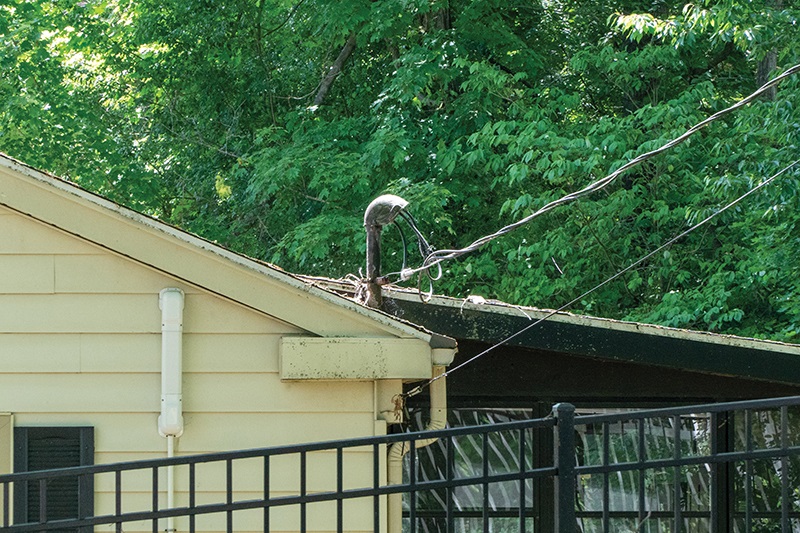
Finally, there are rules for how to attach the overhead service conductors to the building or structure. This is a critical requirement as it is very important that these conductors remain in the air and not on the ground, since they are always energized and have little to no overcurrent protection to automatically de-energize them should they fall.
The NEC mandates the type of fitting that must be used to attach the conductors to the building, typically a specifically designed porcelain fitting, to ensure a solid and reliable anchor point. In the case where a service mast (raceway) is used to support the conductors, there are requirements to ensure the mast is of sufficient strength to support the overhead span. This includes mandating that the mast does not have a weak spot between where the overhead conductors attach and the last point of securement of the mast. This means the mast needs to be a solid raceway with no couplings between the last point of securement and the point of attachment of the service conductors.
Underground service conductors
Next, we move on to the requirements for underground service conductors. The rules here are much simpler to follow. Underground service conductors are required to be insulated for the system voltage and sized appropriately for the calculated load to be served. Also, the NEC specifies which wiring methods are permitted to be used for underground service conductors in Section 230.30(B). Many of these wiring methods are conduit-style raceways such as RMC, IMC, PVC and HDPE.
Underground service conductors are permitted in cable wiring methods when the cable is identified for direct burial applications. The rest of the requirements revolve around protecting service conductors from physical damage. However, this is now done with burial depths from Section 300.7 instead of overhead clearances.
Service-entrance conductors
Finally, we have the rules for service-entrance conductors. Regardless of whether the service conductors were overhead or underground, service-entrance conductors must follow the requirements in Part IV of Article 230. This starts with defining the general rule that there only be one set of service-entrance conductors for each set of overhead or underground service conductors. But there are several exceptions to this requirement. Primarily, the exceptions center around multiple occupancies, multiple service disconnect enclosures or multiple buildings. This ensures that there aren’t unprotected conductors running all over the property unless necessary.
The remaining requirements in Part IV center around making sure the conductors are properly sized and properly protected. Similar to sizing feeders and branch-circuits, we see here that service-entrance conductors must be sized to handle 125% of the continuous load plus the noncontinuous load or be sufficient for the calculated load after the application of adjustment and correction factors. When it comes to physical protection, Section 230.43 gives users several options for wiring methods permitted for service-entrance conductors unless those conductors are subject to physical damage such as being exposed on the outside of a building and accessible from grade. In these cases, Section 230.50 limits the options to conduit and tubing style wiring methods.
Of course, there are several factors such as the type of physical damage threat and the environment where the wiring method will be installed. If the area is subject to vehicle traffic or heavy or severe corrosive conditions, conduit with a heavier wall would be appropriate, such as RMC, IMC or Schedule 80 PVC. Lighter damage threats such as foot traffic or minor shifting can be handled with EMT or other approved means.
Installing service conductors in a manner that ensures they can sufficiently supply the load and remain protected from physical damage is critical to a safe installation. Remember, these conductors don’t have the same level of overcurrent or fault protection as branch-circuits and feeders.
Next month’s article will continue to look at service requirements in Article 230 of the NEC and make our way down to the service equipment. Until next time, stay safe and remember to always test before you touch!
stock.adobe.com/Michael
About The Author

Vigstol is an electrical safety consultant for E-Hazard, a provider of electrical safety consulting and training services. He is also the co-host of E-Hazard’s electrical safety podcast “Plugged Into Safety.” For more information, check out www.e-hazard.com.