As the temperature drops and people decorate their houses with festive holiday decor, what better topic to cover than receptacle placement in dwellings? On the surface, this might seem like a straightforward decision: put receptacle outlets where people need them, and where they make sense. But the requirements in Article 210 aren’t just about convenience; they are fundamentally about safety, usability and a deep understanding of how people interact with electrical systems in their spaces.
What’s in a wall space?
This journey through the NEC has always been about balancing Code compliance with practical applications. One of the most foundational rules for receptacle placement is the so-called “12-foot rule” in most areas of dwelling units. Essentially, no point along the floor line in any wall space should be more than 6 feet from a receptacle outlet, meaning that receptacles must be located no more than 12 feet apart. At the ends of the wall space, receptacles must be within 6 feet of the break in the floor line, such as a door.
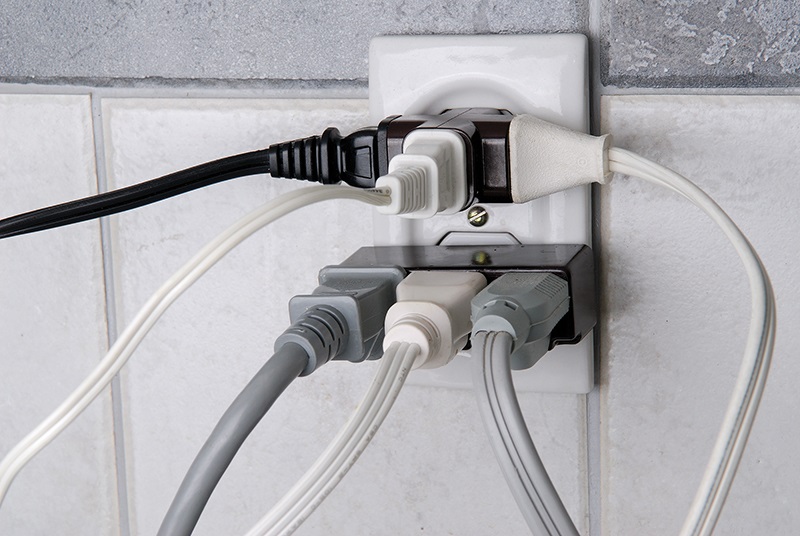
This rule, outlined in Section 210.52(A), is deceptively simple, yet brilliant. It’s aimed at eliminating the need for extension cords, which are notorious for causing residential fires. However, only receptacles mounted below 5.5 feet in height from the floor can meet this requirement.
The Code is also specific about what qualifies as a wall space: Any segment at least 2 feet wide and unbroken along the floor line. This includes measuring around corners, the fixed portion of sliding glass doors, floor-to-ceiling windows and any fixed room dividers such as freestanding counters and railings. Doorways—both sliding and swinging—fireplaces, stationary appliances and fixed cabinets without a countertop surface count as a break in the floor line. For spaces such as railings and windows where the receptacle can’t be placed in the wall, a floor-mounted receptacle outlet is permitted if it is within 18 inches of the wall segment.
Kitchen and bathroom countertops
For countertops and work surfaces, the NEC takes receptacle placement a step further. For countertops and work surfaces 12 inches or greater in width and with wall space behind them, receptacle outlets must be placed so that no point along the wall line is more than 24 inches horizontally from a receptacle, which translates to one roughly every 4 feet. This ensures appliances such as blenders and toasters don’t rely on cords that stretch too far, especially near sinks and stoves. Where a counter-mounted cooking unit, range or sink is installed so the space behind it is less that 12 inches (18 inches if mounted in the corner), the wall line directly behind the sink, range or cooking unit does not require a receptacle outlet since it is not viewed as usable countertop space.
Islands and peninsulas, however, have their own unique requirements depending on dimensions and layout. Receptacles to serve islands or peninsular countertops are optional, but if they are installed, they must be on or above the countertop or work surface, but not more than 20 inches above. There is also the option to install them in the countertop or work surface if the outlet assembly is listed for use in countertops or work surfaces. If a receptacle is not installed to serve these spaces, the means to install one in the future must be provided.
Bathrooms, too, have their own specific requirements. A receptacle must be installed within 3 feet of the outside edge of each sink basin and be in the wall adjacent to the sink or countertop, in the countertop if so listed or in the sink cabinet, provided it is not more than 12 inches below the sink or countertop. What seems like a small detail makes a major difference in usability and safety. Don’t forget, bathroom receptacles must be on a 20A bathroom branch circuit and GFCI-protected.
Garages, attics and more
Garages, attics, basements and crawl spaces also have special considerations. For garages, both attached or detached with electric power, at least one receptacle outlet must be installed in each vehicle bay and not more than 5.5 feet above the floor. This requirement applies to one- and two-family dwelling units, as there is an exception for multifamily dwelling unit detached garages. This means the receptacle in the ceiling for a garage door opener doesn’t count since it is more than 5.5 feet above the floor.
Attics and crawl spaces don’t necessarily have a specific requirement for receptacle outlet placement, but if equipment requiring servicing is installed in these locations, such as HVAC, a receptacle is required within 25 feet and must be on the same level as the equipment. This means that if an AC unit or furnace is installed in the attic, a receptacle must be in the space and within 25 feet of the HVAC equipment (except for evaporative cooling equipment).
Laundry areas and hallways 10 feet or more in length are only required to have one receptacle at a minimum. For both areas, there is not a requirement for where the receptacle outlet must be other than it must be in the laundry area or within the length of the hallway. Foyers, on the other hand, might require more than one receptacle outlet in the space. For foyers larger than 60 feet squared, a receptacle must be located in each wall space 3 feet or more in width.
Outdoor requirements
The NEC mandates that every home have at least one outdoor receptacle readily accessible from grade. For one-family and each unit of a two-family dwelling, there must be a receptacle outlet installed at the front and rear of the dwelling and not more than 6.5 feet above grade. Each unit of a multifamily dwelling at grade level must have a receptacle outlet if the dwelling has individual exterior entrance or egress.
Decks, balconies and porches within
4 inches horizontally of the dwelling unit must also have a readily accessible receptacle. In the age of outdoor living, this requirement makes sense for plugging in holiday lights, power tools and patio heaters.
All of these must be GFCI-protected and have weather-resistant covers.
Of course, applying the NEC isn’t always black and white. Authorities having jurisdiction may interpret or enforce requirements differently, and some municipalities add local amendments. I always encourage colleagues to double-check these before finalizing plans, especially in historic homes or mixed-use buildings where exemptions may apply.
Additionally, the requirements for receptacle locations in a dwelling are only minimum requirements. There is nothing preventing the installer from adding receptacles to work with the room and furniture layout, provided they still fit the requirements listed in Article 210.
Keep in mind, this overview only looked at dwelling unit receptacle placement. The NEC contains several other requirements that apply for different types of occupancies and special equipment. Next month’s article will look at some other receptacle placement requirements within the Code.
Until next time, stay safe and always remember to test before you touch.
stock.adobe.com / Reimar
About The Author

Vigstol is an electrical safety consultant for E-Hazard, a provider of electrical safety consulting and training services. He is also the co-host of E-Hazard’s electrical safety podcast “Plugged Into Safety.” For more information, check out www.e-hazard.com.