Last month's article covered the requirements for receptacle placement in dwelling units. Now, let’s review the requirements for facilities other than residences.
The rule is simple: if power is needed in an area, install a receptacle. In nondwelling installations, the use of a space is usually known prior to occupancy, so the designer and installer will know where a receptacle outlet is needed and can plan for it. However, issues with running extension cords and using multireceptacle devices, such as splitters and relocatable power taps, still exist and installers should work on the system with this in mind.
The NEC has rules to help guide us. First, Article 210 has three sections that mandate receptacle outlets for show windows, areas with equipment likely to require servicing and maintenance, and meeting rooms. Remember, requirements for a receptacle outlet are typically designed to limit the use of cord sets as a “temporary” power solution.
Show windows
Section 210.62 requires at least one receptacle outlet to be located within 18 inches of the top of the show window and that no point along the top be further than 6 feet from a receptacle outlet. The receptacle outlet(s) must be 125V, single-phase, 15A or 20A rated.
This requirement helps ensure that retail displays, which often have cord-and-plug-connected signs or lighting, have access to the necessary power without draping extension cords.
Areas with equipment
Requirements for areas where equipment is installed that is likely to require servicing or maintenance can be found in Section 210.63. A 125V, single-phase, 15A or 20A receptacle outlet is required to be installed within 25 feet of the equipment requiring service work. This receptacle outlet must be located in an accessible location, but 210.63(A) and (B) also have conditions to consider.
For HVAC and refrigeration equipment, the receptacle outlet(s) must be on the same level as the equipment. This gives service technicians convenient access to 120V power to supply tools and testing equipment. When isolating the control circuit for testing, the 120V power should be independent of the power to the HVAC or refrigeration unit main power supply. For this reason, 210.63(A) also stipulates that the receptacle outlet must not be supplied from the load side of the equipment’s branch-circuit OCPD. Section 210.63(A) also applies to dwelling unit installations but is often covered by general-purpose receptacle outlets.
Section 210.63(B)
Section 210.63(B) deals with providing power in electrical distribution equipment areas of a building that is not a dwelling unit, but would also apply to the service area in a multifamily dwelling with common service equipment where each unit supplied by an individual feeder. This receptacle must be located within the same area as the electrical equipment. For instance, a receptacle in the hallway of a hotel would not satisfy the requirement for a receptacle outlet in the electrical room, even if it is only a couple of feet from the door. This minimizes the need to run extension cords in hallways and through doorways, where they could be damaged and present a hazard.
This is only required for locations where there is a wiring system operating at less than 150V to ground. A location with only 480V, three-phase power is not required to install a small transformer to supply a receptacle outlet(s). In that case, a portable generator could deliver the power needed to supply tools and test equipment.
Meeting rooms
Finally, Section 210.65 requires a receptacle outlet(s) to be installed in meeting rooms with an area of 1,000 square feet or less, or for larger rooms where partitions reduce the size of the room to under 1,000 square feet. For the purpose of this section, rooms with temporary partitions shall be configured so the partitions result in the smallest room size.
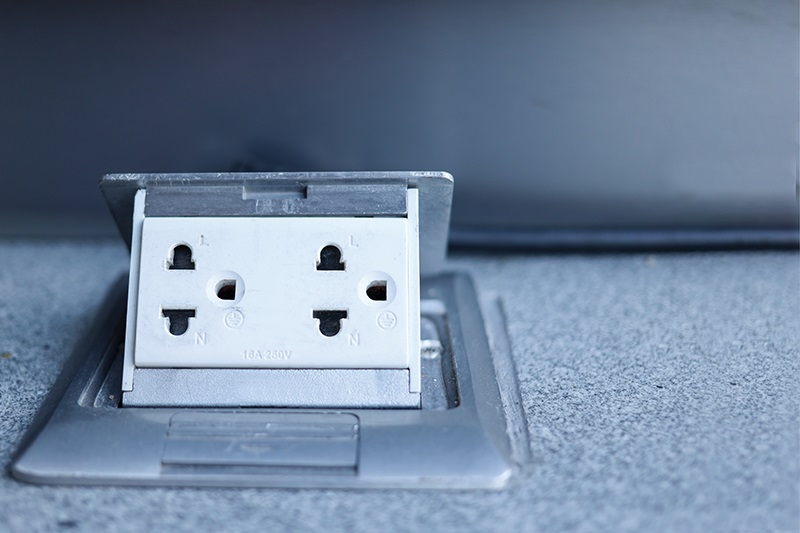
The tricky part of meeting rooms is determining how many receptacle outlets are required. For fixed walls, no point along the floor line should be further than 6 feet from a receptacle outlet, but that is for a device count only. The actual location is up to the designer or building owner. For meeting rooms with a floor area of at least 215 square feet and one room dimension of at least 12 feet, a floor outlet is going to be required for each 215 square foot section of the room or fraction thereof and must be located at least 6 feet from a fixed wall.
For example, a meeting room with a floor area of 900 square feet would require a minimum of five floor outlets, because 900 ÷ 215 = 4.19 outlets, which rounds up to five. Just make sure none are installed within 6 feet of a fixed wall, which also has required receptacle outlets.
Adequate access to power is convenient for building occupants and limits the amount of risk from improper use of electrical equipment.
Next month’s article will start taking a look at some specific requirements for the backbone of a building’s electrical infrastructure: the feeder. Until then, stay safe and remember to always test before you touch!
stock.adobe.com / witsawat
About The Author

Vigstol is an electrical safety consultant for E-Hazard, a provider of electrical safety consulting and training services. He is also the co-host of E-Hazard’s electrical safety podcast “Plugged Into Safety.” For more information, check out www.e-hazard.com.