Codes and standards are not developed to make our lives more difficult; they are created to make buildings safer. Fire alarm, life safety and sprinkler systems are installed to improve safety for everyone. The more you know about using the codes and standards, the easier it is to apply them. Still this process takes time.
In my experience, one of the best ways to understand the requirements is through good communication. Get to know your fire inspectors and fire marshal. If you are unsure about a code requirement and how it will be interpreted, ask. I have found that most of them are very willing to help. It makes their job easier in the long run. It also shows that you are a professional interested in getting the job done right the first time.
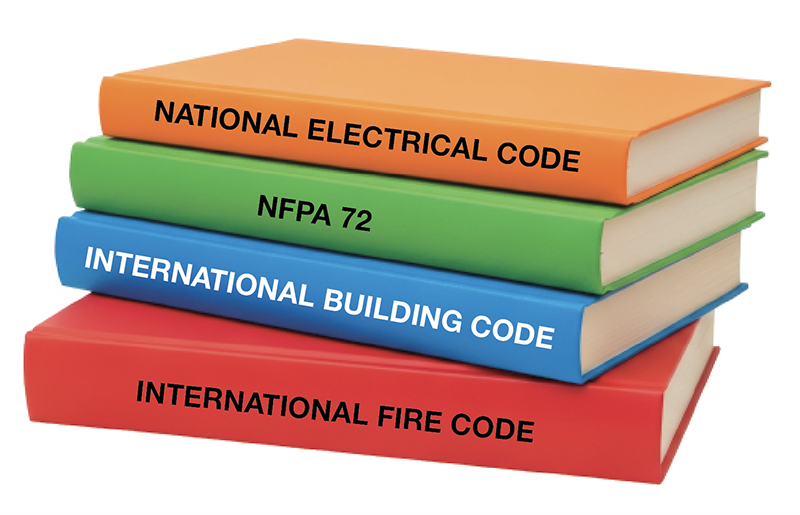
If you are responsible for designing or laying out a fire alarm system, you need to know where to find the code requirements applicable for the job. What codes and editions are enforced and are there any local amendments? You need to know which edition of NFPA 72 and the National Electrical Code are referenced. If you are a project manager or lead installer, you need to know that what you are installing is correct.
Getting to know the I-Codes
The most common codes applicable to fire alarms are the International Building Code (IBC) and International Fire Code (IFC). To a lesser extent, NFPA 101, Life Safety Code, or NFPA 1, Fire Code, may be applicable. The I-Codes are laid out differently than the NFPA Codes, so the process for finding fire alarm requirements is quite different. This is applicable for design-build jobs and specified jobs.
The fire alarm requirements in the I-Code are developed in the IFC and copied into the IBC. The primary difference is that the IBC is only used for new systems, while the IFC is for new and existing systems. For a particular fire alarm installation, you first need to know what the occupancy classification will be. Start in Chapter 3. This lists each occupancy use group and gives examples of businesses that will fall into each category.
If you have a building that will typically have a lot of people, such as a conference center, restaurant or movie theater, you would use Group A, Assembly, which is broken down into 5 subcategories, depending on the use. A restaurant would be in Group A-2. An outdoor stadium would be in A-5. There will be general requirements for all Group A occupancies, plus some specific requirements for each subcategory. If you are unsure which is applicable, talk to your fire marshal or building official.
Once you know the occupancy classification, you will need to review Chapter 4 for specific requirements applicable when you have a high-rise building, an atrium, a covered mall, an underground structure or parking facility, etc. Specific requirements take priority over general requirements.
Now that you have the background information you need, go to Chapter 9 for the fire alarm and sprinkler requirements. Section 903 is for sprinklers; Section 907 is for fire alarms. The requirements are listed per occupancy classification. This will tell you if you need a fire alarm or not based on factors such as occupant load per floor.
You will see a number of exceptions allowing you to eliminate manual pull stations when the building is fully sprinklered. This does not mean you can eliminate the fire alarm system, just the pull stations at the exits.
You still need to install one pull station at the fire alarm panel, the notification appliances and other devices such as smoke detectors.
Keep in mind…
It is important to remember that not all the device requirements you'll use are found in the IBC or IFC.
For example, the requirements for smoke detectors in elevator lobbies, machine rooms or hoistways come from the Elevator Code, A17.1. Duct smoke detector requirements come from the International Mechanical Code.
In addition, not all smoke detector requirements will be found in Section 907. For example, smoke detectors used to close smoke doors or dampers will be found in Chapter 10, Means of Egress.
The IBC or IFC will tell you that everything must to be installed per that code and NFPA 72. All the wiring needs to be installed per the NEC.
This sounds more complicated than it is. Once you get more familiar with the codes, it gets easier. There are many seminars and webinars available to learn more in detail.
As always, if you are not sure, ask someone for help. It goes a long way.
stock.adobe.com / Emil
About The Author

HAMMERBERG, SET, CFPS, is an independent fire alarm presenter and consultant currently residing in The Villages, Fla. Tom represented the Automatic Fire Alarm Association on multiple NFPA technical committees as well as actively participating in the ICC code making process for many years. He is NICET Level IV certified in fire alarm systems and a Certified Fire Protection Specialist. He can be reached at [email protected].