What is a standard?
What is a standard? Here is one definition from the world’s biggest standards organization. ISO/IEC Guide 2:1996, definition 3.2 defines a standard as:
“A document established by consensus and approved by a recognized body that provides for common and repeated use, rules, guidelines or characteristics for activities or their results, aimed at the achievement of the optimum degree of order in a given context.”
Why do we have standards?
Standards have existed as long as commerce has because it depends on standards. Without standards, it would be impossible to say how big something is—length standards for how long a foot or a meter actually is, weight standards for what constitutes a pound or mass standards for how much a gram is. Time needs a standard second to define the length of an event, and so on. Throughout history we have created standards that allow buyers and sellers to have a language for commerce. That continues today in our high-tech world.
No application in the communications industry could work without industry standards. Any standard’s main goal is to create uniform specifications for products that ensure interoperability among various manufacturer’s products. Standards start at the component level that cover specifications for connectors and cables. For example, standards make cables intermateable and include procedures on how to test them. Standards at the system level cover signal bitrates, frequencies and amplitudes, protocols, data encoding, packet length, timing, error correction and many other factors needed to guarantee that systems can talk to each other. Systems such as cellphones, ethernet and Wi-Fi rely on industry standards to allow devices to communicate, as does the cabling that connects them.
How are standards created for fiber optics and structured cabling?
Manufacturers contribute to the standards so they can have, as a participant who headed one of these committees once said, “mutually agreed-upon specifications for product development.” Telecommunications Industry Association (TIA) and ISO/IEC cabling standards for fiber optics and structured cabling, for example, are written by manufacturers for manufacturers, and as such are much more useful to manufacturers of cables, connecting hardware, networking electronics and test equipment than to end users installing cabling in their networks.
Few users actually need to refer to the standards themselves. In fact, few users could be expected to wade through the boilerplate of the standards, translating them from “standardese,” the quasi-legal “language” they are written in, sifting among the minutiae and “shoulds” or “shalls” to try to figure out how to design and install a cabling network.
Furthermore, these standards written by manufacturers are continually being updated to reflect the newer technologies they currently sell. As a result, legacy applications are pushed aside for new technology, creating a problem for some users of these systems who need to repair or upgrade their cabling. It’s been suggested in the standards committees that users can still refer to older standards when appropriate.
Manufacturers must provide their customers with products that meet the standards and directions for their proper use, meaning customers generally do not need to depend on understanding the meaning of the standards themselves. Other organizations like the FOA, military, telcos, etc., that represent the interests of the products’ users tend to write their own standards that reflect the needs of their members.
For standardized fiber optics and premises cabling, standards are now under the auspices of the TIA Technical Committee TR-42 for the United States and ISO JTC 1 internationally, which also handles premises or structured cabling, including unshielded twisted-pair copper and fiber optics. The goal of this committee is to produce a predictable minimum performance level for cabling that manufacturers can use for developing communications products. Those products have traditionally been communications products like telephone systems, CATV systems and ethernet LANs, but now also include security systems (both CCTV and alarms), building control systems, audio and anything else that can work over the standardized cabling system. The cabling standards are minimums, so many companies can offer enhanced products that exceed the standards and offer benefits to certain users, as well as providing a competitive advantage.
The manufacturers of network electronics have their own standards meetings where they do similar work, including ethernet in the IEEE 802.3 committees and various IEC international telecom standards. Liaison between the network and cabling committees generally assures that their standards will work together. In fact, the committees often use input from each other to set their agendas and technical targets. Other applications that use cabling, such as video, must rely on the cabling standards during their product development, as they are basically proprietary applications and not covered by industry standards. However, should manufacturers of video products want such a standard, they could initiate a similar process to create one.
Since the manufacturers develop the standards for their own use, they assume the responsibility for educating their personnel, customers, distributors and end-users. Fortunately, companies involved in developing the standards or selling products based on them generally do a very good job of translating the relevant standards into understandable language. Practically every company involved in fiber optic cabling seems to have a section in the back of their catalog and on their website devoted to explaining the standards. It is here, not the standards themselves, where the relevant information is to be found. A quick search of “fiber optic cabling standards” on the web will give you numerous links to companies and technical websites like the FOA Guide that offer summaries of these standards.
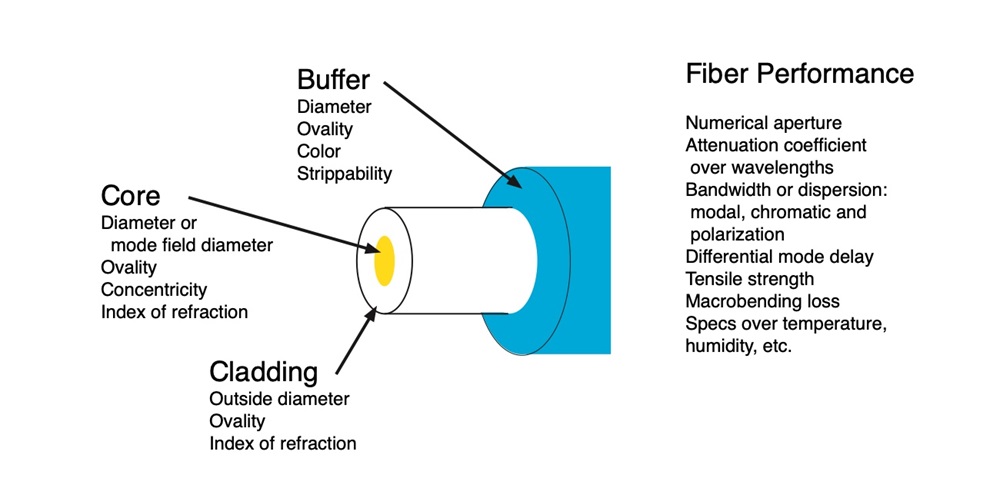
Header image: Example of fiber specifications covered by international standards. Illustration by Jim Hayes.
About The Author

HAYES is a VDV writer and educator and the president of the Fiber Optic Association. Find him at www.JimHayes.com.