In the last couple of articles, we took a small break from the requirements of Article 210 to explore some common myths that surround arc-fault circuit interrupter (AFCI) and ground-fault circuit interrupter (GFCI) devices required to be installed with certain branch circuits. Understanding why these devices are necessary and what they do and don’t do might help us understand why the NEC requires them. Let’s return to GFCI protection and where it is required.
When the term GFCI is mentioned, often the first place in the NEC that comes to mind is Section 210.8, which covers GFCI protection of personnel requirements for receptacles installed in dwelling units and nondwelling type installations. This section specifically refers to Class A GFCIs. These devices have the lowest current range to initiate the interruption of power, set at 4–6 milliamps, hence why this is for personnel protection. Take note, however, that there are other forms of ground-fault protection with higher trip settings, such as special-purpose GFCIs and ground-fault protection of equipment. We will focus mainly on Class A GFCI protection here.
Dwelling units
Starting with the dwelling unit GFCI requirements found in 210.8(A), the requirement applies to all 125V through 250V receptacles connected to branch circuits with a voltage to ground of 150V or less installed in the specific locations listed in 210.8(A). Essentially, this will apply to all receptacles in these locations, since dwelling units typically use a 120/240V, single-phase system or are fed by a single-phase feeder from a 208Y/120 three-phase system. Either way, the voltage-to-ground on these systems is 120V and the line-to-line voltage is under the 250V level.
Therefore, essentially all receptacles installed in locations specified in 210.8(A) will need to be protected by GFCI in some form. There are several exceptions, though, including for premises security systems, snow-melting equipment and the little internal receptacle inside bathroom exhaust fans.
Let’s walk through which locations in a dwelling require GFCI protection. Remember, GFCI protection looks for a variance between the outgoing current and the incoming current. One difference between these currents indicates a potential ground fault where current is taking an alternate path back to the source. Therefore, the locations that require GFCI protection typically are those where an alternate path for current to take back to the service exists. Often this is going to be through metal water pipes, concrete floors or the ground.
This is evident when you look at the list of locations that includes sinks, concrete floors below grade and, of course, outdoor locations. The locations centered around water pipes as a return path include bathrooms, kitchens, within 6 feet of a sink, any area with a sink and permanent provisions for food or beverage preparation or cooking, laundry areas, and within 6 feet of a shower stall or bathtub.
There is also a requirement for indoor wet or damp locations, which might be something like an indoor pet washing area or a mudroom where water on the floor could make the floor a conductive alternate path that increases the risk of electric shock.
The rest of the locations requiring GFCI protection in a dwelling revolve around either a concrete floor at or below grade or the earth itself. These locations include spaces such as basements, garages, boathouses, outdoor locations and crawl spaces at or below grade. The locations in this group with concrete floors often have rebar embedded in the concrete, which just increases the conductivity of the floor even more.
Boathouses and other outdoor locations have direct pathways back to the panel through the ground and grounding electrode system. Crawl spaces might be either of these, since crawl spaces with dirt or concrete floors are fairly common. Keep in mind that 210.8(C) also requires the lighting outlets in a crawl space to be GFCI-protected because of the possibility of a person crawling in this space coming in contact with an energized filament from a broken lamp.
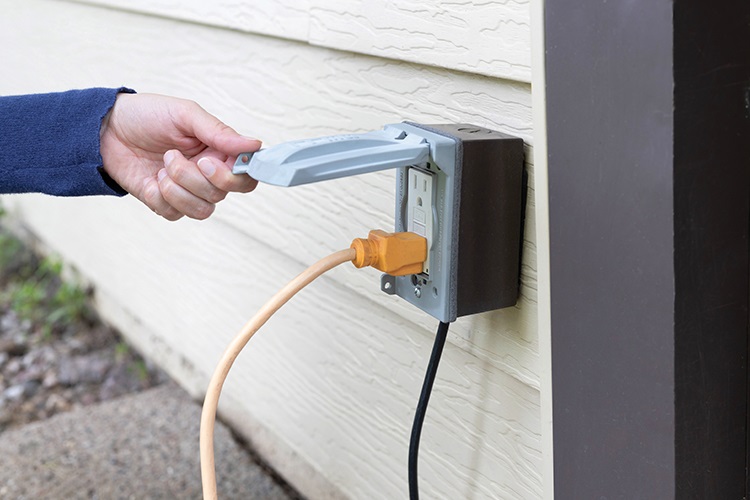
Also, 210.8(F) requires GFCI protection for outdoor outlets, even when it doesn’t end in a receptacle, but rather hardwired equipment such as air conditioning equipment. However, this doesn’t include lighting outlets, and an exception for listed HVAC exempts this equipment from the GFCI requirement until Sept. 1, 2026.
Nondwelling units
Now let’s take a look at nondwelling unit locations that require GFCI protection. For the most part, the locations in nondwelling unit locations are mostly the same as in dwelling units and are required for the same reasons we discussed in dwelling units. However, there are a few areas listed in 210.8(B) that are different than dwellings.
Several locations simply don’t exist in dwellings, including locker rooms with showering facilities, buffet serving areas with permanent provisions for food or beverage serving or cooking, and within 6 feet of aquariums, bait wells or similar open aquatic vessels like tanks or bowls. There are also a couple locations similar to dwellings, with small differences such as basements and sinks.
In a dwelling unit, the entire basement requires GFCI protection, but in nondwelling locations, GFCI requirements apply to just the unfinished portions of the basement. Also, when it comes to sinks outside of the kitchen or other areas with provisions for cooking, preparation or serving food and beverages, GFCI applies to receptacles within 6 feet of this sink and cord-and-plug-connected fixed or stationary appliances within 6 feet of the sink.
Additionally, nondwelling installations differ slightly on which receptacles are covered by 210.8(B). In dwellings, the requirements essentially cover all receptacles rated 125V through 250V, but, in nondwellings, according to the charging statement, GFCI requirements apply to single-phase and three-phase receptacles operating at 150V or less to ground.
There is also a cap on the current rating of the receptacles covered. For single-phase circuits, GFCI protection is required for receptacles up to 50A; for three-phase circuits, it is required for up to 100A. There are also more exceptions under 210.8(B), since the concept of nondwelling occupancies is a much broader space and there are more situations that either don’t warrant GFCI protection or where GFCI protection could cause a greater hazard by interrupting power unexpectedly, such as in a hospital operating room.
In addition, several specific appliances require GFCI protection. The list is in 210.8(D) and is repeated in Article 422 for appliances. Then there are several other specific areas later in the NEC with their own rules for GFCI protection; many of these can be found in Chapter 6 for Special Equipment, such as for pools, hot tubs or spas, and fountains. We will cover these in future issues when we review specific requirements for such installations.
Next month’s article will discuss specifics for branch circuit AFCI protection and Section 210.12.
Until next time, stay safe and remember to always test before you touch!
stock.adobe.com / NC Photo
About The Author

Vigstol is an electrical safety consultant for E-Hazard, a provider of electrical safety consulting and training services. He is also the co-host of E-Hazard’s electrical safety podcast “Plugged Into Safety.” For more information, check out www.e-hazard.com.