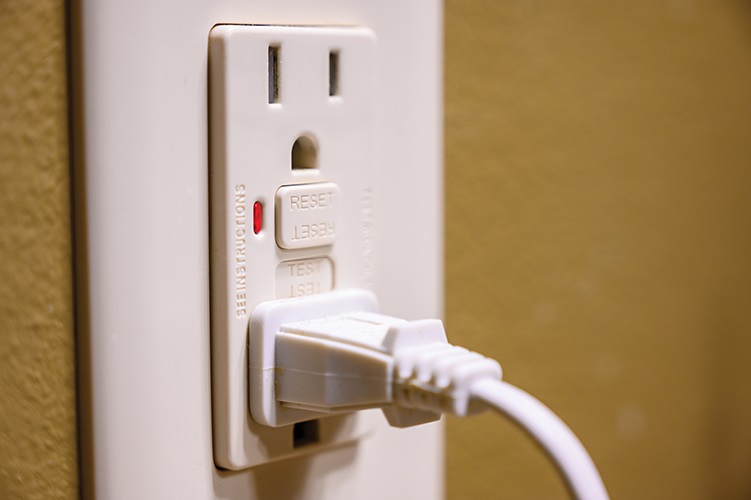
Welcome back to the ongoing discussion on branch circuit and feeder requirements from NFPA 70, National Electrical Code (NEC). Last month’s article discussed properly sizing branch circuit conductors based on the load they supply and ensuring they are properly protected from overcurrent in accordance with their ampacity. Now we are shifting gears to talk about possibly some of the most discussed NEC topics: arc-fault circuit interrupters (AFCIs) and ground-fault circuit interrupters (GFCIs).
Many myths float around AFCIs and GFCIs. I figured before we get into the nitty-gritty of NEC requirements for these devices, it might be good to debunk some of the myths, which mainly show common misconceptions about what GFCIs are and how they operate.
Myth No. 1
GFCI receptacles need to be connected to an equipment grounding conductor (EGC) to operate.
This idea is a pure misunderstanding of what a GFCI receptacle does to detect ground faults. Many think the GFCI monitors current on the EGC or that if there is no EGC, the person on the other end of the circuit isn’t getting shocked because there is no return path. But neither of these ideas could be further from the truth.
A GFCI does nothing with an EGC. All the circuitry within the GFCI receptacle involves the ungrounded and the ground (neutral) conductor. When a complete circuit is made and current flows from the receptacle to utilization equipment, the same amount of current should be coming back on the neutral.
However, if there is an alternate pathway for current to flow back to the source, such as through a metal water pipe, the GFCI will detect a difference between what goes out and what comes back in. When that difference in current exceeds 4–6 mA, the GFCI initiates the tripping sequence to interrupt the circuit and prevent further current from flowing outside the normal circuit pathway. An EGC could be an alternate pathway for current to take that trips the GFCI, but it is not required for the GFCI to function.
Myth No. 2
GFCI protection prevents personnel from being shocked.
On the contrary, for GFCI protection to interrupt the circuit, there must already be current flowing on a different pathway than the intended circuit one. If that different pathway is a person, current will need to flow through them for the GFCI device to do its thing. The amount of current that flows will be based on the voltage and the resistance in that alternate pathway.
If we use the resistance value that OSHA uses to determine the shock threshold of 50V, initially the current that will flow through the person is roughly 240 mA if the circuit voltage is 120V. This is well above the 4–6 mA tripping range for a Class A GFCI device. However, this will initiate the tripping action and the GFCI will open the circuit and not allow 240 mA to flow for very long. As the Consumer Protection Safety Commission bulletin states, “The GFCI device will prevent a fatal electrical shock.”
Another fact to dispel this myth is that GFCI devices will not detect a shock that is not “to ground,” such as when an individual is holding two hot conductors or makes contact between a hot and neutral. However, most shocks occur between an ungrounded conductor and a grounded surface, such as the frame of the equipment connected to the circuit.
Myth No. 3
GFCIs nuisance trip for no reason and should not be used on equipment such as refrigerators or freezers.
This one has been around for a while now. While I won’t pretend to say there has never been a bad GFCI that has opened a circuit for no reason, the technology has been put through its paces. Properly maintained and functioning GFCI devices don’t trip without a reason.
That being said, we might feel as though an unexpected GFCI trip on something like a refrigerator or freezer is a nuisance that might lead to spoiled food. However, the GFCI tripped because it was doing what it is designed to do, and the problem likely lies with the equipment plugged into the receptacle. Older refrigeration equipment often develops ground leaks, especially with the defrost cycle, and if the current level exceeds the GFCI’s trip value, it will trip.
The NEC requires all receptacles in a dwelling unit kitchen or basement to have GFCI protection, regardless of whether the appliance being supplied has issues that trip the GFCI. Even if the manufacturer’s instructions say not to connect to a GFCI receptacle, the NEC requirements must still be met.
If there is an alternate pathway for current to flow back to the source, such as through a metal water pipe, the GFCI will detect a difference between what goes out and what comes back in.
Myth No. 4
GFCI receptacles are not compatible with combination-type AFCI circuit breakers.
I’m not sure where this myth comes from. However, there is no evidence that this is the case, and GFCIs and AFCIs often complement each other. While GFCI receptacles monitor for ground faults and help reduce the possibility of a serious or fatal electrical shock, combination-type AFCI circuit breakers are monitoring the circuit for series and parallel arcing faults. The two technologies have nothing to do with each other and are absolutely fine to be installed on the same branch circuit. They work so nicely together that there are even dual-function AFCI/GFCI circuit breakers.
Myth No. 5
GFCI receptacles are needed because of receptacle proximity to water.
While it does seem like GFCI receptacles are required in many places where there seems to be water and electricity in close proximity (kitchens, bathrooms, outdoors), it is more about there being a return path for ground-fault current.
Article 210 requires GFCI protection for personnel, and there are several places where it is required to provide a return path for ground-fault current. Kitchens and bathrooms often have metal water piping that provides a return path, while basements and garages have concrete floors in contact with the earth.
If the goal of the GFCI is to prevent serious electrical shocks from affecting personnel, then it stands to reason that they would need to be installed where the conditions are favorable to get shocked due to electrical equipment and potentially alternate pathways for current to return to the source.
GFCI protection for personnel is one of the cornerstones of how the NEC enables safe electrical installations. By minimizing the chances of fatal electrical shocks, GFCIs help the NEC accomplish its purpose of providing practical protection of personnel from the hazards that arise from the use of electricity.
Next month’s article will start to head down the rabbit hole of dispelling myths about AFCIs.
Until next time, stay safe and remember to always test before you touch!
Lost_in_the_Midwest/stock.adobe.com
About The Author

Vigstol is an electrical safety consultant for E-Hazard, a provider of electrical safety consulting and training services. He is also the co-host of E-Hazard’s electrical safety podcast “Plugged Into Safety.” For more information, check out www.e-hazard.com.