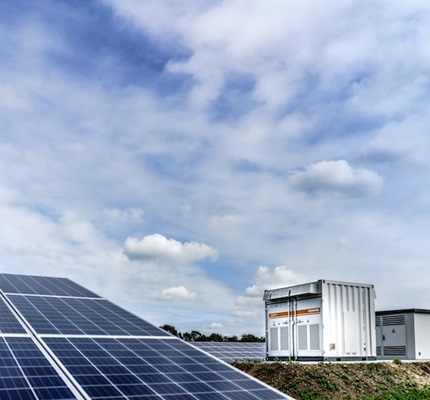
While the Trump administration is making headlines for postponing coal plant retirements and removing guardrails on greenhouse gases, its policies have created at least a short-term boom in solar energy construction.
Although residential solar installations have taken a hit, utility-scale work has been a bear market since legislation was passed shortening the eligibility period for valuable tax credits. The current boom could be short-lived, but it’s buying developers and manufacturers breathing room to establish a sustainable domestic supply chain.
Longer-term, favorable economics bode well for continued utility-size expansion, given uncertainties over fuel costs with solar’s biggest competitor, natural gas, especially considering these turbine generators are designed to remain in service for decades.
Short-term run-up
The One Big Beautiful Bill Act (OBBBA), signed last July, significantly reduced incentives for residential and utility-scale solar put in place just a few years earlier through the Inflation Reduction Act. Under the new legislation, homeowners only had until Dec. 31, 2025, to complete projects that would qualify for tax credits. Now, however, utility-scale developers must meet one of two deadlines: begin construction by July 5, 2026, or go into service by Dec. 31, 2027.
The result has been a rapid drop-off in homeowners open to solar now that the 30% tax credit has been removed. Market research firm Ohm Analytics anticipates a 25% drop in installations this year versus 2025 figures.
However, the longer runway for large projects has led to an acceleration in utility-scale orders. Developers installed 11.7 gigawatts (GW) of new capacity in 2025’s third quarter, making it the industry’s third largest on record. Solar and storage accounted for 85% of all new capacity added to the grid between January and September, according to Wood Mackenzie. In the Q4 2025 U.S. Solar Market Insight report, Wood Mackenzie and the Solar Energy Industries Association noted that about 50 GW of proposed capacity were well-positioned to start construction by the end of 2025, with another 40 GW ready to go by the end of June 2026.
Post-incentive market
While project volumes might drop some once solar incentive deadlines have passed, utility-scale demand isn’t expected to fall as dramatically as the residential market. In its January Short Term Energy Outlook, the U.S. Energy Information Agency (EIA) predicted utility-scale solar will remain the fastest-growing U.S. generation source at least through 2027, with operating capacity jumping 49% compared to the end of 2025.
Why the bullish EIA predictions despite dropping incentives? The math is different for utility-scale buyers versus homeowners seeking to save a few bucks off their monthly utility bills. Upfront costs are a more significant consideration for residential customers, who might otherwise need more than a decade to realize a profit.
Utilities and developers take a longer view, treating solar arrays as multidecade assets with a guaranteed fuel price of zero. Natural gas generators, on the other hand, face decades of price uncertainty. Lazard, the global investment bank and financial advisory firm, puts unsubsidized utility-scale solar at $38–$78 per megawatt-hour versus $48–$109 for new gas combined-cycle plants. A gas turbine installed today could still be running in 2055, with fuel prices no one can predict, while energy from the sun will still be free.
Speed to market is also in solar’s favor, especially with today’s rapid uptick in demand. Utilities and developers now are competing with new data centers for a limited supply of new turbine generators, with backlogs stretching three to five years. Developers also often face the need to build new pipelines to serve these installations. Utility-scale solar arrays, though, can often be up and running within 18 months. Transmission interconnections can pose their own hurdles, but that challenge applies to any new generation source.
The growing sustainability of a domestic supply chain also is contributing to the industry’s positive outlook. Going back to the Obama administration, there have been efforts to curtail alleged illegal trade practices of Chinese manufacturers that have long dominated international sales. The OBBBA strengthened these efforts by denying tax credits to projects using too many Chinese products. Several recent corporate moves, with Chinese-owned U.S. plants sold to domestic buyers, have created greater access to tax-favored suppliers, giving developers more options while incentives are still available.
So it could be that, after several decades of on-again, off-again government support, the U.S. solar industry—at least at the utility scale—is ready to stand on its own two feet. It’s perhaps ironic that this turn comes during a presidential administration focused on pushing fossil fuel generation. Those efforts might have short-term effects, with a limited number of coal plants remaining open past their planned retirement dates. But when Lazard’s analysts put unsubsidized solar costs below new gas plants, even before accounting for decades of fuel price uncertainty, simple economics appear to favor solar’s fortunes over the longer term.
stock.adobe.com/Dariia
About The Author

ROSS has covered building and energy technologies and electric-utility business issues for more than 25 years. Contact him at [email protected].