Five years ago, Vicki Chapman, founder and president of Chapman Construction Group Inc. (CCGI), Sandwich, Mass., invested heavily in training that would enable 40 CCGI employees to perform offshore wind work. Despite having to weather stiff headwinds in a high-stakes environment, she has no regrets.
“I love the excitement of wind work,” Chapman said. “I like the reactivity of it, things not being the same every day, dealing with the weather and other considerations you never have to deal with onshore. The guys and women that do this work love it, and I feel their passion.”
When Chapman entered Boston’s JATC apprenticeship program in 1987, she was one of just five women in her class and among even fewer with enough grit to stay in the field. A master electrician licensed in Massachusetts, she founded CCGI in 2002.
The company specializes in electrical infrastructure work, including for the Massachusetts Bay Transit Authority, Massachusetts Port Authority, Massachusetts Department of Transportation and local wastewater facilities.
In a news release, NECA’s Greater Boston chapter commended CCGI’s first wind gig—Vineyard Wind 1, a $2.3 billion project approved by the Massachusetts Department of Commerce in 2019.
In all, 62 offshore turbines were erected to generate 804 megawatts (MW), enough electricity to power 400,000 homes, and with leases granted to three East Coast utilities.
CCGI’s offshore wind crews include journeymen electricians, iron workers, carpenters, painters and other laborers. Their training includes Global Wind Operation (GWO), tier III Society of Professional Rope Access Technicians (SPRAT) and helicopter underwater escape training (HUETT).
Beginning in 2021, those CCGI employees started workdays extra early, riding crew transfer vessels from New Bedford to elevated platforms 15 miles off the coast of Martha’s Vineyard. Just getting safely from the vessel to the platform required special instruction.
“Safety records and procedures are like OSHA on steroids,” Chapman said. “They require more precautions and intense documentation. These guys absolutely did gain the skills to do this for the long game.”
The state of Massachusetts local unions provided $2,500 grants per member involved in the wind work for GWO and HUETT training. CCGI paid for employee medical physicals, retraining and recertifications.
“I sacrificed a lot to get into this industry,” Chapman said. “There’s a ton of risk and the insurance is not cheap either.”
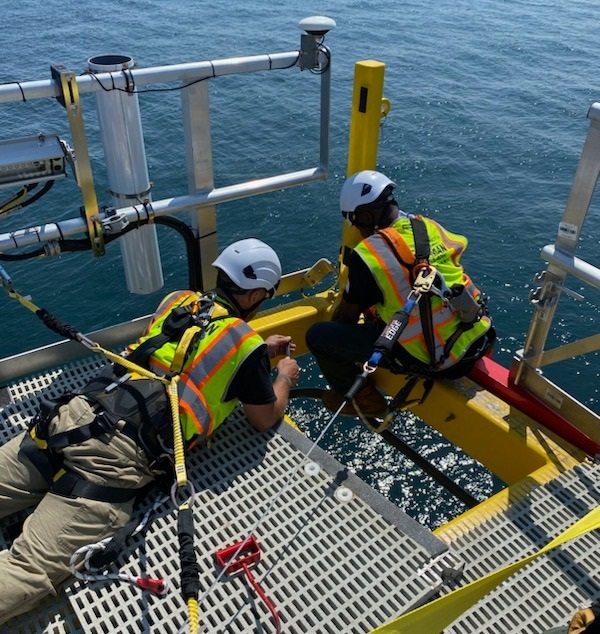
Besides performing electrical work on the transition pieces that form the lower portion of the turbine structures, which allow access for maintenance, CCGI electricians worked on anodes, installed cable tray covers and performed small electrical work.
They also performed bolt retensioning, repaired railings and floor gates, painted surfaces and cleaned away seabird guano.
Unique to offshore wind work is a high level of cooperation and crossover among the different trades—“the result of the trades and their unions coming together and making the multiskilled concept work in practice,” Chapman said.
Adding tension to their high-wire act, last December, President Trump ordered a pause on offshore wind leases, which stopped work on the East Coast. But by then, Vineyard Wind I was 95% complete. In January, a judge overturned the order, and the project concluded March 13.
CCGI crews would not immediately go on to perform maintenance work, though the project’s massive size and duration had required them to clean and maintain the first turbines installed.
“The hook with that initial [training] investment was that the training would prepare us to do maintenance for the next 20 years,” Chapman said. “That was the whole idea—job security for local residents.”
Chapman remains determined to secure additional offshore wind work for CCGI’s multiskilled crews.
Header image: CCGI crew members work on a transition piece platform at the base of a Vineyard Wind 1 offshore wind turbine. Photo provided by CCGI.About The Author

DeGrane is a Chicago-based freelance writer. She has covered electrical contracting, renewable energy, senior living and other industries with articles published in the Chicago Tribune, New York Times and trade publications. Reach her at [email protected].