New tracking data from the U.S. Energy Information Administration indicates that utility-scale battery storage grew at an average annual rate of 70% over the past three years, reaching 43.6 gigawatts (GW) of operating capacity by the end of 2025 and increasing to almost 52 GW by June 2026. Going back to 2024, U.S. battery capacity increased 66%. Operators report plans to bring another 54 GW online through 2028, which would push the national total past 105 GW.
But while nationwide battery capacity has practically quadrupled since 2023, batteries can only discharge for 15 or 30 minutes. This can assist with spikes in demand, but cannot cover several hours in the early evening when solar generation drops near zero but demand is heavy.
Today, several plants in California, Texas, Florida and Nevada can bank hundreds of megawatts of stored power and discharge continuously for four hours or more. This allows grid operators to dispatch stored solar power after sunset instead of firing up a natural gas peaker plant (small natural gas units built to run only a few hours a day during periods of the highest demand and highest wholesale prices) to cover the shortfall.
A battery farm can now be more than just a backup; it can become a stand-in for a natural gas plant during the hours the grid needs help the most. It can also operate at less cost than a peaker plant because it doesn’t burn fuel at the moment of discharge, doesn’t require standby maintenance crews like its counterpart and can purchase cheaper midday power.
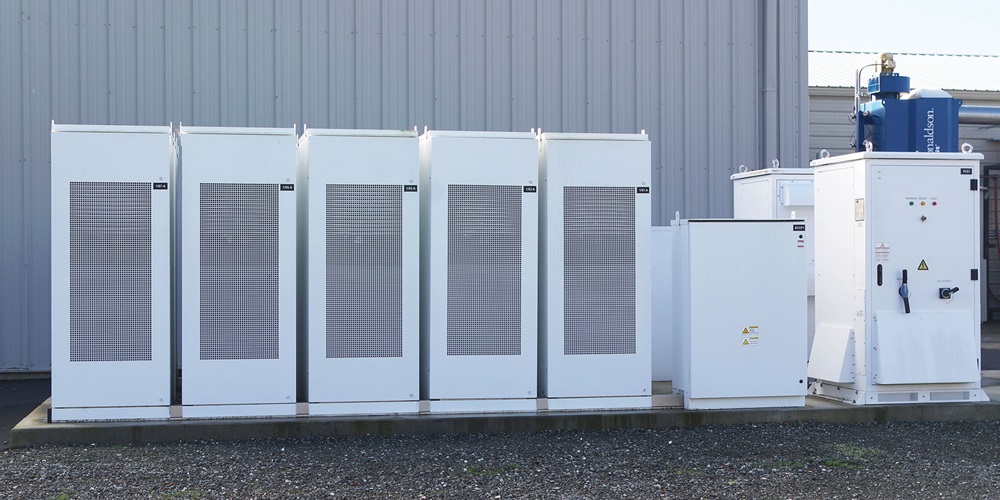
The scale of battery plants has increased in recent years, from a shipping container or two bolted onto a substation to hundreds of megawatts of batteries directly connected to a solar or wind farm, letting the plant capture midday sunshine and hold it for release during the early-evening hours when solar output falls off.
One of these larger-scale plants, Bellefield Solar and Energy Storage Farm in California, began operating in December 2025. It combines 500 megawatts (MW) of solar generation with 500 MW of battery storage, according to the U.S. Energy Information Administration. Plans call for the facility to double its solar and storage capacity by the end of 2026, which would make it the largest power-storage plant in the country.
Other large-scale operations include Florida’s Manatee Solar Energy Center, with 409 MW of battery capacity attached to a 75-MW solar array, and Nevada’s Gemini Solar Hybrid project, which pairs 690 MW of solar panels with 380 MW of storage.
Because battery farms at this scale require such large volumes of lithium, nickel and other minerals, further expansion may be hindered by mineral supply constraints, fire safety concerns and permitting hurdles when multi-hundred-megawatt battery sites move into areas close to homes and businesses. Nevertheless, several projects are expected to come online within the next few years.
About The Author

Lori Lovely is an award-winning writer and editor in central Indiana. She writes on technical topics, heavy equipment, automotive, motorsports, energy, water and wastewater, animals, real estate, home improvement, gardening and more. Reach her at: [email protected]