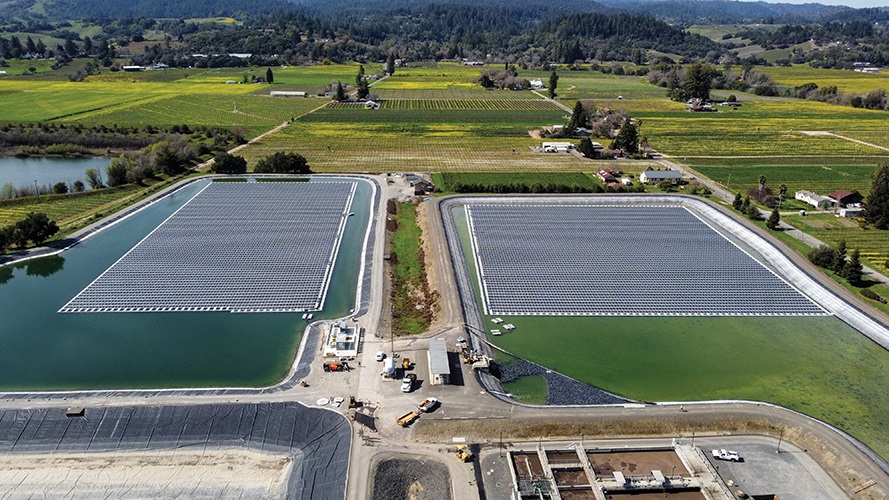
Floating solar farms—also known as floatovoltaics—offer some environmental benefits in comparison with land-based solar farms, although some concerns remain. Not only do floating solar farms leave land available for agricultural or other uses, but they also are able to take advantage of otherwise unusable space, such as reservoirs, commercial retention ponds, stormwater retention sites, irrigation canals and flood zones.
Recent improvements in solar conversion efficiency can enable floating solar developers to produce as many—or more—kilowatts from fewer solar panels. In 2018, a study by the U.S. Department of Energy revealed that installing solar panels on a selected pool of 24,000 human-made water bodies met about 10% of U.S. electricity demand. On land, that would require more than 5 million acres.
Floatovoltaics also minimize the risk of migratory birds mistaking land-based farms for bodies of water. They can benefit aquatic life in other ways, as well. The Netherlands’ Bomhofsplas solar park installed cages below the panels that serve as homes for aquatic wildlife, increasing the livable aquatic habitat in the area.
Solar panels have a beneficial cooling effect on aquatic life, helping to prevent algae blooms while reducing evaporation. However, water conditions can vary greatly. It’s still possible that a solar park covering a higher percentage of a lake’s surface or one that is installed on a deeper lake could negatively affect water quality and cause harmful algal blooms.
There are other water quality concerns, such as bird droppings washing off the panels and altering the water’s nutrient levels. A 2021 study published in Sustainability showed that this was not a major concern at Bomhofsplas. In fact, studies show no significant changes in temperature, dissolved oxygen or water quality under the panels, and shellfish and birds thrive beneath the structures, enhancing local biodiversity.
Nevertheless, the long-term effects of floating solar farms need to be studied. For example, a 2024 article in Environmental Science & Technology raised concerns about microplastics and metals leaching into the water from floating solar farms.
Despite unanswered questions about long-term effects, floating solar farms are being installed with increasing frequency. AccuDock provided the floaters for the nation’s first floatovoltaic project in 2009, located on an irrigation pond at a Napa Valley winery in California.
Since then, floating solar farms installed have included a 50-kW demonstration project in Tallahassee that acts as a real-world validation center and two 7-kW systems at the San Acacia Canal in New Mexico. Projects like these demonstrate the adaptability of nontraditional sites where standard infrastructure is not feasible in constrained waterways by installing custom wheels that allow the units to float or rest securely on the canal bed as water levels fluctuate.
About The Author

Lori Lovely is an award-winning writer and editor in central Indiana. She writes on technical topics, heavy equipment, automotive, motorsports, energy, water and wastewater, animals, real estate, home improvement, gardening and more. Reach her at: [email protected]