A few years back, I was in one of the large home improvement stores looking for a metal old-work box to extend a receptacle circuit in my bathroom. I was concentrating on finding the box I needed and happened to overhear a conversation between an older man and his daughter.
He was looking at a particular metal box and explaining to his daughter how he was going to cut the side of the box and extend a connection to a device so she could remotely control her master bedroom ceiling paddle fan. The metal box he was contemplating was not designed to support a ceiling paddle fan, and his planned modification would potentially yield an unsafe wiring method.
I felt I had to step in
I could not help my reaction and decided to give my opinion on his potential modification and use of the box. I told them that ceiling paddle fans are considered to be a rotating load, designed to spin at low to high speeds, and they might wobble slightly when spinning. They require a box listed for ceiling paddle fan support based on NEC 314.27(B).
I also explained that mounting a ceiling paddle fan to a modified box not listed for such could result in the paddle fan coming loose and “helicoptering” around the room, with the possibility of injuring someone and causing damage to the room.
He very politely told me to mind my own business, that he was 86 years old and had modified all of his home ceiling fans in exactly the same way he was planning for his daughter’s home without a single mishap!
There are obviously products that are designed, tested and listed to provide electrical safety, but not everyone can be trusted to comply with these safety requirements, even when warned of these hazards. I urged them to use a qualified electrical contractor and to take out a permit for their ceiling fan project, but, at the end of the day, I don’t know if they took take my advice. I have a feeling they did not.
As per the NEC
NEC 314.27(B), as previously mentioned, states the following: “Outlet boxes or outlet box systems used as the sole support of a ceiling-suspended (paddle) fan shall be listed and marked by the manufacturer of the box on the interior of the box as suitable for this purpose.”
This marking on the box’s interior will permit anyone installing a ceiling paddle fan to see the marking prior to installing it to ensure the box is listed for that application.
The box must be marked with the maximum weight to be supported, if more than 35 pounds, and it cannot support a paddle fan more than 70 pounds.
In addition, any box installed in the ceilings of living and sleeping areas within dwelling units must be listed for ceiling paddle fan installation, even if one is not installed. This ensures that a ceiling paddle fan could be installed later.
The ceiling paddle fan locations indicated by the installer, designer or building owner must be listed for the sole support of ceiling-suspended paddle fans and must be installed to allow direct access through the box to structural framing capable of supporting a ceiling-suspended paddle fan without removing the box.
Think of the ceiling
There are ceiling fan boxes designed for existing locations where the ceiling drywall is already installed. These boxes incorporate an adjustable fan brace with the box located in the middle of the brace.
The box is adjustable side to side, depending on the location of the hole and the ceiling support joists. A hole is cut into the ceiling drywall, the brace is inserted into the hole and the brace is then expanded laterally in the hole until the brace locks into the adjacent ceiling joists. This brace results in connection of the ceiling box to the structure of the home.
If a ceiling joist is located where the ceiling fan is to be placed, a ceiling saddle box listed for ceiling paddle fan use can be installed. A saddle box fits over the ceiling joist with the box bolted into the joist. Saddle boxes are designed for ceiling paddle fans up to 70 pounds (a rotating load) or a static load, such as a regular luminaire, up to 210 pounds.
These ceiling paddle fans require extra care while performing the initial installations. When modifications are made, safety is not guaranteed.
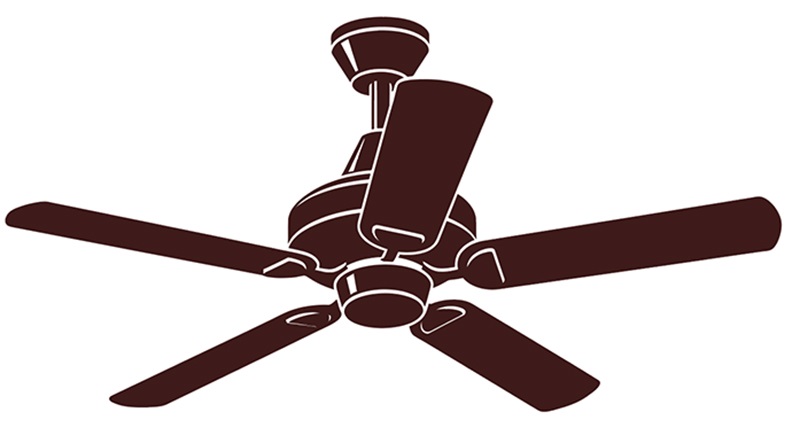
stock.adobe.com/ArtBySalea07
About The Author

ODE is a retired lead engineering instructor at Underwriters Laboratories and is owner of Southwest Electrical Training and Consulting. Contact him at 919.949.2576 and [email protected].