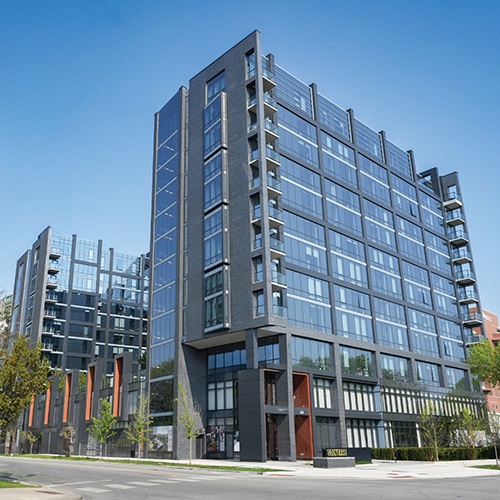
With 303 studio, one-bedroom and two-bedroom rental apartments; two floors of parking garage space; a third-floor pool deck; and great views of Lake Michigan, the new 12-story residential high-rise located at 4600 Marine Drive in Chicago has become a popular hub that’s helped transform the city’s historic and diverse Uptown entertainment district. Completed in 2024, the $90 million sustainable structure features green roofs, electric vehicle charging stations, 80% construction waste diversion and much more.
Design-build expertise
According to Tim Moylan, Gurtz Electric Co.’s director of design development, the company has developed strong relationships with many general contractors over the years and was brought into the 4600 Marine Drive project by Providence, R.I.,-based Gilbane Building Co., the general contractor.
“We’d recently worked on a hospital job in Indianapolis with the Gilbane team and, based on that project’s success, they encouraged us to bid on 4600 Marine Drive,” Moylan said. “While we serve as the electrical contractor on most of our projects, we also served as the Engineer of Record [in partnership with Chicago-based technology engineering design firm Engineering Plus] on this design-build high-rise and were involved in designing the full electrical system.”
As part of that responsibility, Gurtz worked with the building’s owners, architects and engineers, as well as colleagues at Gilbane, to produce the full electrical permit and contract document set and complete the design to construction-detail level and installation readiness.
“As concrete was poured, we installed conduit in the slabs and then moved up the building to install the full electrical scope, including low-voltage communication systems, electrical power, fire alarm and security systems, lighting fixtures and controls, EV chargers and more,” Moylan said of the project, which involved such products as receptacles and switches, Wattstopper lighting controls and Blink EV charging stations from Leviton, Melville, N.Y.
About Gurtz Electric Co.
Founded in 1932 and based in Arlington Heights, Ill., with additional locations in Port Washington, Wis., and Franksville, Wis., Gurtz Electric Co. is a fourth-generation, family-owned firm that’s grown from a local Chicago-based entity to a large regional electrical contractor servicing all aspects of the business. The company works across all market sectors, from high-rise residential buildings to large hospitals, pharmaceutical facilities, airport terminals, data centers and more and serves customers in Ohio, Michigan, Iowa and Indiana. It currently has about 1,500 employees and continues to grow.
‘Preparing for all eventualities’
On-site work began in late 2022 and ultimately involved 20 team members at the height of the job. Gurtz Electric had to address a number of challenges as construction got underway. One of them involved a rare structural hurdle related to the building’s horizontal scale.
“The building’s 150- by 280-foot footprint—which is unusually wide for a 12-story building—required a unique electrical layout far beyond standard high-rise configurations,” Moylan said.
Instead of the typical single bus duct riser used in many other high-rises, this project required three separate electrical closets and risers to distribute apartment power effectively across the wide expanse. For Gurtz Electric’s part, precise underground conduit layout and main service planning were critical to meeting this demand.
“In addition, the building required two low-voltage closets per floor to overcome the extended run lengths,” Moylan said. “This is uncommon in traditional residential high-rise layouts, which typically only have one closet, but the long width of the footprint exceeded the distance limit for Cat 6 cable and required two closets. The original building design didn’t account for that, so we had to modify the design and build in the space required for the second closets by reducing the size of other areas.”
Gurtz Electric collaborated closely with the architectural team to strategically place the additional closets and integrate them into the building’s structural and aesthetic design without compromising rentable or functional space. Moylan said that several other job site challenges tested the field team’s resilience and ingenuity as well.
Among them, significant post-pandemic supply chain issues and long equipment lead times affected availability of the required permanent switchboards and meters. Gurtz Electric adapted by deploying a robust temporary power strategy that allowed full commissioning and testing of building systems without delay; once permanent equipment arrived, the transition was seamless and required no rework or downtime.
“Early on in the project, our utility provider was also delayed in energizing temporary power,” Moylan said. “We responded by powering the site with three large generators that we ran for nearly two years until permanent power systems became available in order to keep construction moving forward.”
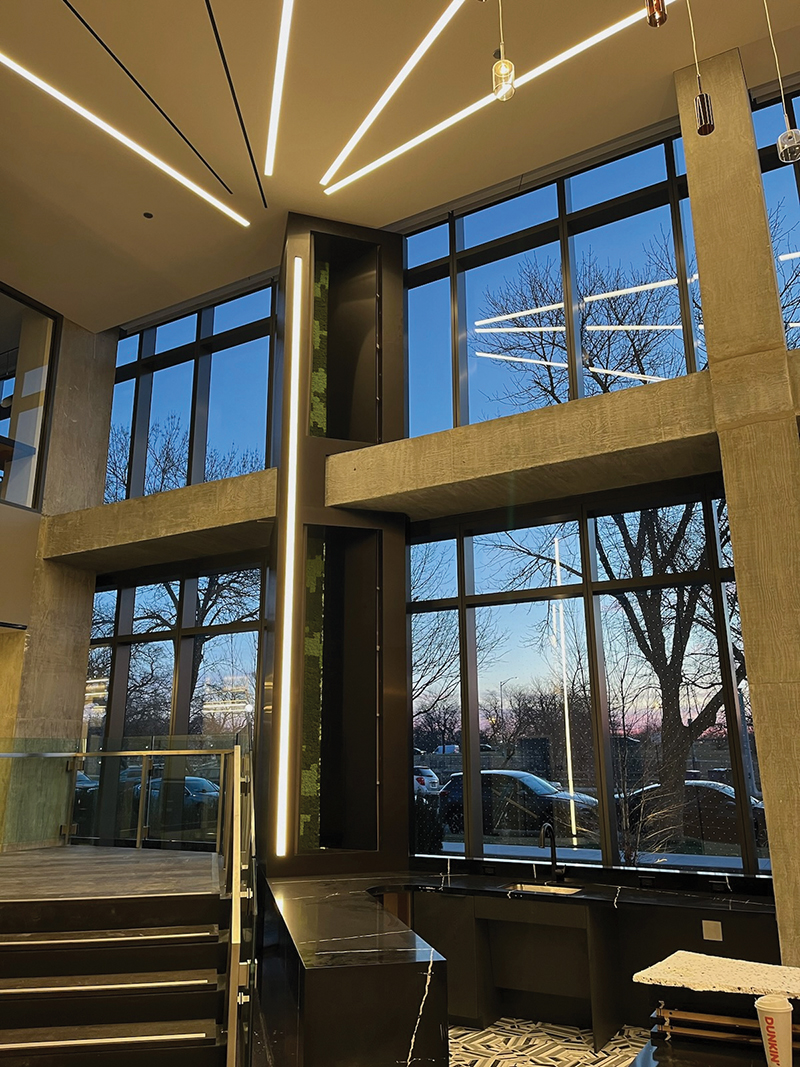
Gurtz Electric team members were additionally challenged to install the building lobby’s recessed linear lighting fixtures late in the project after ceilings and architectural openings had already been finalized, which demanded absolute precision with no room for error. But thanks to their extensive preplanning, field measurements and design coordination, they were able to execute the architect’s vision and bring to life a striking visual feature that stands as one of the hallmarks of the property.
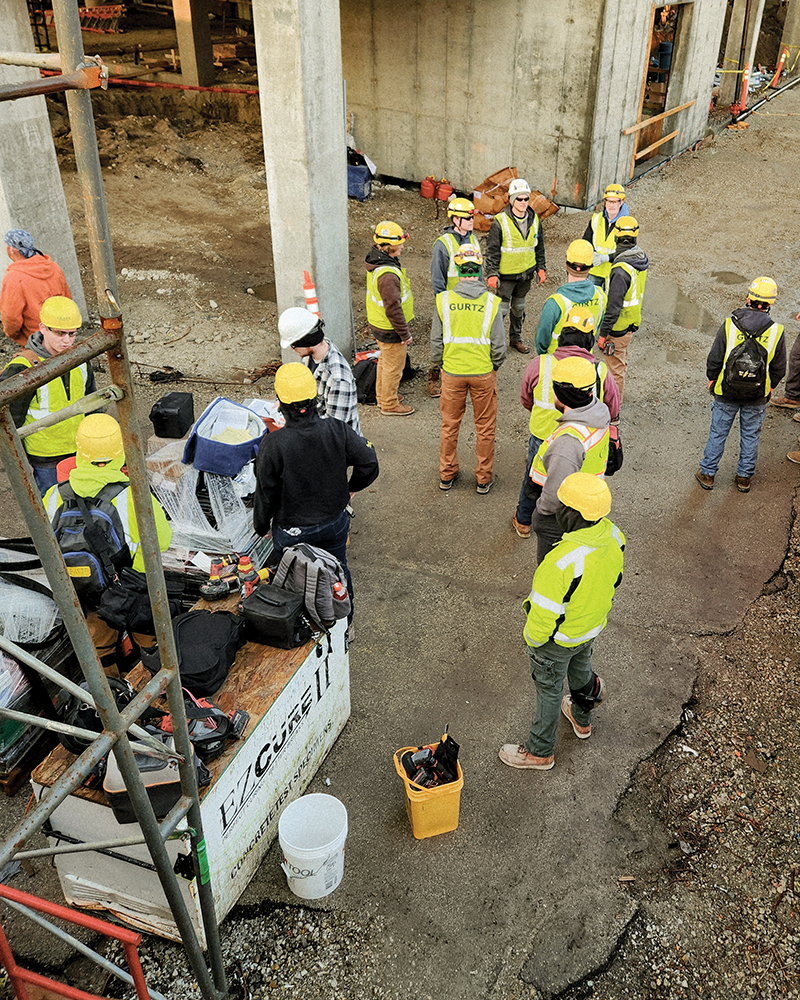 | 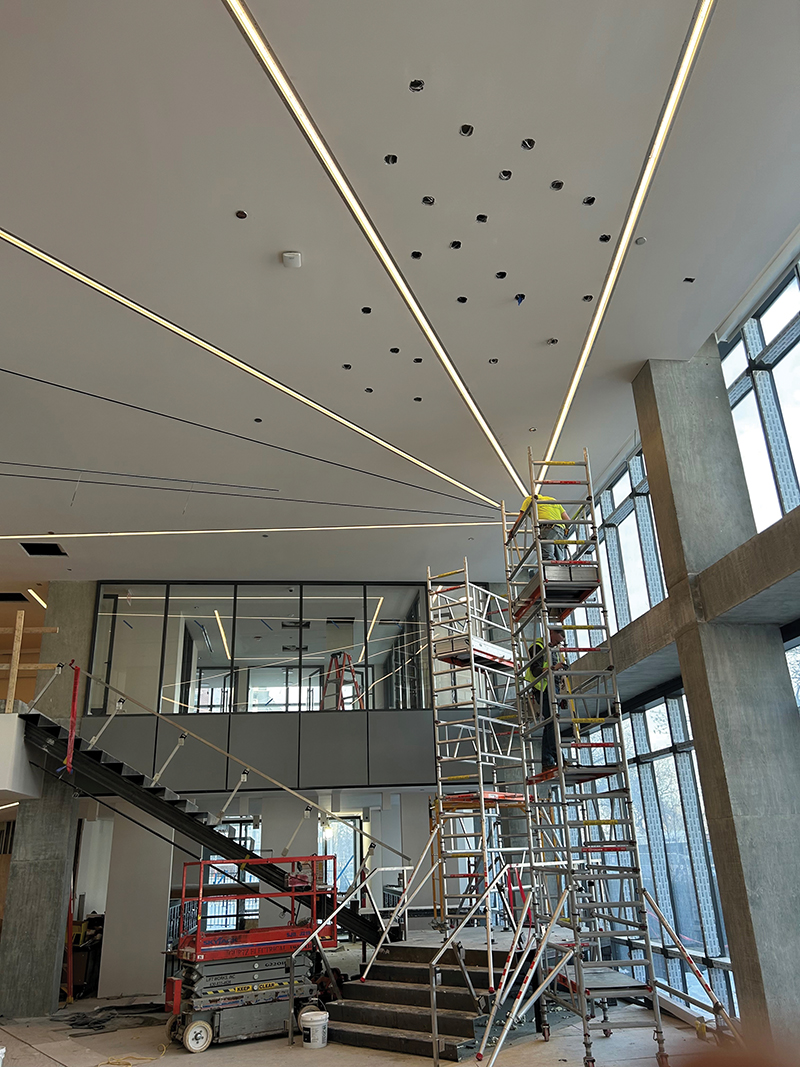 |  |
Left, Gurtz Electric employees participate in a morning meeting and safety discussion before the day’s work.
Middle, electricians install recessed lighting in the lobby.
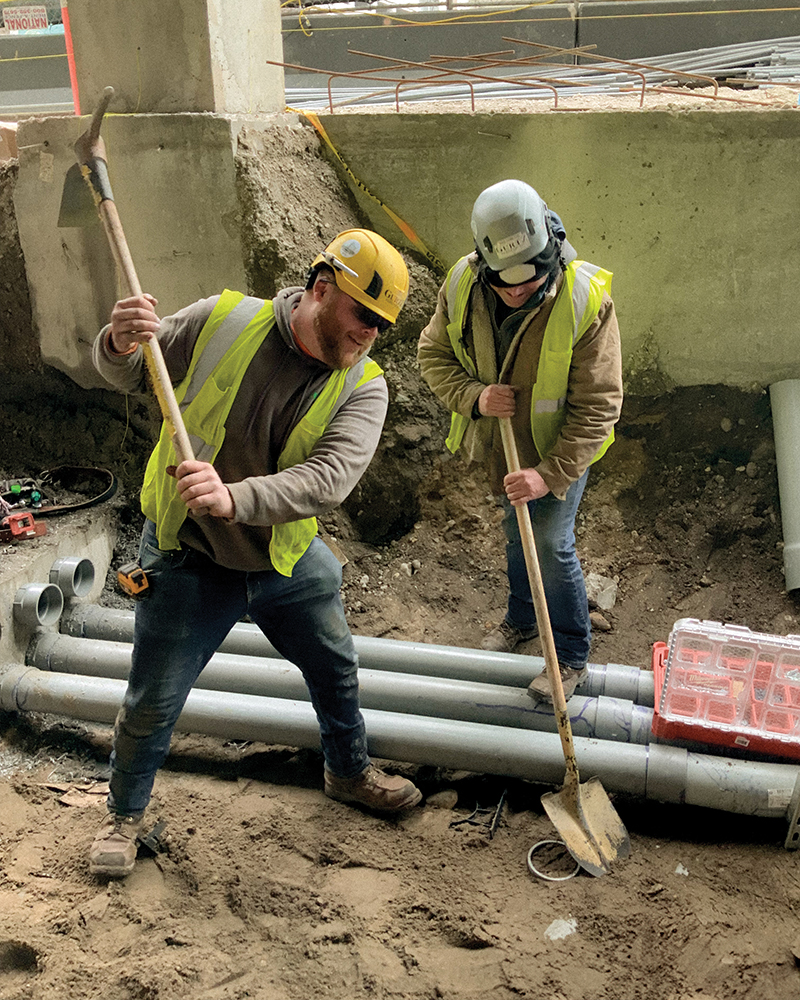
Right, Gurtz Electric team members lay underground conduit.
Productive practices
Moylan confirmed that Gurtz Electric’s proactive use of technology and prefabrication played a key role in the project’s success. The company deployed robotic layout stations from Trimble, Westminster, Colo., to execute and verify all cast-in-place electrical systems. These were then rescanned post-installation to ensure the tightest tolerances. The use of full BIM coordination ensured early clash detection, system compatibility and dramatic savings in on-site labor and rework.
All Gurtz Electric foremen accessed the fully coordinated 3D model on iPads and site laptops, enabling exact adherence to design throughout the build, and the post-layout scanning process piloted on this project proved so effective that Gurtz Electric has since adopted it as a standard quality control measure for all of its future concrete-embedded MEP installations.
Among Gurtz Electric’s prefabrication activities, lighting fixtures, panels, deck/wall boxes, transformers, temporary power equipment and large/small conduit were all assembled at the company’s dedicated 40,000-square-foot prefab space located at its Arlington, Ill., headquarters.
According to Moylan, shifting this labor to a safe, climate-controlled environment improved working conditions and allowed for more efficient installation sequencing on-site.
Bringing vision to reality
After completing the project on time and within budget in 2024, team members couldn’t be more delighted with the results.
“The building owners and GC were very happy with the overall project and our installation,” Moylan said. “We forged a strong relationship with them, worked collaboratively to figure things out together, and took pride in helping to shape this project from concept to completion.”
Among key takeaways from the project, “we learned a lot from the material delays we experienced,” Moylan said, who oversaw the Gurtz Electric designers and engineers assigned to the project and was heavily involved in on-site meetings and activities.
“It’s about being prepared for longer lead-time items, and we’ve adjusted to that as industry-wide equipment delays have continued to persist by getting involved in our projects sooner and ordering our gear earlier to ensure that it arrives as design and construction starts,” he said.
“Our experience at 4600 Marine Drive confirmed the importance of preparing for all eventualities regardless of market dynamics,” Moylan said.
Looking ahead, he is excited for Gurtz Electric’s continued growth and ongoing participation in some of the region’s most prominent projects.
“The type of work we did at 4600 Marine Drive is what we address on a regular basis; we specialize in handling the unique aspects and complexities of each project and are dedicated to getting the job done,” Moylan said, who felt connected to this project as a former resident of Chicago’s Uptown area. “There hadn’t been a lot of large residential housing along the lake in that neighborhood, so this property represents a nice addition to a young, vibrant and growing area of Chicago.”
The project won the 2025 NECA Project Excellence Award, Residential/Mixed Use.
“This was a very complex and long-duration project, so to see all of that effort recognized by such a respected industry organization was nice for our teams to experience,” Moylan said. “After working through a difficult project like this for two years, the opportunity to see a completed building that people can now live in and enjoy ... [is] extremely rewarding.”
gurtz electric Co.
About The Author

BLOOM is a 25-year veteran of the lighting and electrical products industry. Reach her at [email protected].
