As electrical contractors move into larger data centers, advanced manufacturing facilities, battery plants and major infrastructure projects, energized work has become a more common part of project execution. Improvements in PPE, training programs and safety protocols have strengthened worker protection across the industry, yet certain activities still carry substantial risk. Large circuit energization remains one of them.
Bringing electrical systems online is a major milestone on any project. It is also one of the moments when the consequences of a failure are highest. According to the latest U.S. Bureau of Labor Statistics (Electrician snapshot), electricians experienced 7,270 nonfatal injuries serious enough to require days away from work in 2020. The injury incidence rate reached 128.2 cases per 10,000 workers. During the same year, 70 electricians lost their lives in occupational incidents. With exposure to hazardous environments, falls and contact with energized equipment remain among the leading causes of severe injuries. The challenge becomes more pronounced as the industry expands. More than 650,000 electricians were employed nationwide in 2020, and demand has continued climbing alongside investment in electrical infrastructure. More projects, energized systems and commissioning activity create more opportunities for exposure. Whether crews are commissioning switchgear, testing power distribution systems or energizing equipment for the first time, every step demands careful planning and disciplined execution.
Focusing on the energization aspect of the report, these operations place workers in arc-rated PPE near energized equipment while they perform switching and energization procedures. Before work begins, methods of procedure (MOPs) are created, teams review the scope, confirm lockout and isolation requirements, establish arc flash boundaries, and ensure everyone involved understands their role. The process is deliberate because the stakes are high.
Those precautions reduce risk, but they do not eliminate exposure. Personnel still work close to equipment that has the potential to experience an arc flash, fault or mechanical failure. Incidents are uncommon, yet the outcome of a single event can be severe.
The advancement of robotics is starting to offer a different approach.
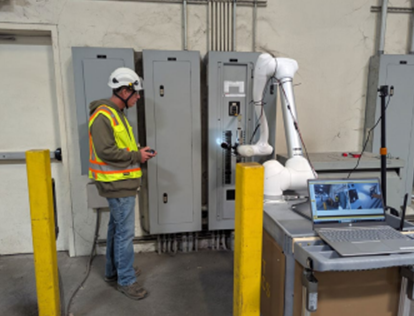
Companies such as Hardhat Robotics, Cupertino, Calif., have developed a remote system built specifically for strenuous and hazardous electrical-specific tasks. The platform performs switching and energization actions that would otherwise require a worker to stand directly in front of energized equipment. Operators remain in control of the process, but from a location with far less exposure to the hazard. These robotic solutions are being implemented right now and are starting to show up on data center job sites.
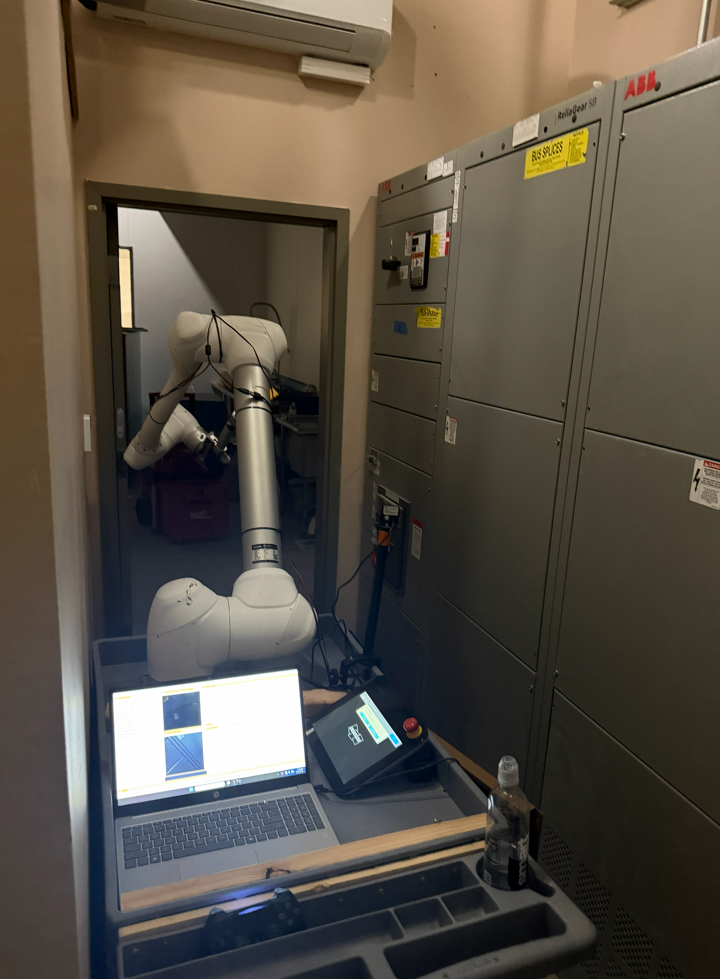
HardHat Robotics' "Sparky" is used to flip a breaker remotely in a confined space.
At its core, the technology serves as an extension of the electrician. The robot carries out the most dangerous process remotely, while the operator directs the work and monitors the outcome.
The role of the electrician does not disappear. Electricians still verify conditions, make decisions and oversee each step of the operation. The difference is proximity. Instead of standing within the immediate hazard zone, personnel supervise the work from a safer distance while maintaining full control of the task.
That distinction matters. The value of robotics is not automation by itself. The value is reducing unnecessary exposure to risk. With the advancement of robotic technology, it is a natural progression. Rather than depending exclusively on protective equipment to shield workers from hazards, they increase the physical separation between people and energized equipment. The advantages reach beyond safety. During critical operations, reducing direct exposure helps limit fatigue, supports more consistent execution and allows experienced electricians to focus on oversight, troubleshooting and decision making instead of high-risk manual actions.
The technology is still developing, but the trajectory is easy to see. As robotic platforms become more capable, their use will likely expand into commissioning, switching, inspection, testing and other electrical operations where risk reduction is a priority. The electrical industry has always adopted tools that improve safety and productivity. Robotics appears to be the next step in that progression, giving contractors a practical way to manage critical energized work while keeping personnel farther from potential hazards.
About The Author

CHRISTMAN specializes in innovation and construction technology from an electrical contractors point of view. He is passionate about elevating the industry. He can be reached at [email protected].