Data centers are about to overtake office buildings when it comes to U.S. construction spending, and that could have some big implications for electrical contractors focused on the commercial sector. For example, firms specializing in lighting could have some new skill sets to learn because, while these new facilities might use similar fixture types, their lighting goals can be unique. Additionally, new low-voltage approaches using digital power technologies could challenge those who have built businesses dependent on old-school copper and conduit.
Shifting markets
In June, the U.S. Census Bureau released figures showing construction spending on data centers had reached $40.1 billion annually, versus $44.17 billion on office buildings. More important, trend lines for both industries indicate data center spending could take the lead by the end of 2025.
This rapid turnaround is playing out across the country. In downtown business districts and suburban office parks, planners and building owners are scrambling to figure out new uses for buildings that have yet to return to prepandemic occupancy levels. As a result, lighting manufacturers are pivoting to address growing data center needs. Electrical contractors focused on commercial clients could benefit from making a similar move.
Of course, not all data centers are the same. While these facilities all support server operations, they differ widely in size and occupancy. In general, they’ll fall into one of three categories.
- Enterprise data centers are developed by individual companies for their own use.
- Colocation data centers provide rack space for lease to multiple tenants, who provide their own servers and networking equipment.
- Hyperscale data centers are the massive facilities capturing headlines for their size and power demand. Enterprise- and colocation-scale installations have been around since the rise of e-commerce. These new designs are supersized to meet the enormous computing needs artificial intelligence (A.I.) is introducing to the market.
Hyperscale centers are expected to dominate the U.S. market over the next decade in terms of power demand (the metric used to describe data center size), but their developers tend to focus on specific regions. Because of their size, they’re much more dependent on access to massive power supplies and existing data network infrastructure.
Colocation facilities, on the other hand, have a broader range of tenants, including small- and medium-sized businesses that want their servers to be closer to headquarters operations, so they’re more regionally dispersed.
More than big boxes
From the outside, data centers can resemble enormous warehouses, but you’ll notice a difference once you walk in the door.
“One of the key differentiators is that they are windowless spaces—primarily for security and to control the temperature of the space year-round,” said Michelle Peak, director of marketing and product management for lighting manufacturer H.E. Williams Inc., Carthage, Mo., which has a specialty focus on these facilities.
While warehouses often incorporate skylights and clerestories to bring natural light to interior spaces, data centers are much more enclosed environments.
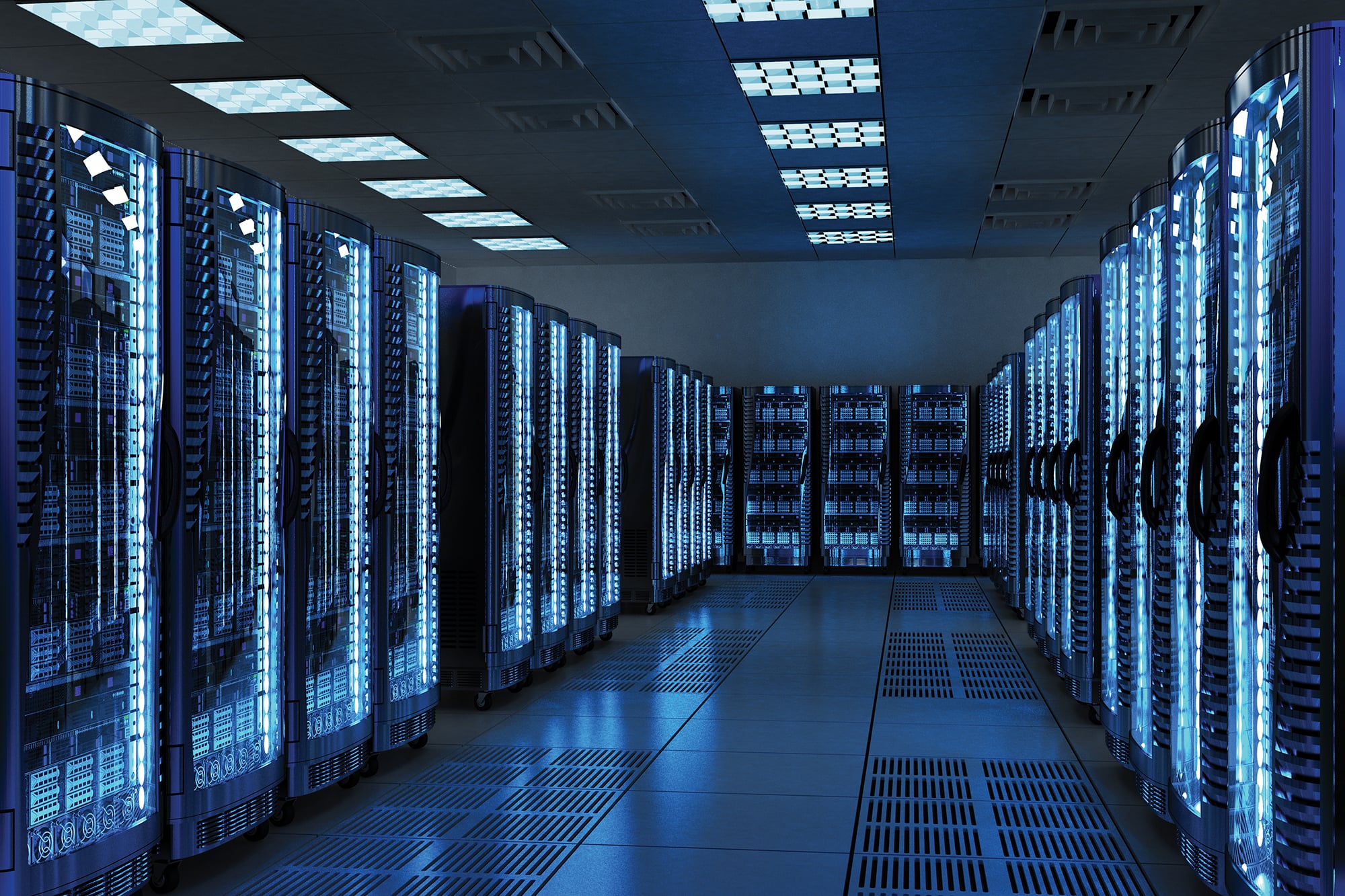
You also won’t be seeing the concrete floors and exposed rafters common in many warehouses. Instead, raised floor systems predominate, with plenum space below used for wiring and air distribution. Air distribution—or, more specifically, cooling—is a governing factor in data center design. The question of how to manage the heat generated by thousands of servers whirring away factors into every decision developers face, from server placement to ceiling design—and, of course, lighting.
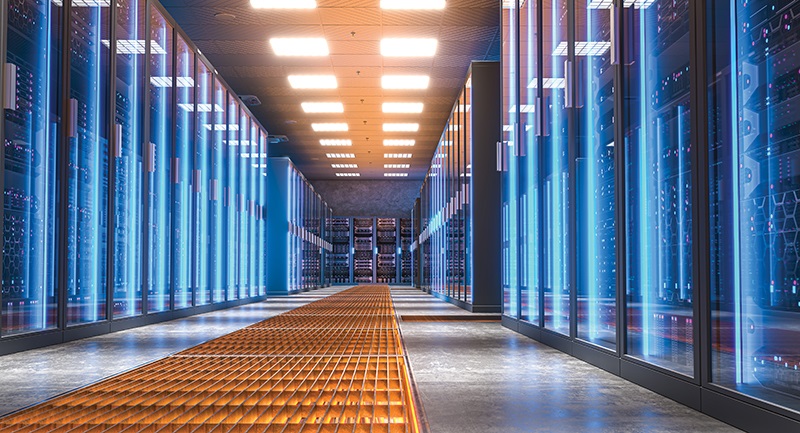
Floor plans typically feature server racks arranged back-to-back, with a gap between the rear side of the racks for air circulation. An open ceiling above the racks can allow room for heat to rise and provide space for cable trays for power and data distribution, with strip lighting installed above the aisles. Specifiers in these applications often opt for fixtures featuring some uplighting to support any future work moving cables in and out of the tray. Alternatively, Peak said, designers might take a more enclosed approach that can help maintain a separation between hot and cool spaces.
“There, they will do a kind of drop ceiling with a structural grid,” she said, describing metal-framed systems with integrated cable tray, which also has implications for fixture design. “It causes the real estate for a fixture to be a little smaller than a traditional two-by-four or two-by-two size, so there are fixtures to fit into that smaller parameter.”
Understanding requirements
In closed- and open-ceiling approaches, lighting is kept to above-the-aisle locations only, for several reasons, noted Chris Hutchins, indoor product management leader, Genlyte Solutions, a Signify business.
“It’s really to focus the light on the vertical plane of the racks, and also it creates less waste of light,” he said. “Data centers are trying to save as much wattage as possible, so placing them over the aisle allows for the light to reach just where it’s needed.”
Lighting makers are beginning to develop new products specifically for data center installations—for example, products sized to fit into structured ceiling systems—but most fixtures in these spaces were originally developed for other commercial settings. However, as these facilities have become such a driver in the U.S. construction market, standards have developed for how lighting is used in data center applications. Most important, the Telecommunication Industry Association’s TIA-942 Standard outlines three different lighting levels that should be available through building control systems.
- Level one provides just enough illumination to allow security and video surveillance systems to operate when the space is unoccupied.
- Level two is a higher lighting level to enable personnel to move safely through the space, when activated by occupancy or motion sensors.
- Level three is a high-intensity lighting for installation, maintenance and other detailed work activities, with a minimum horizontal illuminance of 500 lux on horizontal work surfaces and 200 lux vertical illuminance for interacting with equipment, including in overhead cable trays.
The standard’s most recent edition, TIA-942-C, released in 2024, also addresses a new development in data centers: operating under “lights-out” conditions when they’re running unstaffed. These updated lighting provisions allow unoccupied data centers to go fully dark as long as security systems are able to function without visible light.
Going digital
With their emphasis on efficiency, data center operators now are beginning to explore the option of using the cutting-edge technology of fault-managed power (FMP) in their lighting system wiring plans. This approach cuts kilowatt-hours by eliminating conversion losses. It’s similar to power over ethernet (PoE) designs in that it uses ethernet cable instead of standard wiring to deliver power to individual fixtures. However, rather than providing a continuous power flow, FMP uses a remote transmitter that converts standard alternating current into 336V DC, and then breaks that current into packets—500 of them per second—the way data is broken into packets in internet communications.
Every packet is checked for safety before it is sent to a receiver that smooths power out into a continuous stream and converts it as needed to standard AC or DC at the desired voltage. These receivers are often connected to PoE switches, allowing ethernet cables to transmit power to DC-based end-use devices.
FMP was recognized by the National Electrical Code as Class 4 power in the 2023 edition, under the new Article 726. It offers several advantages for data center operators always looking for new ways to wring construction and operational savings out of their designs. Wiring in such projects is much less expensive, involving structured Class 4 cable in runs up to 2 kilometers long instead of traditional copper and conduit. And, unlike electrical wiring, FMP cable can be installed in the same trays as data cables, without fear of radio frequency interference.
“Data centers typically have physical separation between power cables and data cables, but FMP cables can reside alongside the data cables,” said Farukh Aslam, CEO of Sinclair Digital Services Inc., a low-voltage design and consulting company focused on FMP technology based in Fort Worth, Texas. “FMP is packet energy transfer, so it’s not continuous energy going across like a sine wave, as with AC power. So, it doesn’t create that kind of radiation or electromagnetic flux.”
On an operational basis, this DC-based power architecture eliminates heat-producing AC-to-DC drivers. Instead, centralized PoE drivers are located remotely and serve a number of connected fixtures. This reduces cooling requirements in server spaces.
“Heat is the biggest output of data centers; all those servers are emitting heat,” Aslam said. “So, if you have 500 light fixtures not generating any heat in the facility, I’m sure that would be very attractive.”
Illuminating developments
When it comes to the next three to five years, those following the data center lighting market expect continuing efforts to boost LED efficiency, along with a greater push to design products specifically for these facilities.
“I definitely see an increase in the push for efficacy to continue improving—I think there’s a little more juice to squeeze, there,” said Jim Fisher, H.E. Williams’ director of sales. “And I think we’ll continue to evolve the light fixtures we put in those spaces. I don’t know what that looks like, but I would definitely expect there will be more designs to come on board specifically for data centers.”
Hutchins also sees greater emphasis coming to designs that account for a product’s full life cycle.
“Anywhere we can provide repurpose, upgrade or serviceability programs so there’s less waste at end of life, I think those sustainability aspects add to and improve the story of data centers,” he said, noting the economic and environmental impact such efforts could have. “I think it comes down to dollars and cents at the end of the day—it has a bottom-line impact.”
stock.adobe.com / tiero | stock.adobe.com / Cybrain
About The Author

ROSS has covered building and energy technologies and electric-utility business issues for more than 25 years. Contact him at [email protected].