Lineworkers are still at great risk of injury and death due to falls. Over the past decade, falls remain one of the leading causes of fatalities and severe injuries, according to industry data.
While strides have been made since OSHA revised its standards for fall protection for wood pole and structures in 2014, fall protection remains an area where “continued vigilance, improvement and adaptation of best practices are essential,” said Mike Starner, NECA’s executive director of outside line safety and industry engagement.
“In the utility construction industry, fall protection is not just a priority—it’s a critical necessity,” Starner said. “Workers in this trade face some of the most challenging environments, often working at significant heights or in conditions where slips and trips are common.”
Most fatal falls involve workers on transmission towers, poles, aerial lifts or crane-mounted personnel platforms, he said. These heights present significant risks, and any lapse in safety measures due to equipment malfunction or improper fall protection can result in deadly outcomes.
But industry data also shows that slips, trips and falls from the same level, often due to icy, wet or uneven surfaces, also contribute to serious injuries, he said. These types of falls are less likely to be fatal but still lead to significant injuries and lost workdays.
“While the overall number of fall-related fatalities has shown slight improvement, data indicates that same-level falls remain stubbornly frequent, underscoring the need for continuous improvement in hazard awareness and prevention measures,” Starner said.
To effectively prevent falls, Starner recommends that line contractors consider the full spectrum of protective measures available in the hierarchy of controls: elimination, substitution, engineering and administrative controls, and personal protective equipment (PPE).
While eliminating fall hazards entirely may not be feasible in power line work, some tasks traditionally conducted at height can be modified to reduce exposure, he said. For example, some maintenance tasks can now be performed using remote-operated or telescoping equipment from ground level, which significantly reduces the need for workers to climb poles or towers. Moreover, certain components can be preassembled on the ground and lifted into place, reducing time spent at elevation and minimizing fall risk.
Hierarchy of controls
Engineering controls include permanent guardrails on platforms and secure anchor points on transmission towers; aerial lifts, crane-mounted personnel platforms and bucket trucks compliant with ANSI A92/B30 standards; and temporary guardrails and scaffolds during construction and maintenance when permanent guardrails are not possible.
Administrative controls include robust training programs, hazard assessments and ongoing inspection routines, Starner said.
“Industry-specific training has become more robust, with tailored instruction in tasks like pole climbing, safe aerial lift operation and ‘long lining’—working suspended under a helicopter,” he said. “Competency-based training has strengthened the workforce’s ability to work safely in diverse conditions.”
Finally, Starner said PPE and the use of technology should be the last line of defense. Recent innovations in PPE include wearable safety technology and safety helmets in a newer style that maintain an electrical rating while enhancing impact protection and retention systems.
“Innovations in wearable devices offer an added layer of protection,” he said. “Sensors and alerts notify workers of proximity to unprotected edges or provide real-time location monitoring, reducing fall hazards through situational awareness.”
Areas for improvement include more consistent equipment inspections, expanding engineering solutions to reduce reliance on PPE and better training on same-level fall hazards, Starner said.
“Our goal, as safety professionals, is not just compliance but the creation of a work environment where every worker feels safe, secure and empowered,” he said. “With continued attention to best practices, rigorous adherence to standards and a commitment to innovation, we can ensure that utility construction is as safe as possible for all.”
Proper PPE use
A lot of injuries from falls occur because workers are not using PPE properly, said Mack Turner, executive director of the Institute for Safety in Powerline Construction, a nonprofit focusing on safety in the utility industry based in Alexandria, La.
Older lineworkers might have learned to free climb a pole or hitchhike up a pole with a strap. But the fall-restraint system used now is more involved because workers have a strap that goes around the pole and an additional strap between them and the pole—and that strap is often not adjusted properly.
“If it’s too loose, they’re going to slide down the pole, and until they can get a gaff in a pole, they’re not going to be able to stop their descent,” he said. “They would swing into the pole because they would still have the strap around the backside of the pole. Poles are made out of wood and there’s lots of slivers and different things that can injure workers.”
Workers could fall a significant distance, and the sudden stop might cause back issues or other health problems, Turner said. They could also fall to the ground, risking serious injury or death.
Workers also make mistakes when they pass over obstructions, such as a transformer or a cross-arm, he said. They must have a second safety belt that goes around the pole so they can crawl around an obstruction, “but it takes a lot of practice to be able to do that correctly because it’s a really difficult thing to do,” he said.
While still tied to the pole with the first strap, workers are supposed to hook the second strap above the obstruction and then unhook the first strap and climb above the obstruction, Turner said.
“However, many workers just do it the old way instead—they don’t use the second strap at all, but rather just unhook the first strap and free climb past the obstruction,” he said. “But that really increases the risk of falling. They need to practice and be able to use that correctly and safely.”
Lattice towers have climbing steps, but workers still must use harnesses and lanyards to traverse those towers, Turner said. Many workers hook their lanyard too low and leave a lot of slack in it, or they put the anchor point of the safety strap underneath them or down around foot level.
“Then, if they fall, that increases their fall distance before the safety harness and lanyard starts to protect them. They’ve got potentially about a 13-foot fall before it stops them,” he said. “So that anchor point needs to be at shoulder level or above them, because that will restrict their fall to less than 6 feet.”
Another problem is that anchor points can only hold so many pounds, but many workers just attach lanyards to the most convenient object, even if it is not engineered to hold that kind of weight, Turner said. For example, workers in substations wrongly anchor their lanyard to bolt holes.
In addition, workers often do not size or correctly adjust climbing belts and safety harnesses, or they use an unadjusted harness or belt, he said. Leg straps are also often adjusted too loosely.
“They leave them to where they have a lot of play in them, but if they fall, they’re probably going to end up with more injury if they don’t fall out of it, as they could do some serious damage to their body when the leg straps catch them with greater force,” Turner said. Falling in a harness with loose thigh straps can cause a greater injury than suspension trauma.
Choosing the right PPE
For PPE, employers should not have a one-size-fits-all approach—a variety of styles from different manufacturers should be offered, said Michael Giordano, technical safety director at Haugland Energy Group LLC in Melville, N.Y.
For underground transmission manhole work, a five-point body harness with two rescue rings located at the shoulders, two at the hips and one at the chest is appropriate, Giordano said. The harness allows for rescuing an incapacitated worker. It’s a very different harness than the kind used for climbing transmission towers, which has extra lumbar and thigh support.
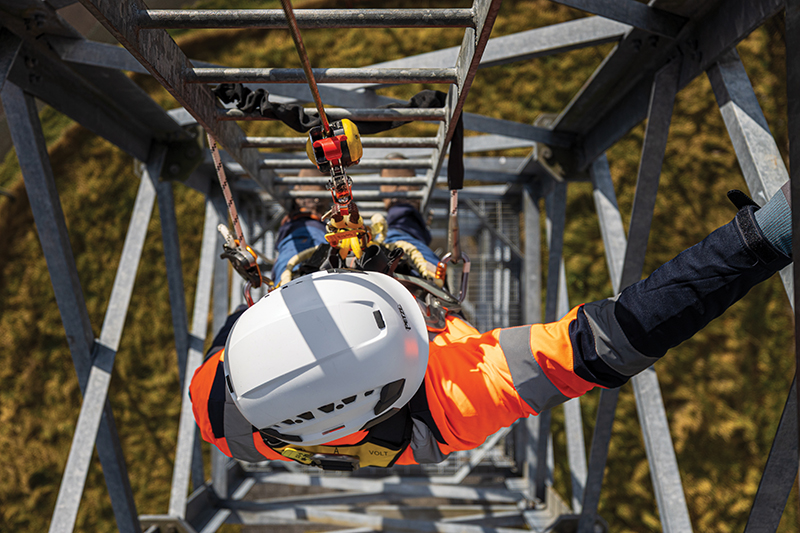
“Periodic inspection of PPE is key— just because something worked yesterday doesn’t mean it’s going to work today,” Giordano said. “Before each use, workers need to ensure that the harness fabric is not frayed or threadbare and is free of stains, such as from transformer oil.”
The manufacturer’s tag must be legible so information, such as weight capacity range, warnings, attachment points and inspection record can be reviewed and verified, he said.
If a harness is compromised or no longer properly fits the worker, it should be replaced, he said. Additionally, if a harness, shock absorbing lanyard or self-retracting lanyard is subject to a fall, all items need to come out of service and be replaced.
Equipment is increasingly designed with fall prevention in mind, Giordano said. For example, utilities are specifying transformers with antislip paint on the top and a means to attach fall-arrest systems. Ladders to access substation equipment are equipped with a cage and preinstalled cable ascending systems that harnesses can be attached to.
“When contractors are part of a design-build effort, we can get ahead of instances where our workers could be subject to a fall,” he said. “For example, if we identify that a control cabinet for a substation breaker on paper may be too high to access without a ladder or a platform, we may be able to provide an engineered solution to keep our workers’ feet on the ground.”
Contractors should be committed to preventing all falls, whether it is personnel or dropped objects such as tools, Giordano said.
“When working on an offshore platform, are we wearing our helmet chin straps to prevent the helmet from landing in the ocean? When working aloft, are our tools tethered to prevent the tool from striking people or property on the ground? Some thoughts to consider,” he said.
stock.adobe.com / NC Photo
About The Author

KUEHNER-HEBERT is a freelance writer based in Running Springs, Calif. She has more than three decades of journalism experience. Reach her at [email protected].