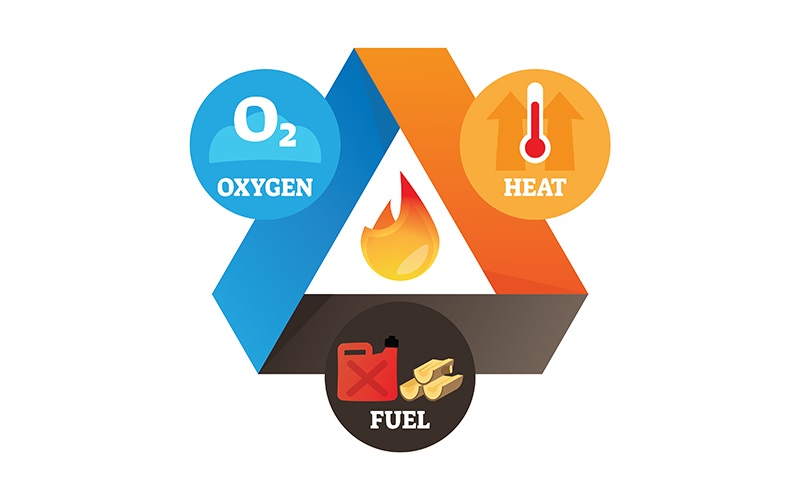
Electrical installations in hazardous (classified) locations require compliance with more restrictive rules in Chapter 5 of the National Electrical Code. Good design will locate as much electrical equipment and wiring outside hazardous (classified) locations as possible; however, this is not feasible in many cases. Electrical equipment and systems installed in these environments must be identified for use and be protected with one or more of the protection techniques in sections 500.7 or 505.8. Use of protection techniques usually results in eliminating one or more components of the fire triangle (air, fuel and an ignition source).
This article focuses specifically on the intrinsically safe (IS) protection technique as provided in 500.7(E) and 505.8(C). If circuits are intrinsically safe, the circuit energy is at a low enough level that ignition of an explosive atmosphere will not occur if the circuit is opened, shorted or faulted to ground at the same time a fault occurs at the source.
Wiring methods
IS circuits do not depend on the wiring method to prevent ignition of flammable or explosive atmospheres. Therefore, the wiring method is not limited to what would be required for ordinary branch circuits installed in hazardous locations. Any wiring method can be used for IS circuits.
Although the wiring is not an ignition threat, due consideration should be given to the circuit’s operation. Should the circuit have a safety function that would be lost if the circuit were damaged, then the wiring method chosen is important. Section 504.20 provides detail on the IS wiring methods. IS apparatus and associated apparatus must be listed.
Control drawings
Section 504.10(A) requires IS apparatus, associated apparatus and other equipment to be installed in accordance with the associated control drawing. A control drawing provides specific information and instructions related to wiring methods, circuit lengths and so forth. The control drawing is essential for proper installation and for making inspections of these systems. Zener-diode barriers installed for IS systems often reference a specific control drawing.
These control drawings often include grounding and bonding information critical to the integrity of the IS system or circuit(s). A supplementary connection to the grounding electrode may be needed for some associated apparatuses, e.g., Zener-diode barriers, if specified in the control drawing. The main reason relates to the Zener-diode barrier shunting to ground as it operates.
Grounding and bonding
Sections 504.50 and 504.60 include the grounding and bonding rules for IS systems. Section 504.50(A) requires IS apparatus, associated apparatus, cable shields, enclosures and raceways, if made of metal, to be grounded. This includes the metal raceways and enclosures for such systems. Branch circuits that include an equipment-grounding conductor as covered in 250.118 must supply IS systems. The equipment-grounding conductor is necessary for grounding the metal enclosure(s) and other metal parts and equipment of the system.
It is common for the required control drawing(s) to specify a grounding electrode conductor connection in addition to connection to the required equipment grounding conductor. Usually, terminals for these grounding connections are located within the system enclosure or control panel. If a grounding electrode connection for the IS system is required, the grounding electrode(s) shall be as specified in 250.52(A)(1), (2), (3) and (4). The grounding electrode(s) specified in 250.52(A)(5), (7) and (8) shall not be used unless the electrodes in 250.52(A)(1), (2), (3) and (4) are not present. Metal parts and raceways for IS wiring must be bonded in accordance with Section 504.60.
Separation requirements
The NEC recognizes that any wiring method can be used for IS circuits. There are also specific spacing requirements that must be maintained between IS and non-IS circuits. The concern is the possibility of compromising the intrinsic safety of the circuit through inductive or capacitive coupling effects related to proximity to other wiring.
IS circuits are generally restricted from being installed in the same raceway, cable tray or cable with conductors of any non-IS circuit. IS circuit conductors are permitted where they are separated from non-IS circuit conductors by a space of not less than 50 mm (2 in.) or by grounded metal partitions or insulating barriers. The identification rules in 504.80 help owners, installers and facilities managers maintain initial spacing when additional wiring or systems are installed.
Always refer to the control drawings and see Article 504 for all NEC requirements that apply to IS circuits and systems. A properly functioning IS system and equipment depends on rigid compliance with the applicable control drawing. See Section 504.30 for details on separation requirements for intrinsically safe conductors.
stock.adobe.com/VectorMine
About The Author

Michael Johnston
NECA Executive Director of Codes and Standards (retired)JOHNSTON, who retired as NECA’s executive director of codes and standards in 2023, is a former member and chair of NEC CMP-5 and immediate past chair of the NEC Correlating Committee. Johnston continues to serve on the NFPA Standards Council and the UL Electrical Council. Reach him at [email protected].