Requirements for electrical wiring in hazardous (classified) locations are more restrictive than the rules for wiring in general types of occupancies. National Electrical Code Chapter 5 includes rules for special occupancies such as hazardous locations, healthcare facilities and assembly occupancies. This article reviews important sealing requirements for wiring in hazardous locations, specifically locations designated Class I, Division 1 and 2. Class II locations are those dealing with fire and explosion hazards from combustible dust and are not covered here. Seals are not required in Class III locations, but all boxes and fittings must be dust-tight.
In determining the need for seals in hazardous locations, recall why and where seals are required in Class I locations. There are two primary purposes for installing conduit seals. The first is to prevent explosions (flames) within the conduit and equipment
from being transferred from one portion of the system to another. Generally, conduit seals are required within 18 inches of the point of entry to explosion-proof enclosures. This requirement seeks to contain explosions and flames within the enclosure
and prevent them from being rapidly transmitted through the conduit systems.
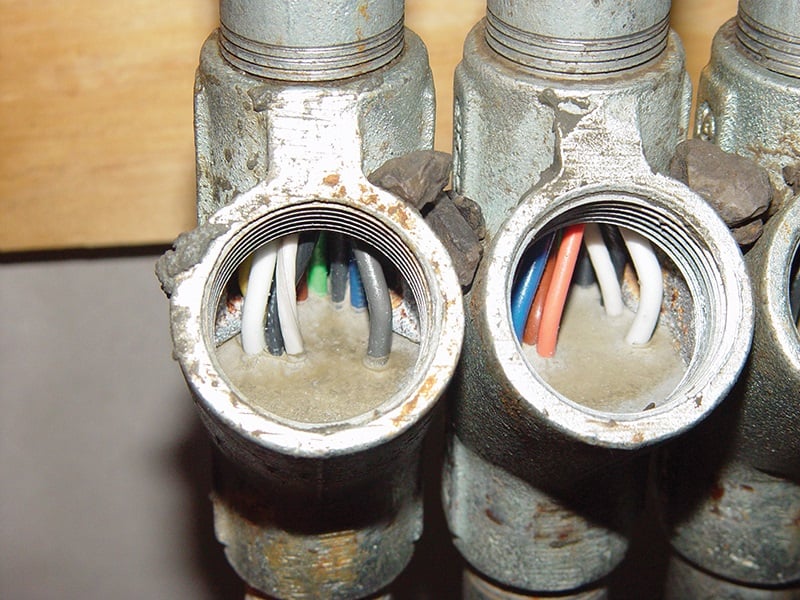
Another reason for conduit seals is to minimize the passage of gases or vapors from a hazardous to a nonhazardous location. Sealing fittings perform as intended if the seal is dammed (packed) and poured in a compliant manner. It is a Code violation and a risk to property when the seal is not completed.
Some have used excuses for not pouring sealing fittings, such as not being able to draw wires in or out in the future. Others have used inferior sealing techniques, such as filling conduit seals with silicone or electrical sealing putty. These methods
fall short of Code compliance and achieving functional objectives.
Conduit seals in Class I, Division 1 and 2 locations must meet the requirements in Section 501.15(C). Sealing fittings must be listed and installed in accordance with instructions in 110.3(B). Sealing fittings cannot contain splices and must be installed in accessible locations, without exception.
Creating an effective seal
Completing an effective conduit seal requires installing a damming fiber and sealing compound specific to and listed for use with a particular fitting. This compound must be durable for the surrounding atmosphere or liquids. The melting point cannot be less than 93°C to withstand flames and heat from explosions. This compound must be at least 5/8 inch thick and not less than the trade size of the conduit in which it is installed.
For example, if the seal is installed in a 2-inch conduit, the compound in a completed seal cannot be less than 2 inches thick. Conductor fill is restricted in conduit runs where sealing fittings are installed. The Code generally permits up to a 40% fill for conduits containing more than two conductors as provided in Chapter 9, Table 1.
Limiting the fill to 25% of the conduit cross-sectional area of the raceway provides adequate room in the fitting for separating the conductors and achieving an effective seal around each conductor as it passes through the fitting. If the fill is more than 25% of the conductors, it can bunch up in the middle of the seal, creating spaces through which gases or vapors could migrate. Some manufacturers produce listed sealing fittings that are oversized and can accommodate the 40% fill requirements.
Proper sealing methods
Conduits containing multiconductor cable assemblies used for voice, data or control must also be sealed. Section 501.15(D) provides cable sealing requirements. Where multiconductor cables pass through conduit seals, there are two methods of achieving an effective seal. The method used depends on whether the cable jacket can transmit gases or vapors through the cable core. If the cable jacket or sheath allows passage of gases or vapors, the jacket must be removed so the conductors in the cable assembly can be separated and sealed individually when installing the sealing compound.
For cables that do not transmit gases or vapors through the sheath to the cable core, the cable can be dammed and sealed without removing the sheath. Cable manufacturers should be able to provide evidence of cable sheath suitability.
Sealing is required for conduits and cables installed in Class I, Division 1 and 2 locations. Conduit seals must be listed and meet specific requirements to achieve an effective seal to ensure performance as anticipated. Conduit seals prevent passage of explosion and flames beyond explosion-proof equipment and minimize the migration of gases or vapors across boundaries from classified locations to unclassified locations. The seal fitting installation is not complete or Code-compliant if the seal is not dammed and poured.
michael johnston
About The Author

Michael Johnston
NECA Executive Director of Codes and Standards (retired)JOHNSTON, who retired as NECA’s executive director of codes and standards in 2023, is a former member and chair of NEC CMP-5 and immediate past chair of the NEC Correlating Committee. Johnston continues to serve on the NFPA Standards Council and the UL Electrical Council. Reach him at [email protected].