I recently attended the 2026 Florida Chapter meeting of the Independent Alliance of the Electrical Industry (formerly called the International Association of Electrical Inspectors) in Miami. There was the usual discussion panel by National Electrical Code experts based on the 2023 edition. However, one of the questions and the resulting answer seemed somewhat controversial to me.
One of the reasons for a discussion panel is to provide attendees with a better understanding of the NEC and to talk about any issues attendees might raise. At times, some of these questions and answers become very involved and require animated discussion with input from the panel and attendees. Many of these questions and answers showcase legitimate application issues with the NEC.
I believe one question and answer at the meeting in Miami may raise an issue and provide a possible application that NEC Panel 9 should address with its jurisdiction over Article 314 in the 2023 and 2026 codes. This issue will involve electricians, electrical contractors and electrical inspectors and the possibility of overfilling boxes.
Box fill calculations
The question was about a requirement in NEC 314.16(B) involving box fill calculations in new NEC 314.16(B)(6), “Terminal Block Fill.” The text states the following: “Where a terminal block is present in a box, a single volume allowance in accordance with Table 314.16(B)(1) must be made for each terminal block assembly based on the largest conductor(s) terminated to the assembly.”
In the first revision committee statement for the 2023 process, Panel 9 admitted that “the use of terminal blocks in outlet and device boxes is not common, but where provided, the terminal blocks take up enough volume to merit a conductor allowance.” Panel 9 also provided an example of the use of terminal blocks that occurs in NEC 680.23(F)(2)(b) involving “an underwater luminaire supplied by a transformer, a ground-fault circuit interrupter, a clock-operated switch, or a manual snap switch located between a panelboard and a junction box. The equipment grounding conductor is permitted to terminate on the grounding terminals on the transformer, ground-fault circuit interrupter, clock-operated switch enclosure, or at an outlet box used to enclose a snap switch.”
In the example, a grounding terminal within a box supplies an underwater luminaire, which would technically be a terminal block and would be bolted to the box. The phrase “for each terminal block assembly based on the largest conductor(s) terminated to the assembly” clarifies that the volume allowance does not apply to each pole of a multipole terminal block, which Panel 9 said would be excessive.
The basic issue here is the difference between “terminal blocks” and “splicing devices,” such as wire nuts and similar devices. Where a conductor is spliced to another conductor inside a box, part of the volume counted includes the two conductors with a connection to a wire nut so the splice counts as two conductors based on the largest one at the splice.
Push-in splice devices
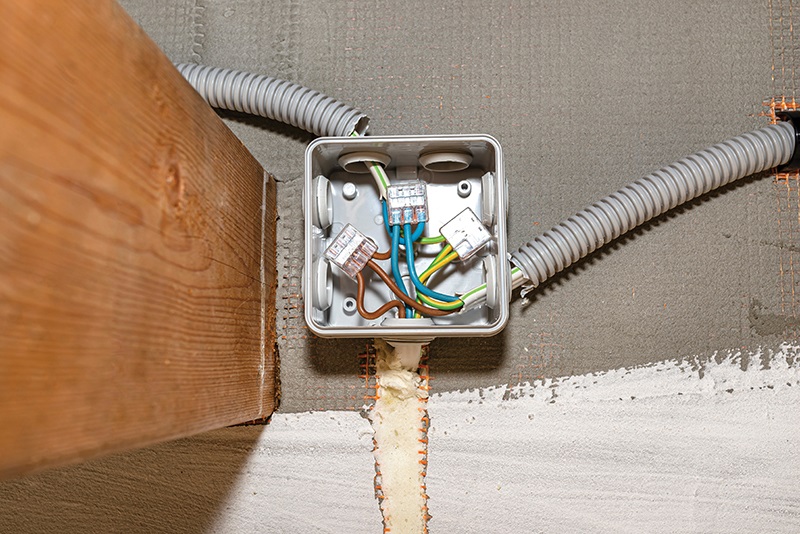
The new push-in splice devices can terminate up to eight wires with sizes from 20 AWG to 12 AWG solid and 18 AWG to 12 AWG stranded conductors. They are not screwed down inside the box, but instead are basically floating in it. Although these devices are fairly flat, installing a number of them inside a box can certainly restrict the installation of receptacles and switches and could result in overfill.
Where internal clamps and support fittings in a box take up space and device or equipment fill must be calculated, I believe these new splice devices should be counted based on their cubic inch dimensions.
For example, NEC 314.24(B) provides dimension requirements for outlet and device boxes with enclosed devices or utilization equipment. This section requires the following: “Outlet and device boxes that enclose devices or utilization equipment must have a minimum internal depth that accommodates the rearward projection of the equipment and the size of the conductors that supply the equipment.”
This requires box selection based on the cubic inch capacity of the device, equipment and conductors. I might be pushing it by including the application of a splicing device, but certainly wire nuts and the new push-in spicing devices are still considered to be devices, even though we don’t normally apply this cubic-inch calculation to wire nuts. Panel 9 should consider how to deal with these new push-in splicing devices and the cubic-inch sizing of boxes.
No one on the NEC discussion panel at the Miami meeting seemed to have any concerns about increased box fill using these push-in splicing devices, especially where trying to install a GFCI, receptacle or switch in the box.
stock.adobe.com/Michal
About The Author

ODE is a retired lead engineering instructor at Underwriters Laboratories and is owner of Southwest Electrical Training and Consulting. Contact him at 919.949.2576 and [email protected].