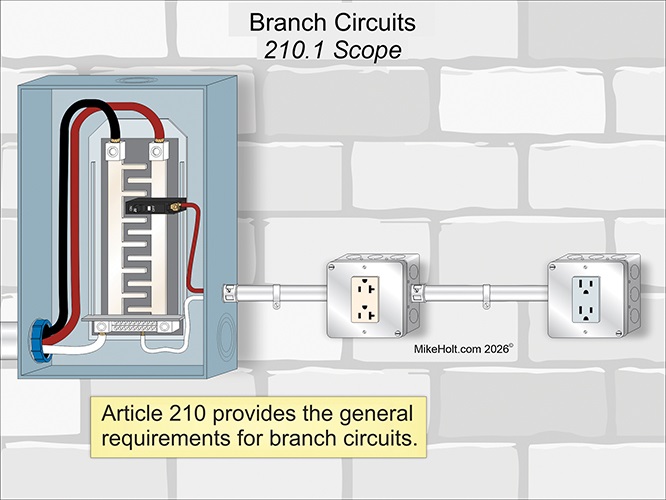
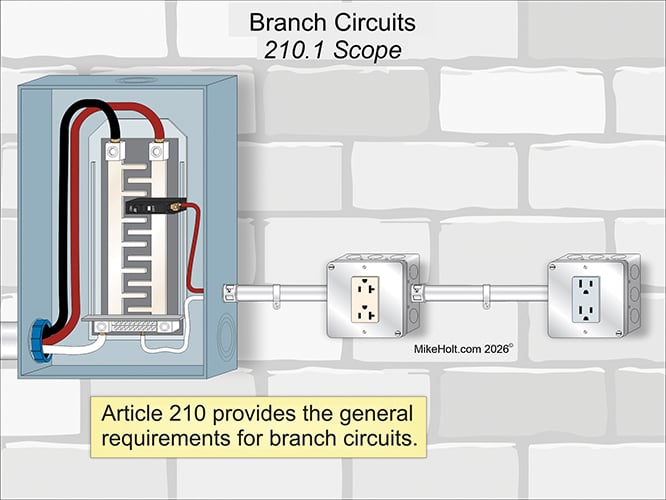
Article 210 of the National Electrical Code provides the general requirements for branch circuits. These include requirements for receptacle outlets, lighting outlets, conductor sizing, overcurrent protection, identification and GFCI/AFCI protection.
Requirements for branch circuits supplying specific equipment are in other articles. For example, for motor circuit conductors, see Section 430.22.
Multiwire branch circuits
A multiwire branch circuit can be considered as multiple circuits [210.4(A)]. All conductors of a multiwire branch circuit must originate from the same equipment containing the overcurrent protective devices (OCPDs). Each multiwire branch circuit must have a means to simultaneously disconnect all phase conductors at the point where the circuit originates [210.4(B)].
Multiwire branch circuits must supply only line-to-neutral loads [210.4(C)], but there are two exceptions. One is that the circuit can supply an individual piece of utilization equipment with both line-to-line and line-to-neutral loads (e.g., a range or dryer).
The phase and neutral conductors of a multiwire branch circuit must be grouped or identified together by cable ties, wire markers or similar means within each enclosure per 200.6(B) [210.4(D)]. See the two exceptions in 200.6(B). One is that grouping is not required if multiwire branch-circuit conductors pass through a box without splices or terminations [200.6(B), Exception 2].
Conductor identification
The branch-circuit neutral conductor must be identified per 200.7 [210.5(A)] and the branch-circuit equipment grounding conductor must be identified per 250.119 [210.5(B)].
Identify branch-circuit phase conductors as follows:
1. One Nominal Voltage System. Where the premises wiring system has branch circuits supplied from one nominal voltage system, the branch-circuit phase conductors must be identified per 310.6(A)(3).
2. More Than One Nominal Voltage System. Where wiring is supplied from more than one nominal voltage system, the branch-circuit phase conductors must be identified by phase and nominal voltage system at termination, connection and splice points per 210.5(C)(2)(a) and (b).
- Means. Identification of the branchcircuit phase conductors can be by color coding, marking tape, tagging or other means approved by the authority having jurisdiction.
- Posting. Branch-circuit phase conductor identification must be readily available or posted at the enclosed panelboard. The identification can’t be handwritten and must withstand the environment involved. But where a different voltage system is added to an existing installation, branch-circuit identification is required only for the new one.
Branch circuits required
To determine the number of branch circuits required, divide the total calculated load by the ampere rating of the circuit [210.11(A)].
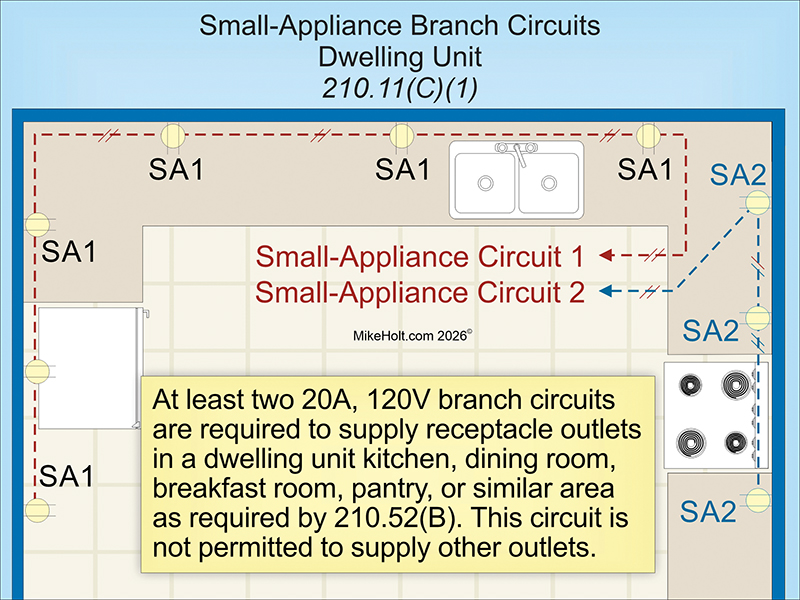
If you calculate the load based on volt-amperes per square foot, the wiring system must serve the calculated load. The load must be evenly proportioned among the branch circuits within the panelboard [210.11(B)]. At least two 20A, 120V branch circuits are required to supply receptacle outlets in a dwelling unit kitchen, dining room, breakfast room, pantry or similar area as required by 210.52(B). This circuit cannot supply lighting outlets or any other receptacle outlets [210.11(C)(1)].
One 20A, 120V branch circuit is required to supply the receptacle outlets for a dwelling unit laundry area, per 210.52(F). This circuit cannot supply lighting outlets or any other receptacle outlets [210.11(C)(2)].
One 20A, 120V branch circuit is required to supply the dwelling unit bathroom sink receptacle outlets required by 210.52(D). This circuit cannot supply lighting outlets or any other receptacle outlets [210.11(C)(3)].
In dwelling unit garages with electric power, one 20A, 120V branch circuit is required to supply receptacle outlets, including receptacle outlets required by 210.52(G)(1). This circuit is permitted to supply other garage receptacle outlets, but not outlets in other areas of the dwelling unit [210.11(C)(4)].
Branch circuits are permitted in addition to the required 20A, 120V garage vehicle bay branch circuit. There are two exceptions; for example, the garage branch circuit can supply outdoor receptacles.
Branch-circuit ratings
Branch circuits are rated per the rating or setting of the OCPD. Where conductors of higher ampacity are used for any reason, the ampere rating or setting of the OCPD determines the circuit rating [210.18]. Branch circuits rated 10A must not supply receptacle outlets.
Branch circuit conductors must have an ampacity per 210.19(A) through (D).
A. General. Branch-circuit conductors must have an ampacity no less than the calculated load and must be sized to the larger of either 210.19(A)(1) or (2).
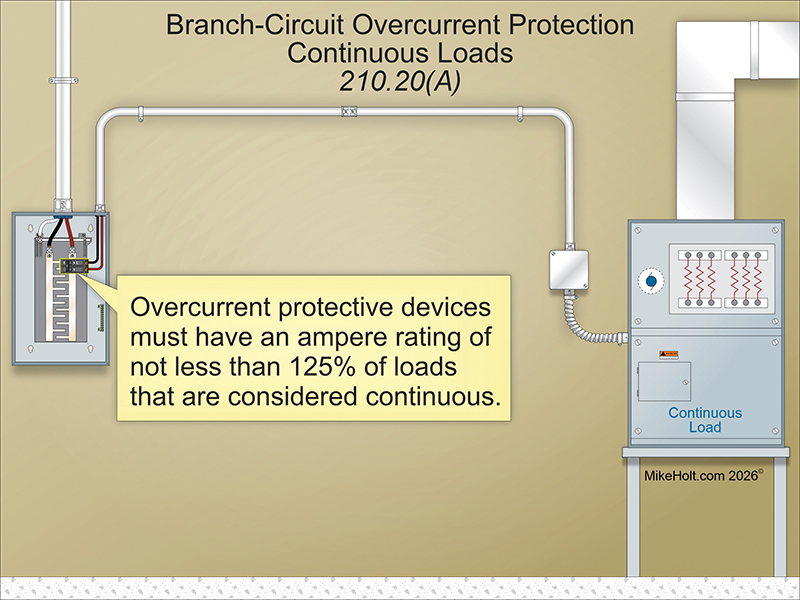
- Continuous and noncontinuous loads. Branch circuit conductors must have an ampacity no less than 125% of the continuous loads, plus 100% of the noncontinuous loads.
- Ampacity correction and/or adjustment factor. Branch circuit conductors must have an ampacity of no less than 100% of the continuous and noncontinuous loads after conductor ampacity correction and/or adjustment per tables 310.15(B)(1)(1) and 310.15(C)(1).
The temperature ampacity correction of 310.15(B)(1)(1) and ampacity adjustment factors of 310.15(C)(1) are applied to the ampacities listed in Table 310.16. This is based on the conductor insulation temperature rating, which is typically THWN-2, 90°C (194°F) [310.15(A)].
Exceptions to (1) and (2): Conductors rated 90°C that terminate to pressure connectors in separate enclosures or wireways at both ends per 110.14(C)(2) must have an ampacity not less than the sum of the continuous and noncontinuous load (100% of all loads). This is based on the 90°C column of Table 310.16.
B. More than one receptacle. Branch-circuit conductors supplying more than one receptacle for cord-and-plug-connected portable loads must have an ampacity not less than the rating of the branch circuit.
This rule prohibits the practice of using a 14-AWG pigtail from 12 AWG to supply a 15A receptacle on a 20A circuit.
C. Household cooking appliances. Branch-circuit conductors supplying household cooking appliances must have an ampacity not less than the rating of the branch circuit and not more than the maximum load to be served.
D. Other loads. Branch-circuit conductors that supply loads other than those specified in 210.14 and other than cooking appliances as covered in 210.19(C) must have an ampacity sufficient for the loads served and cannot be smaller than 14 AWG.
Branch-circuit conductors must be protected by OCPDs with a rating or setting provided in 240.6(A). The OCPD must have an ampere rating not less than 125% of the continuous loads, plus 10% of the noncontinuous loads [210.20(A)].
Example problem No. 1
Let’s solve an example problem about branch-circuit OCPD sizing.
Question: What size circuit breaker is required for a 9,600W, 240V fixed electric space heater with a 3.4A, 240V blower motor?
Possible answers:
A. 40A
B. 45A
C. 50A
D. 60A
How to solve it: Step 1, find the total load.
I = watts/volts
I = 9,600W/240V = 40A
Circuit current = 40A (heat) + 3.4A (blower) = 43.4A
Step 2, size the OCPD at 125% of the continuous load [424.5].
Protection rating = 43.4A × 1.25 = 54.25A
This means you need a 60A circuit breaker [Table 240.6(A)]
Answer: D. 60A
An individual branch circuit must have an ampere rating sufficient for the load per the manufacturer’s instructions [210.22].
Example problem No. 2
Let’s solve another problem.
Question: What size branch circuit is required for a hood/microwave rated at 14.5A?
Possible answers:
A. 10A
B. 15A
C. 20A
D. 25A
How to solve it: An individual 15A branch circuit is required for a hood/microwave rated 14.5A, 120V.
Answer: B. 15A
10A branch circuits can supply lighting outlets or dwelling unit exhaust fans on bathroom and laundry room lighting circuits. They cannot supply branch-circuit receptacles [210.23(A)].
A 15A or 20A branch circuit can supply lighting, equipment or both [210.23(B)]. The rating of cord-and-plug-connected equipment not fastened in place with other outlets can’t exceed 80% of the branch-circuit rating. The rating of utilization equipment fastened in place (other than luminaires) can’t exceed 50% of the branch-circuit rating, where lighting units or cord-and-plug-connected equipment are also supplied.
Overcurrent selection/conductor size
Confusion can result when you ask, “What size breaker do I need for a branch circuit with 12-AWG conductors?” The OCPD is what defines the circuit and serves as its origin. Remember, the ampere rating or setting of an OCPD determines the circuit rating [210.18].
You must determine, early on, what kinds of loads each circuit will supply, and choose the appropriate OCPD. A larger OCPD is going to permit more current to flow through the circuit, and you must size the conductors so that they can handle it.
mike holt enterprises
About The Author

HOLT is a National Electrical Code expert, author and educator with more than 50 years of experience in the electrical industry. He started his career as an apprentice and became a master electrician, electrical inspector, contractor, instructor and publisher. He has written hundreds of electrical training books used nationwide through MikeHolt.com. He can be reached at [email protected].