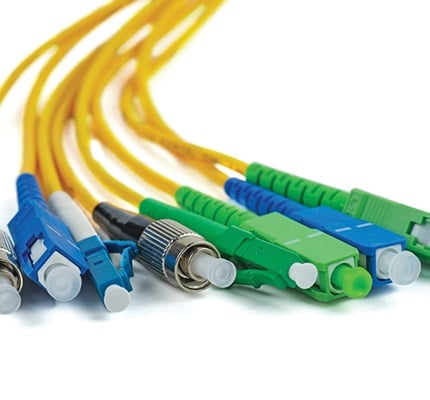
While I was being educated about fiber optics at AT&T Bell Labs in New Jersey in the late 1970s, the optical fiber development was being done mostly by Corning Glass. AT&T was also doing cable development at its giant cable factory in Atlanta. Fiber, cables and connectors are the essential elements of a fiber optic cable plant, but you need many more components to make a complete fiber optic communications system.
Fiber optic communications work by sending pulses of light down the fiber, so you need a source of light. Conveniently, the scientists at Bell Labs were also developing that technology. In 1958, they patented the laser, first as a large device using gas, but, by 1962, they used their expertise in semiconductors to make solid-state lasers (remember, they invented the transistor at Bell Labs in 1947).
The development of the laser was not unlike that of the vacuum tube evolving into the transistor. It required shrinking a large tube of gas down to a semiconductor chip the size of a grain of sand. (Yes, laser chips are actually as small as a grain of sand.)
And that’s another trick in the magic of fiber optics.
Early laser TLC
The energy density required to stimulate light to become a laser created a lot of heat. This meant the laser chip had to be mounted on to another chip, a semiconductor device that cooled it, and then on a chip package that could conduct the laser’s heat away.
Before it could be used as a source for a fiber optic link, the light the laser chip emitted needed to be coupled into a hair-thin optical fiber. In 1980, that alignment process was done by micrometer adjustments made by a human operator, with the light coupled into the fiber measured by an optical power meter to maximize coupled light power. Then the fiber was glued or soldered in place and the device package assembled and sealed.
At practically every step of this process, the laser had to be tested, often for longer periods of time to ensure reliability. That is where I became involved with this manufacturing process at AT&T. After learning about fiber optics I decided to start a company to build fiber optic test equipment, which we called FOTEC (Fiber Optic Test Equipment Co.).
FOTEC became involved in several projects for test equipment, including building a manufacturing and test station for the first 1,310-nm single-mode lasers they were developing. It had an adaptable test head, where devices at various states of manufacture could be mounted and tested electrically and optically. Since this was 1980, everything was done manually, but we included attachment points that could allow computer interfaces for control and gathering data. Today, of course, this entire process is done by computers and robots.
Early laser reliability
We also learned a lot about the reliability of early lasers. Part of our agreement with the manufacturer was they would sell us 1,310-nm lasers to put in our field test gear. Those devices at the time were rare and precious—we paid $3,500 each! Today, those same devices cost around $10–$20. But the agreement was that any lasers that failed would be returned for a free replacement; they wanted to analyze every failure to understand how to make them more reliable.
And fail they did—about half of them in the beginning. But as the volume of devices built up, the failure rate decreased significantly, as the analysis of the failures was fed back to correct the design and manufacturing processes. It took a few years, but, by the time the other parts of the single-mode fiber optic puzzle were ready—fiber, cable, connectors, etc.—the lasers were reliable enough for network use.
They were so reliable, in fact, that only a couple of years after the first single-mode fiber networks were built on land, AT&T installed the first submarine cable across the Atlantic, TAT-8, which remained in operation until the early 2000s when its data capacity was eclipsed by other submarine cables, and it was declared obsolete.
Today, lasers are cheap and reliable commodities, built by computers and robots by the millions. But the technology used to be pure magic, and those who developed them were researchers, engineers and magicians.
stock.adobe.com/Green Wind
About The Author

HAYES is a VDV writer and educator and the president of the Fiber Optic Association. Find him at www.JimHayes.com.