In recent months, I reminisced how I was introduced to fiber optics at Bell Labs by the researchers inventing a lot of the technology needed to convert the phone network into fiber optics. At Bell Labs, I met the scientists and engineers developing the equipment to digitize phone lines, the lasers needed for transmitters and the various components needed for the cable plant such as cables, splicers and connectors.
One of the most interesting labs I visited at Bell Labs was where fiber optic connectors were being developed. When you entered the lab, you walked through a curtain formed by connectors hanging on pigtails like a beaded curtain in a old-time Italian restaurant. The lab was the office of Jack Cook, an engineer developing the Biconic connector.
In the back corner of Cook’s office was a plastic molding machine. Shelves were filled with plastic molding compounds. Counters had microscopes and measuring machines. Boxes held more pigtails with connectors. It was the most crowded office/lab I have ever seen.
Connector creation woes
Cook explained the problems with creating connectors for optical fibers. Imagine joining two human hairs precisely, then being able to disconnect them and recorrect them hundreds of times. The precision necessary was measured in microns—one-thousandth of a millimeter, or one-millionth of a meter. A micron is about the size of a wavelength of light being transmitted in the fiber. That’s small!
Making a permanent joint was easier to solve—build a machine that aligns fibers under a high-power microscope and then welds them in an electrical arc. That problem was already solved.
A pure mechanical joint was much more difficult. Wire connectors were machined from aluminum or stainless steel, but machining techniques were not precise enough for the tolerances required for optical fibers. In addition, the expansion and contraction of metal connectors over temperature made it difficult to glue glass fibers into a hole in the connector or maintain alignment over temperature variations.
Cook’s solution was to use molded plastic, but a special plastic with a very high percentage of micron-sized glass particles, which made it have thermal characteristics similar to glass itself. The connector and alignment sleeve were conical, reducing the sensitivity to variations in dimensions.
Precision counts
At this time in the 1970s, plastic molding was not precise enough to mold a hole the size of a glass fiber—125 microns or 0.005 inches in diameter. Cook’s solution was to mold the connector around the fiber. He would strip a fiber, thread it into a tiny hole in the plastic mold and mold the connector around the fiber. All those pigtails hanging over his door were the recently molded connectors, cooling down and waiting for polishing. That, of course, was no way to build connectors in volume.
Working with vendors, he developed the tools to mold connectors with holes so they could be installed by anyone, even in the field. But those connectors were only good for multimode fiber; single-mode fiber required almost 10 times the precision. To use Biconic connectors with single-mode fiber, it was necessary to grind the finished connector to align the fiber core precisely enough for single-mode—an unacceptable practice for volume production.
Others trying to make connectors had similar problems. Machined ferrules were hard to keep within the tolerances needed for multimode fiber, and nowhere near what was needed for single-mode. Some tried to make connectors like a mechanical splice for bare fibers with index-matching gel in the connector, but they were too messy and unreliable.
All this effort was required to get connection losses below 1 decibel!
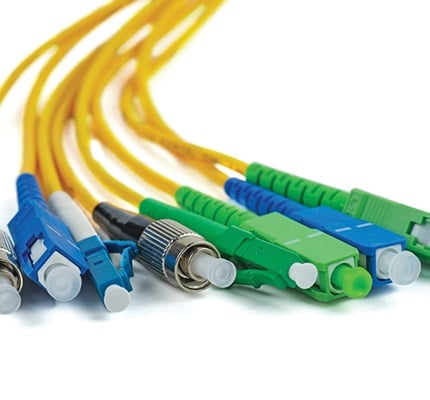
The solution to the connector problem came from an unexpected place. A company in Japan called Kyocera, which made precision-molded ceramic cases for integrated circuits, developed a cylindrical ferrule for fiber optic connectors. The first two connectors to use ceramic ferrules were the FC and D4 types.
The ferrules were precise enough to provide proper alignment for single-mode and multimode fiber. In addition, the ceramic had characteristics like glass; it expanded and contracted very little with changes in temperature, and it had a hardness similar to glass to make polishing the ferrule easy.
Soon after the introduction, others adopted the same 2.5-mm ceramic ferrule, using it in the connectors that became the most popular, the ST and SC. A decade later, the ferrule diameter was reduced to 1.25 mm for the LC and other smaller connectors.
The solution was so good that it is still the favored connector design 40 years later.
For a history of the fiber optic connector, read my December online column, “Development of the Fiber Optic Connector” on ECmag.com.
stock.adobe.com / elenabsl
About The Author

HAYES is a VDV writer and educator and the president of the Fiber Optic Association. Find him at www.JimHayes.com.