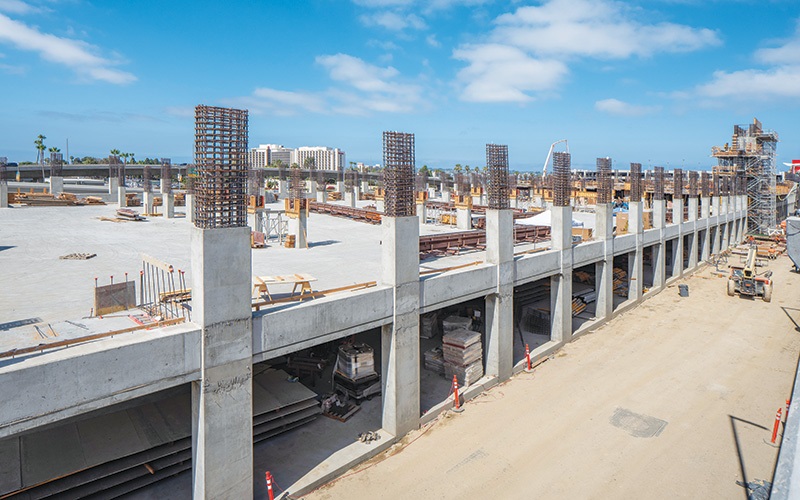
While residential building construction experiences its own vicissitudes in the face of uncertain economic conditions, other sectors of the building industry continue to sustain growth.
The industry analysis firm ConstructConnect, Cincinnati, reports that nonresidential construction starts reached $100.3 billion in June 2026. The figure represents the dollar value of new projects that broke ground. The June number is up $24.8 billion from the month before, and 35% above the 12-month moving average of $74.5 billion.
Nonresidential constructions starts is a broad category. Breaking down the sum into its component parts, growth is apparent across multiple sectors. For example, nonresidential building (NRB) starts measured $65.5 billion for June. That is a 56% increase from May. NRB starts year-to-date are also up 21.6% from the same period in 2025.
Within the category of NRB, office building starts nearly doubled from $14.5 billion to $23.5 billion. That figure, which includes offices and data centers, represents more than a third of all NRB starts in a single month. ConstructConnect notes this reveals a concentration in one industry, indicating that a small number of large projects are driving the growth, rather than broad subsector expansion.
On the other hand, office starts did not drive all the growth. According to the analysis, schools also contributed to the trend. Starts of new junior and senior high schools grew $3.7 billion to $8.6 billion, and elementary and preschools grew by $1.8 billion to $4.4 billion.
The broader category of nonresidential construction also encompasses infrastructure projects. Also known as civil construction, this includes such projects as roads, bridges, airports, and sewer and water systems.
Starts in this category also are on a positive trend. According to ConstructConnect, civil construction starts rose to $34.8 billion in June, a 3.9% increase from May.
Growth in this sector can be traced along a much longer trend that goes back several years. According to ConstructConnect, civil construction starts more than doubled between 2021 and 2025, driven by public investment and private demand.
Growth has been driven by federal legislation, such as the Infrastructure Investment and Jobs Act, which passed in 2021 and directed $550 billion in new federal spending toward civil construction. The surge in data center development, and the infrastructure that this requires, also contributed to demand.
ConstructConnect notes that the momentum has carried into 2026 and will likely continue. Year-to-date civil construction starts through June are 9% ahead of the same period in 2025.
About The Author

LAEZMAN is a Los Angeles-based freelance writer who has been covering renewable power for more than 10 years. He may be reached at [email protected].