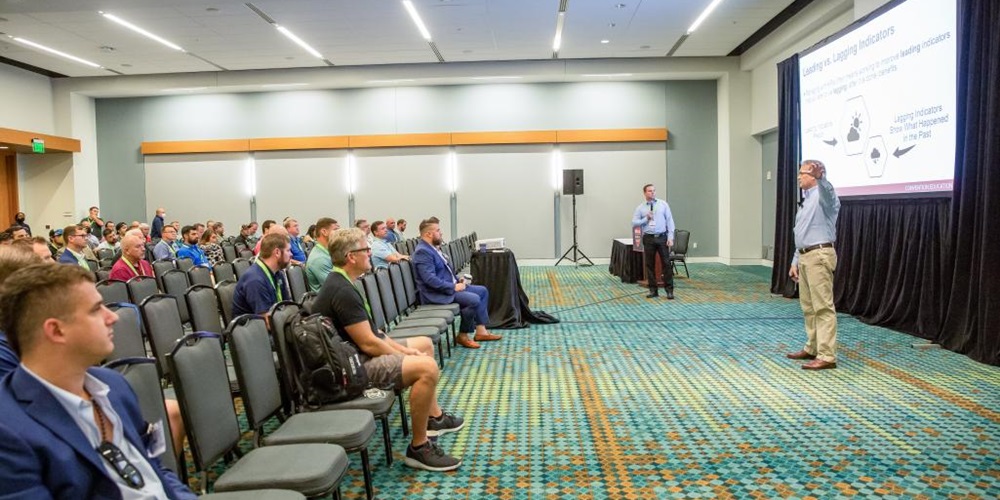
NECA 2026 Las Vegas abounds with education opportunities. From convention and trade show education sessions to Ask an Expert hours in the Innovation Zone, you can learn just about anything an electrical contractor might need to know. Come learn in a classroom, in direct conversation with experienced contractors or on the show floor with your peers. You can view the full schedule HERE.
Ahead of the show, we asked education speakers and thought leaders to give us the lowdown on their upcoming sessions. Interviews have been lightly edited for space and clarity.
Session: Integration Essentials: Building the Foundation for Intelligent Electrical Services
Speakers:
- Jeff Beavers, executive director of network integration and services at NECA
- Dr. Anthony Sparkling, executive director of industry infrastructure education at NECA
- Bryan Larson, vice president of integrated services at Pro Electric, L.C.
- Joseph Weyel, director of limited energy systems at Big State Electric, Ltd.
- Joe Richard, Schneider Electric
- Chanakya Gupta, Schneider Electric
- Jason Shearer, Cisco Systems
Time and location: Sunday, Oct. 4; 8:00 a.m. – 5:00 p.m.; MBCC, Breakers K
What are you hoping convention attendees get out of this year’s education sessions?
Sparkling: I do think a big takeaway should be on the continued role A.I. will play in our electrical contractors’ workflows, looking beyond the data center market. What’s next?
Is there anything you’d like to note that I haven’t asked about?
Sparkling: The new phrase I introduced at NECA Emerge this year during the Service and Maintenance panel is for contractors to rephrase “recurring revenue” to providing “recurring value,” which is outward-facing rather than inward. By doing so, we can get companies to realize that they are truly electrical/energy service providers that bring value to clients no matter what their needs are, driving repeat business through service and maintenance, NFPA 70B, tapping into the growing smart buildings and building automation markets, and more.
Session: Key A.I. Functions for Electrical Contractors
Speaker:
- Christopher Carr, CEO of Dynaimix AI
Time and location: Monday, Oct. 5, 8:00 a.m. – 8:50 a.m. and 9:00 a.m. – 9:50 a.m.; MBCC, Lagoon K
What would you say to contractors who are holding out on A.I. technology?
Carr: The biggest concern I would have is the widening gap between the companies that are actively implementing A.I. and those that are waiting. The gap between those two groups is widening rapidly. At some point, your competitor isn’t simply using a better tool. They’re operating an entirely different kind of company, and catching up becomes exponentially more difficult.
There are really two stages to this journey. The first is substitutionary A.I. You’re essentially doing many of the same things you were doing before, but now you’re using A.I. to do them bigger, stronger, faster. The second stage is transformational A.I. That’s when you begin unlocking capabilities that simply weren’t possible before the age of A.I. But you can’t just skip the first stage and jump straight to transformation. The substitutionary stage is where your people learn how A.I. works, how to communicate with it, how to supervise it, where it succeeds and where it fails.
What are you hoping convention attendees get out of your session?
Carr: The goal is to give contractors an honest way to evaluate where their company stands today compared with where I believe they should be at this point in the evolution of A.I. We’re going to benchmark companies across three major areas.
- A.I. literacy: There are two components to A.I. literacy. The first is global empowerment ... A.I. shouldn’t be something [only] understood by a handful of people in the organization ... [and] identifying your A.I. Power Users. These are the people with the aptitude and interest to go further.
- A.I. governance and roadmap: Governance means establishing the policies and procedures for how A.I. should be used throughout the company. You also need a living roadmap that your company continually follows and updates so that as A.I. evolves, your organization evolves with it.
- A.I. + custom code: A.I. by itself is incredibly powerful, but it still has challenges with consistency, misinformation and precision. By combining the flexibility and intelligence of A.I. with the structure, control and reliability of custom software, contractors can build dependable enterprise agents and solutions that integrate into the way their businesses actually operate.
The objective ... is for attendees to walk out knowing: Here’s where we are today. Here’s where we should be. And here’s the gap we need to close.
Is there anything you’d like to emphasize for your session?
Carr: Urgency. I think we’re past the point where contractors should still be asking whether they’re going to use A.I. or waiting for the dust to settle. The dust isn’t going to settle. This is a call to action.
Session: The 2026 NEC: Key Changes Every Electrical Contractor Should Know
Speakers:
- Kyle Krueger, executive director, regulatory and technical affairs at NECA
- Alan Manche, vice president of external affairs for Schneider Electric
Time and location: Wednesday, Oct. 7; 8:00 a.m. – 8:50 a.m.; MBCC, Lagoon J
Who’s your audience?
Krueger: It's anyone who has to apply the code on a real project. That includes contractors and owners, project managers, estimators, foremen, journeyman electricians and designers. It's also for inspectors and apprenticeship instructors. You don't have to be a code expert. If your work is affected when a state adopts a new edition of the NEC, this session is for you.
What would you say to anyone who’s debating whether or not to attend?
Krueger: Ask yourself whether you want to learn about the 2026 changes in a classroom or on a job site after a failed inspection or a change order. This edition has a lot in it. There are updates to protection requirements, grounding and system design, and much of Chapter 2 and Chapter 7 have been reorganized, so even familiar rules may not be where you expect them. In about an hour, I'll go through the changes that matter most and explain why they were made. You'll leave knowing how to apply them without costly mistakes.
Is there anything else you’d like to emphasize for your session?
Krueger: The code is written by people in our industry. NECA has helped develop the NEC since the 1905 edition, and our members still sit on the panels that decide these requirements. I want attendees to understand the reasoning behind the major changes, not just what changed. When you understand why, applying the rules becomes much easier.
Session: Leveraging Data to Preserve Customer Relationships
Speakers:
- Fred Sargent, president of Great Service Forums
- Ian Hoppe, founder and CEO of Condoit
- Dan Colvin, director of sales and marketing for Ferguson Electric
Time and location: Tuesday, Oct. 6, 2:00 p.m. – 2:50 p.m.; Show Floor, Booth 128
What’s your elevator pitch for leveraging data to preserve customer relationships?
Sargent, Hoppe, Colvin: Put aside everything that you’ve ever heard about creating “customers for life.” Today there’s a better way. It’s available to any electrical contractor, large or small. It creates an unbeatable competitive advantage. We’re talking about capturing and keeping the data that measures the condition of customers’ electrical equipment and systems.
What would you say to contractors who think data doesn’t have a place in that relationship?
Sargent, Hoppe, Colvin: Electrical contractors can secure their relationship with their customers—customers whose operations as never before will enjoy protection and cost-savings through data-driven maintenance. Without good data, maintenance is mostly guesswork.
Session: Partnering Over Competing
Speakers:
- Josh Bone, executive director of ELECTRI International
- Jim Medina, Columbia River Electric Maintenance
- Brian McCance, MCC Electric
Time and location: Monday, Oct. 5, 8:00 a.m. – 8:50 a.m. and 9:00 a.m. – 9:50 a.m.; MBCC, Lagoon H
What’s your elevator pitch for partnering over competing?
Bone: Your biggest growth opportunity might be the contractor down the road. Most of us were taught to see other shops as the competition, but the contractors on my panel are winning bigger, more complex work by teaming up with national contractors to grow their companies. They're leaning into their strengths, learning from larger companies and going after projects none of them could land alone. Come to Partnering Over Competing and leave with two or three concrete ways to grow your business.
Why does partnering over competing matter?
Medina: In a good partnership, each company plays to its strengths. As a smaller local contractor, we know the market and the local labor, and we can move quickly. We can often match or beat our partner's pricing while delivering quality work. Our partners bring scale and resources we don't have yet. That's how we support each other.
What advice do you have for contractors taking on a contractor partnership?
Medina: In my opinion, the best way to grow in any relationship is through healthy vulnerability: being honest about where you're strong and where you're weak, and having your partner do the same. You'll have to get uncomfortable to build a healthy relationship. Partner with people you trust based on experience and a clear plan and build that trust one opportunity at a time. It works.
About The Author

Tabitha Brower
Production EditorTabitha Brower is the production editor at ELECTRICAL CONTRACTOR Magazine. She studied screenwriting and media arts and has worked as a screenwriter and content writer. At ELECTRICAL CONTRACTOR, she edits feature articles and columns, creates the ISC products and featured products sections, and keeps an eye out for green energy news. Send her your ideas at [email protected] or reach her on LinkedIn. Off-duty, you can find her reading by the river, driving in the woods or meeting friends at the movies.