On his inauguration day, President Donald Trump issued an executive order declaring a national energy emergency, and a second order to ensure “an abundant supply of reliable energy is readily accessible in every State and territory of the Nation.”
Subsequent orders from the White House and the U.S. Department of Energy (DOE) have focused on keeping coal and natural gas plants targeted for retirement online and developing fossil fuel-fired generation capacity.
However, virtually no attention has been paid to a critical element supporting energy reliability and accessibility—transmission. Unfortunately, the cancellation of several critical federal loans has put at risk a vital transmission link that would have connected Midwest wind resources to eastern load centers. But that doesn’t mean transmission planning and construction has ground to a halt. For example, a second interregional line connecting wind and solar resources from Iowa into Illinois is on target for approval pending final signoffs from the U.S. Army Corps of Engineers.
So, what factors enable some projects to move forward? Unsurprisingly, minimizing the number of required approvals tops the list, so shorter lines are easier to construct than multistate projects.
Developing more pathways to success for transmission development will become critical over the next decade to support growing demand driven primarily by one particular client class—data centers focused on artificial intelligence (A.I.)—without driving up energy costs for everyone else.
Meeting hyper-scale demand
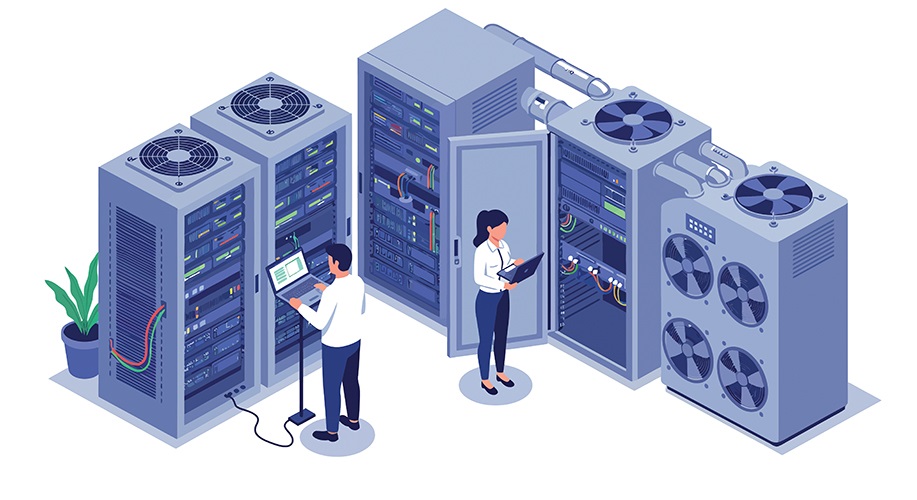
The new data centers on the drawing boards and beginning to break ground aren’t measured in square footage—instead, developers describe the size of the electrical loads they’re expected to draw. While previous-generation facilities might have been sized at 5–10 megawatts (MW), larger designs intended to support A.I. operations can hit 100 MW or more.
A midyear 2025 report from commercial real estate leader JLL identified then-current data center construction pipeline totaling 8 gigawatts (GW)—and 73% of that space was already preleased. Unless those facilities are planning on developing their own on-site power sources (some are), that much new power demand will also drive new transmission construction.
The Grain Belt Express project, planned to carry 5 GW of wind-generated electricity 800 miles from Kansas to the Illinois/Indiana border, is the kind of bulk power transporter intended to help meet this demand. However, in July, the Trump administration canceled a $4.9 billion federal loan guarantee for the $12 billion project. Invenergy, the company developing the line, has pledged to move forward without the backing. But now a court fight is underway in Missouri regarding the approval of the state’s Public Service Commission. This is the last legal hurdle standing in the way of construction.
As a smaller—but almost as ambitious—project planned for Iowa and Illinois shows, going underground could be one way to speed long-distance, bulk-power transmission. Developers of the SOO Green line, a 350-mile project planned to carry 2.1 GW of Iowa wind power into Illinois, have seen fewer challenges than Invenergy has faced. An Army Corps of Engineers environmental permit is the last approval needed before construction can begin.
The plan involves underground installation within existing railway rights-of-way owned by the Canadian Pacific Railway. Though abutters to these rights-of-way will be compensated, this design eliminates the need for the kind of property-taking that has farmers in Kansas and Missouri opposed to the Grain Belt Express.
In October, the Public Utility Commission in Texas approved a new 145-mile, 500-kilovolt (kV) line in a section of the state that falls outside the Electric Reliability Council of Texas (ERCOT) grid’s operating territory, falling within the Midcontinent Independent System Operator (MISO) region instead.
MISO has even bigger plans in the works to provide a more robust system throughout the rest of its network. In December, the organization’s board approved a $22 billion plan to build on earlier efforts to create a 765-kV backbone stretching from South Dakota to Indiana. This could enable better transmission of, for example, wind resources from the ISO’s western region to points east while adding greater resiliency throughout the system.
This plan is facing pushback from utility commissioners in five states within the MISO footprint (only three of which would face cost repercussions). A complaint was filed in July with the Federal Energy Regulatory Commission (FERC) and is currently under review.
Recognizing the need
Despite the challenges many ambitious transmission plans are facing, clean energy advocates, including a number of the companies leading the data center development charge, see value in pursuing their development.
Harry Godfrey, managing director of Advanced Energy United, an advocacy group in this sector, sees three major arguments in favor developing a more robust transmission infrastructure.
“First, transmission is resource agnostic—we’re transporting electrons from where they’re produced to where they’re consumed, whether those electrons are green, brown or any other color,” he said. “Second is affordability—unlocking supply across regions better allows supply to meet demand, lowering prices, particularly in areas of high demand and congestion. And the third I’d point to is reliability. We built this fragmented grid that, in some cases, is like a series of islands with a set of bridges. When they don’t have robust interregional interconnections, if one island—one particular grid—gets in trouble, it can be really hard to provide support.”
Matt Leggett, partner with Pittsburgh-based law firm K&L Gates’ Public Policy and Law practice group, hopes the current administration’s push for generation will help smooth the way for new transmission development.
“A lot of the reforms will also impact transmission,” he said, noting changes to policies regarding regulatory review under the National Environmental Policy Act.
The declaration of a national energy emergency could provide broader governmental authority for siting disputes with new lines. More immediately, Leggett sees FERC becoming more focused on the need for transmission development.
“FERC has become active on transmission issues and has already made rulings on things like cost allocation,” he said, noting the commission’s new chair, sworn in this past June, has a strong background in the area. However, he added, the emphasis could shift from providing new routes of access to renewable resources toward supporting new data center loads.
“Transmission will have a seat at the table, likely at a more streamlined fashion centered on A.I. and data centers, more than wind and solar—transmission lines planned to connect wind and solar likely will come under review. Over the long term, there likely will be room for those intermittent projects and the transmission that goes with them,” he said.
What’s working
The value of streamlined permitting is proving itself in Texas, where ERCOT has announced ambitious plans to bring power to the state’s booming Permian Basin, where A.I. data centers are beginning to rival oil production in economic importance. In October, regulators solicited transmission plans for eight new power-import paths, three of which could be the first 765-kV lines built in Texas, and their decision is expected by May 1, 2026—a rapid timeline for what could be a $13.4 billion approval. Because this is an intrastate project within the one interconnection where FERC has no jurisdiction, ERCOT’s approval is all transmission developers need.
“Texas is obviously an example of a state where we’ve seen really robust buildout of both intrastate transmission and diversified generation resources,” Godfrey said. “I think that has a lot to do with both the simplicity of permitting law as well as simplified interconnection that lets you plug in more readily.”
Even cost-allocation issues, which can be deal killers in interstate efforts, are easier to address in the Lone Star State.
“The question of who’s paying—you see that discussion in ERCOT as well, but there’s less coordination that’s necessary,” said Maria Faconti, a partner in K&L Gates’ Power practice group.
For regions where new transmission development is more contentious, utilities and regulators could be looking for options they can deploy quickly to meet burgeoning data center demand. For Leggett, that means a growing demand for battery-based energy storage, given the support the technology continues to receive across the U.S. political spectrum.
“I believe it will continue to be an important contributor to the grid and will continue to receive support from Democrats and Republicans,” he said.
Godfrey agrees, especially given the many services batteries can provide beyond backup power.
“I think storage has a really promising role to play here in the short—and even long—term, as a substitute solution and ultimately a complementary solution, because storage is a Swiss Army knife,” he said, noting its use in balancing functions such as voltage regulation. Storage has proven its hardiness in severe weather conditions.
“Texas had a really catastrophic grid failure in 2021, but we’ve seen it hold up well in subsequent extreme weather events in no small part because of the sheer amount of storage that’s been deployed. So, there’s a proof point of how storage can be a really effective solution,” Godfrey said.
STOCK.ADOBE.COM/Santiago
About The Author

ROSS has covered building and energy technologies and electric-utility business issues for more than 25 years. Contact him at [email protected].