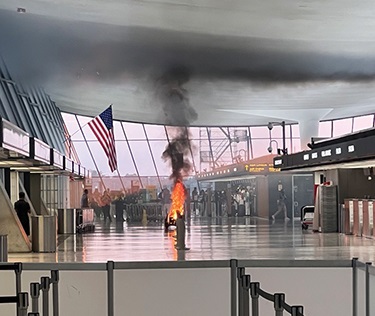
More critical deferred maintenance projects—both commercial and government-funded—are getting delayed. Federal building repair backlogs more than doubled to $370 billion from 2017 to 2024, prompting the U.S. Government Accountability Office (GAO) to add federal building work to the “Managing Federal Real Property” area of its High Risk List in 2025.
The need for maintenance projects
“Unless this trend reverses, federal assets will continue to deteriorate and need premature replacement, which can be significantly more expensive than if maintenance and repairs were done when originally scheduled,” according to the GAO.
Across the local, state and federal levels, the repair tab for deferred maintenance totals more than $10 trillion, said Mary Scott Nabers, president and CEO of Strategic Partnerships Inc., Austin, Texas, and the author of “Inside the Infrastructure Revolution—A Roadmap for Rebuilding America.”
While federally funded projects continue to be allocated for critical water, transportation, bridges and cybersecurity improvement projects, funds have been frozen for work such as electric vehicle charging equipment and other clean energy projects. Though states, cities, counties and universities are still funding those programs, they are leaving out other critical maintenance projects.
“Many of America’s large cities have old infrastructure, some as old as 50 years, and that infrastructure is aging faster than it can be repaired or rebuilt in some locations,” Nabers said. “Other public assets are aging, including city halls, law enforcement facilities, healthcare clinics and school buildings. They all need modern technology, upgrades and more efficient heating and cooling equipment.”
While government jurisdictions hold bond elections to improve their existing assets, the funding is often not enough to cover the project costs because of slow supply chains and price escalations, Nabers said.
“Waiting does not help, because the longer the wait, the more the prices increase,” she said. “And because of the extreme weather we are experiencing, cities and counties must make sure that their infrastructure is sustainable to withstand extreme weather events. As a result, the deferred maintenance problem is only going to continue to get larger.”
As for federal critical infrastructure projects that have the green light, there is still work to be found for electrical and line contractors, Nabers said.
“Part of the concern is the grid’s cybersecurity, and public officials always worry about an attack on the power systems,” she said. “The resiliency and sustainability of our power grids are top-of-mind concerns of governmental officials.”
Cybersecurity gets priority for officials in other government jurisdictions, Nabers said. Texas is creating a Cybersecurity Institute on the University of Texas San Antonio campus.
“Officials there will oversee cybersecurity in the state and make sure that Texas has highly skilled individuals for cyber safety,” Nabers said.
For electrical contractors, there will be funding for many infrastructure projects that require electrical expertise, she said.
“Water treatment plants, road and bridge repair, renewable energy, renovating and upgrading all public buildings, school district expansions—these types of projects rely heavily on electrical contractors,” Nabers said. “New data centers and chip factories are planned, and these two will need electrical expertise.”
What are economists saying?
The slowdown on critical infrastructure projects coincides with the ease in overall construction spending, said Ken Simonson, chief economist for the Associated General Contractors of America, Arlington, Va.
The Census Bureau reported that projects underway in April declined for the third month in a row. Residential construction
accounted for the bulk of the downturn, falling 5% year-over-year, while private nonresidential construction eked out a 1% gain and public construction increased by 5%, Simonson said. But these growth rates were sharply slower than two years ago, when private nonresidential construction increased 24% year-over-year and public construction rose 17%.
“The prospect of steep tariffs and retaliatory measures by U.S. trading partners have caused many project owners to cancel or defer decisions about proceeding with construction until they are more certain about costs and demand for their facilities,” he said. “Drastic changes in federal funding, permitting and tax provisions have also led to project cancellations and deferrals.”
Manufacturing, the largest nonresidential segment, has experienced the steepest slowdown, declining from an explosive 74% year-over-year growth rate in April 2023 to no change between April 2024 and April 2025, Simonson said.
“Despite several announcements by large companies that they would build new or expand plants in the United States, few of these projects have broken ground,” he said. “Meanwhile, an increasing number of manufacturing projects have been canceled, scaled back or slowed.”
The strongest category of construction continues to be data centers, Simonson said. To satisfy the energy requirements for data centers and other customers, electrical power construction—generation, transmission, distribution and storage—is likely to increase substantially in the next several years. But the timing will depend on regulatory approvals and availability of equipment and workers.
“Looking ahead, I expect continued growth, though probably at a modest rate, in data center and power construction,” he said. “Highway, airport and intercity rail construction are likely to increase. But the prospects for most other categories of public and private construction appear shaky.”
There’s a lot of uncertainty when it comes to supply for construction projects, as no one really knows what their input costs are going to be considering the unresolved tariff trade wars, said Chris Kuehl, managing director of Armada Corporate Intelligence, Kansas City, Kan., who also serves as ELECTRICAL CONTRACTOR’s chief economist.
“If you’re in the construction trade, you’re like, ‘I can’t go to a client and say, my input costs could be $2 million or they could be $80 million—I don’t know,’” Kuehl said. “So that’s one of the reasons that you’ve got a lot of projects stalling. Companies are saying they need things to be a little more stable, and, at some point, these big swings have to end.”
Armada has been breaking down the tariff possibilities into scenarios, and one scenario seems a little more likely than others—a potential 11%–15% tariff hit for the construction sector, according to Kuehl. But another scenario also comes to mind, and it depends on what kind of deals are struck and how long the existing deals stay. For China, if talks falter, would the tariff snap back to 145% or would another deal be struck?
“It feels like the dominant voice in the Trump administration is now Treasury Secretary Scott Bessent, and he seems a lot more comfortable with 20%–30% tariffs, but you still have people that talk to Trump about 100% and 200% tariffs,” Kuehl said. “So you never know.”

"Companies are saying they need
things to be a little more stable, and, at some
point, these big swings have to end.”
—Chris Kuehl, Armada Corporate Intelligence
Looking to the future
When it comes to critical maintenance projects, there doesn’t yet seem to be discussion around encouraging medical or energy sector projects.
“If the administration said we really need to develop energy or the country’s medical capability, the next step would be to give tariff exemptions to countries that are providing what we need to do that work,” Kuehl said. “Those critical industries still need a lot of steel, aluminum, rare earths and transformers—all those things that we get from other countries. And the answer so far from the administration is no exemptions for those things.”
That may change as those industries make the case that they need tariff exemptions to provide the energy that people want or take care of their medical needs, he said.
“Regarding the pressure to implement A.I. within infrastructure, there’s going to be people saying, well, if you want us to develop A.I., you can’t deny us the material that we need,” Kuehl said. “But right now the administration is saying, ‘Well, yes, we can deny you, so deal with it.’”
The administration is paying “a little attention” to national security projects, but that’s “kind of down the road, too,” he said.
There’s a lot of conversation about what the military might need going forward, and it’s different from previous years.
“The defense establishment is rethinking weaponry at a really rapid pace,” Kuehl said. “The Ukraine war has changed people’s mindset, as they are fighting this war with drones and doing it very effectively. So the U.S. military is considering building more drones and less planes, tanks and ships.”
One thing to watch: Federal agencies are rife with critical maintenance projects, but what happens if the need is there but the sector has undergone a huge workforce reduction? If the agency decides to go forward with the project, will there be enough people to oversee construction?
“We have a lot of construction clients, and right now they’re sort of in limbo,” Kuehl said. “They haven’t given up on their projects at all, but they’re waiting to see what happens.”
Кирилл/stock.adobe.com | freshidea/stock.adobe.com
About The Author

KUEHNER-HEBERT is a freelance writer based in Running Springs, Calif. She has more than three decades of journalism experience. Reach her at [email protected].