Ensuring safety and compliance in electrical installations is critical, particularly when it comes to maintaining adequate working space around electrical equipment. The National Electrical Code Section 110.26 outlines specific space requirements to facilitate safe operation and maintenance. This case study explores the real-world application of NEC 110.26, highlights challenges encountered during a commercial upgrade and provides best practices to help achieve compliance.
NEC Section 110.26 establishes the minimum space requirements for safe access to and maintenance of electrical equipment, including provisions for depth, width and height of working space; access and egress requirements; and dedicated equipment space.
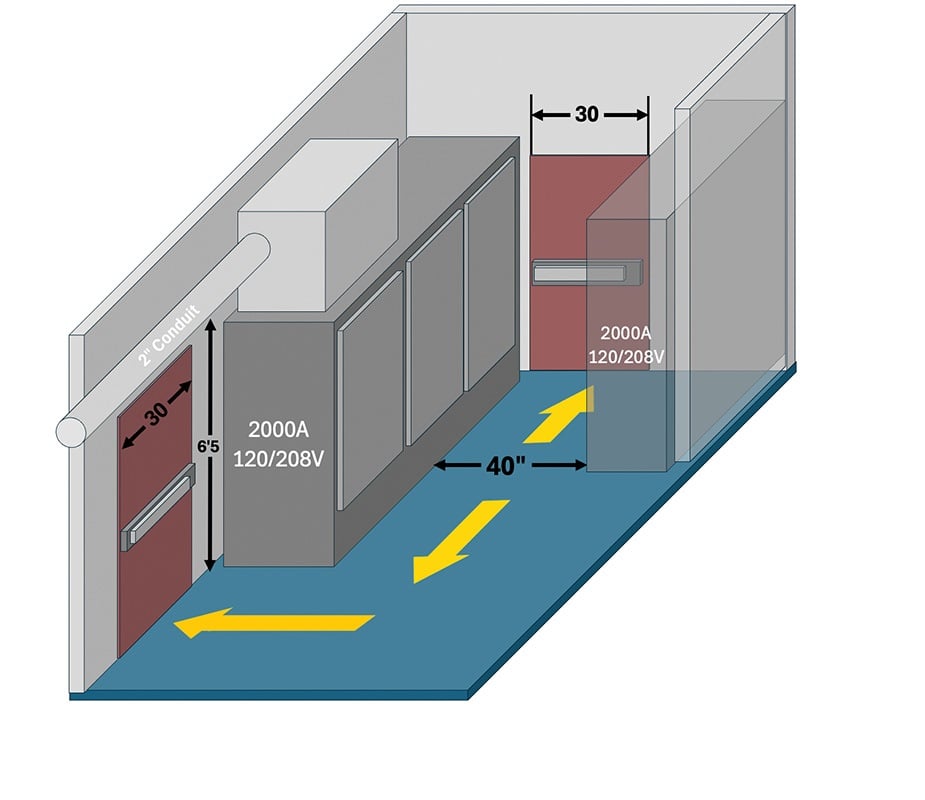
Working space dimensions (Section 110.26(A))
- Depth of working space: Defined by Table 110.26(A)(1), depth varies depending on system voltage and the configuration of grounded or ungrounded parts. Special allowances are provided under subsections 110.26(A)(1)(a)–(c) for certain installations.
- Working space width: Section 110.26(A)(2) mandates a minimum width of 30 inches or the width of the equipment, whichever is greater.
- Working space height: Section 110.26(A)(3) requires 6½ feet or the height of the equipment, whichever is greater. Minor projections, such as conduit or meters, are permitted within limits.
- Clear spaces: The Code requires that working spaces be kept clear at all times and not used for storage. This ensures safe access for maintenance and emergency work.
Access and egress from the working space (Section 110.26(C))
General requirements demand that at least one entrance must be provided for access to the working space per Section 110.26(C)(1).
Large equipment: Two means of egress required
Equipment rated 1,200A or more and over 6 feet wide is considered large. Section 110.26(C)(2) requires two means of egress at each end of the working space. Section 110.26(C)(3) allows a single means of egress under the following special conditions: an unobstructed path exists from the working space, or the working space is at least twice the minimum depth required (see Figure 1).
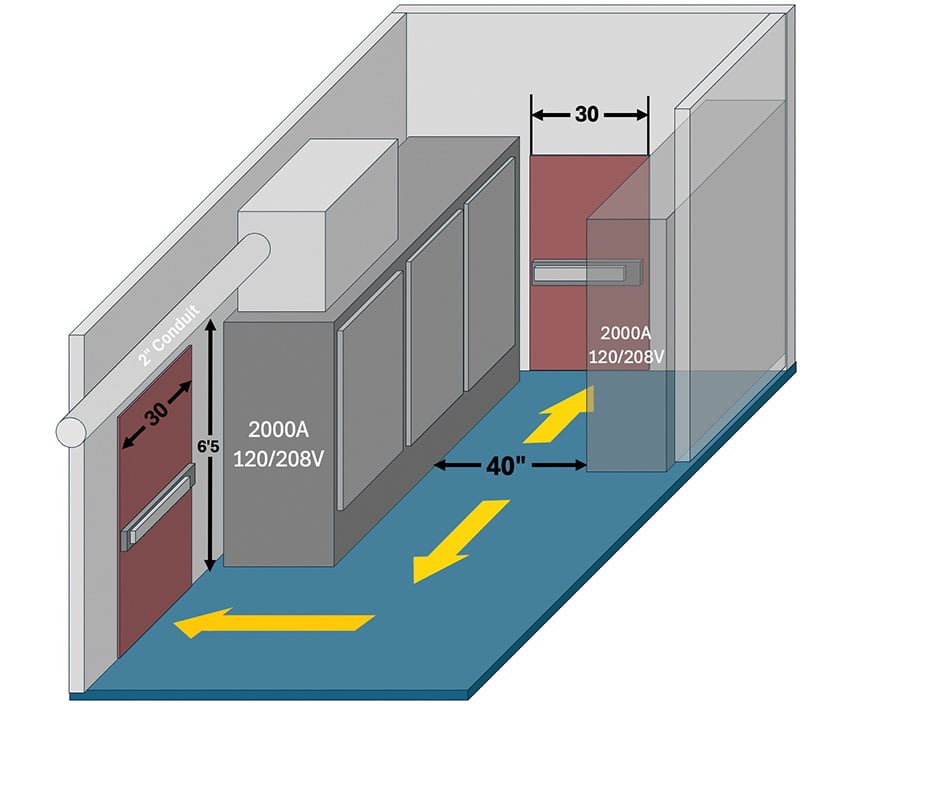
Figure 1
For equipment rated 800A or more with overcurrent or control devices, doors must be within 25 feet, open 90 degrees in the path of egress and have listed panic hardware.
Dedicated equipment space (Section 110.26(E))
Section 110.26(E) requires dedicated equipment space for all service equipment, switchboards, switchgear, panelboards and motor control centers be installed in accordance with all the following:
- Be at least equal to the depth and width of the equipment
- Extend from the top of the equipment to a height of 6 feet or the structural ceiling, whichever is greater.
- Extend from the bottom of the equipment to the floor.
- Be free from piping, ducts, leak protection or any equipment foreign to the electrical system.
Section 110.26(E)(1) covers indoor installations and Section 110.26(E)(2) covers outdoor installations.
Case study: Commercial facility upgrade
A high-rise condominium was undergoing a complete electrical upgrade, including the main service, unit panelboards and fire pump service. The existing electrical room, located in the underground parking garage, had limited space. Despite the constraints, the design called for reusing the room to install new 2,000A, 120/208V service equipment that exceeded 6 feet in width, thus qualifying as “large equipment” under 110.26(C).
To meet the required working space depth for 120/208V systems with opposing equipment, the layout provided a 3-foot pathway between two rows of equipment. On the surface, this installation met the working space depth requirement of Table 110.26(A)(1);
however, challenges threatened compliance regarding the entrance/egress from the working space.
Compliance challenges identified by the AHJ
After completion, the contractor requested an inspection for the new service. The authority having jurisdiction (AHJ) identified key compliance issues.
First, the existing room only had a single personnel door. For large equipment installations, NEC 110.26(C)(2) mandates two egress points on both ends of the working space, unless specific special conditions are met. Also, this door led directly into a tenant’s parking space, which made it unusable.
Second, the single door did not provide a compliant means of egress due to its obstruction and lack of panic hardware. An additional compliant egress path was needed.
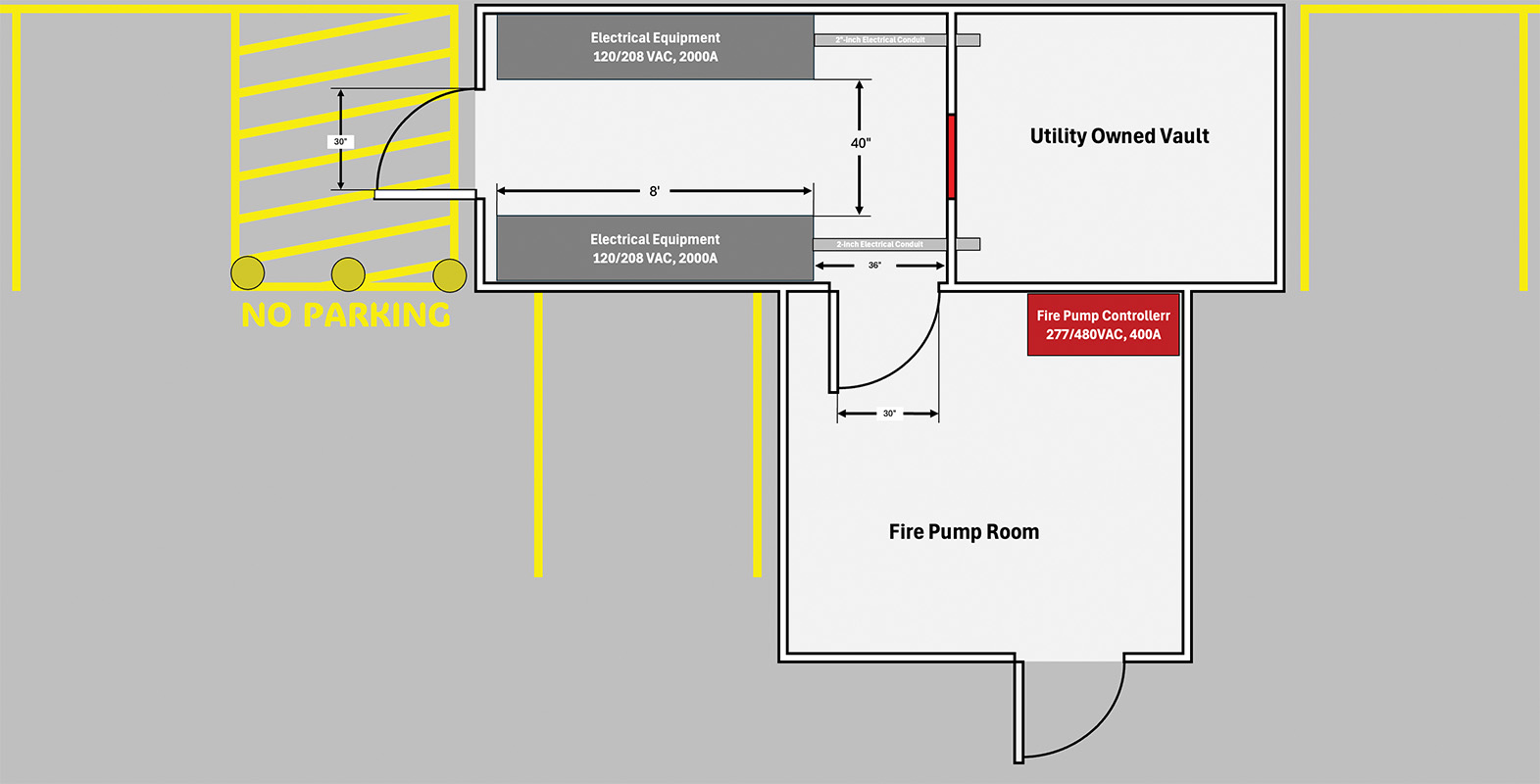
Figure 2
Solutions implemented
To resolve these issues and meet NEC 110.26(C) requirements, the project team implemented a parking space modification and added a second egress path.
The parking spot obstructing the egress door was permanently removed. Bollards were installed to prevent future parking, and the door was equipped with panic hardware and reconfigured to swing open in the direction of egress (see Figure 2).
An adjacent door on the other end of the working space, leading to the fire pump room was evaluated as a second point of egress. However, several issues needed correction.
- A conduit hanging over the egress path was less than 6.5 feet high. It was relocated to provide sufficient headroom.
- The fire pump room door was modified to open outward with panic hardware.
- There were concerns related to the required egress path from the fire pump room. The fire pump electrical equipment did not qualify as large equipment, so the single egress path to the parking garage was acceptable.
Lessons learned
- Plan ahead. Address NEC 110.26 clearance requirements during the design phase. Spatial limitations can be costly to rectify post-installation.
- Communicate with the AHJ. Engagement with the AHJ or a formal plan review can uncover compliance issues before construction.
- Prioritize training. Electrical designers and contractors should be well-versed in the less obvious requirements of NEC 110.26, especially around access and egress for large equipment.
- Preserve working space. Do not rely on shared or multiuse rooms without ensuring clear and compliant access paths.
Conclusion
Maintaining compliance with NEC 110.26 is essential to ensuring safe, functional and code-compliant electrical installations. By understanding and applying the full scope of Section 110.26, electrical professionals can better protect workers, avoid costly delays and deliver installations that meet the Code’s letter and the intent.
Kyle Krueger
About The Author

Kyle Krueger
Executive Director of Codes and StandardsKRUEGER is NECA’s executive director of codes and standards. He has worked in the electrical industry for over 25 years as an inside wireman, authority having jurisdiction and educator. Kyle currently represents NECA on the NEC Correlating Committee, Code-Making Panel 3, NFPA 72 Correlating Committee, NFPA’s Electrical Section Executive Board and the UL Electrical Council. Reach him at kkrueger@ necanet.org.