President Trump made it clear where he stands on the further development of renewable energy his first day in office with an executive order blocking onshore and offshore wind projects from accessing federal lands. The One Big Beautiful Bill Act went even further by significantly reducing deadlines for new solar and wind projects to qualify for federal tax credits. More recently, his administration has forced work to stop on a 700-megawatt (MW) offshore wind farm that was already 80% complete.
However, the current administration is not enacting budget cuts to all carbon- and fossil-fuel-free energy technologies, despite its emphasis on coal and natural gas resources. For example, tax credits remain in place until 2034 for new energy storage installations (though systems using foreign-made materials face strong restrictions). And two emerging technologies—enhanced geothermal and advanced nuclear energy—also maintain their tax-advantaged standing.
While storage technologies are becoming more established, these two new approaches are in their beta stages, so now’s a good time for a deeper dive into what’s drawing investors toward their further development.
Geothermal is getting hotter
Using heat from below the Earth’s surface to drive steam turbine generators isn’t a new concept. California’s Pacific Gas & Electric has been operating its plant in The Geysers geothermal field north of San Francisco since 1960. But the traditional use of geothermal energy to create electricity is limited to areas like The Geysers that feature a combination of accessible layers of permeable hot rock and underground water or other fluids that can be pumped to the surface to drive steam generators. As a result, geothermal energy currently supports a mere 0.4% of U.S. electricity demand.
However, developers are now drawing on technology first developed by the petroleum industry to boost oil and gas production. These include both improved drilling capabilities that enable access through harder, impermeable rocks and hydraulic fracturing (“fracking”) techniques that break up rock to create permeability.
Oil and gas companies have used these approaches to boost fossil fuel production over the last few decades. Now, new energy developers are using these enhanced geothermal processes to force cool fluids down through the cracks, where they’re heated to temperatures of up to 400°F or higher, and then pumped back to the surface to drive steam generator operations.
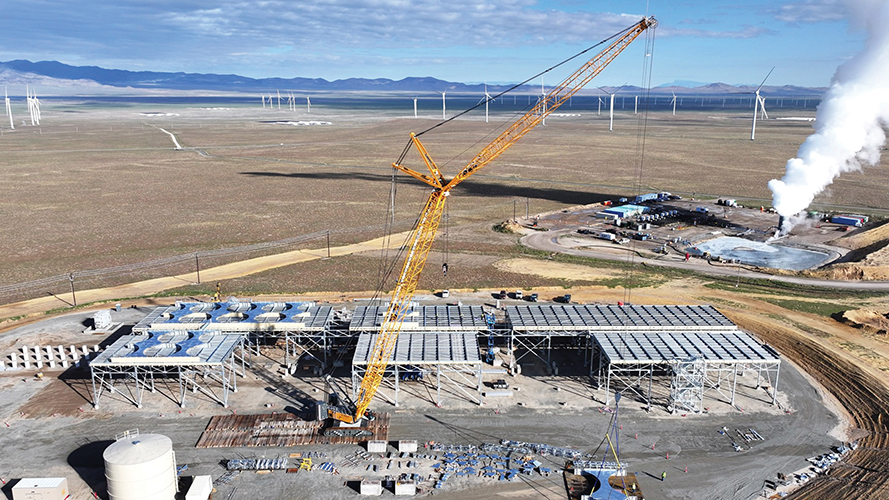
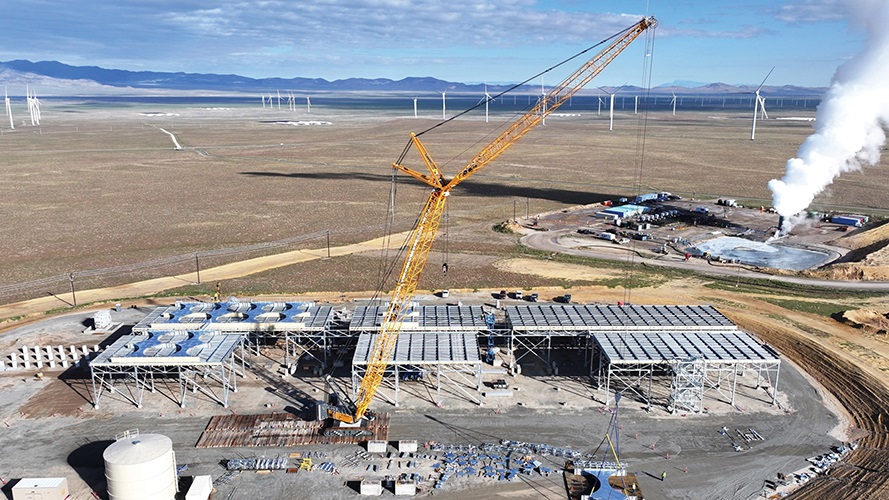
The first phase of Cape Station, a planned 400-MW advanced geothermal plant,
is now under construction in Beaver County, Utah.
U.S. geothermal resources are closer to the surface in the Western half of the country, where most efforts now are focused. For example, Houston-based Fervo Energy, the leader in the field, is currently developing the first 100-MW phase of what’s planned to be a 400-MW generating station in Beaver County, Utah, called Cape Station. Power is expected to begin flowing in 2026. Full-scale operations are planned to begin in 2028. Southern California Edison has contracted for 320 MW, with Shell Energy and other groups buying the remainder.
But the company also sees opportunity in the East, given its success in a less hospitable location. It recently completed a 15,765-foot-deep test well using advanced drills and bits in just 16 days, which could make more regions of the country economically viable geothermal targets.
New nuclear approaches
Nuclear energy also has retained tax advantages under Trump administration policies. A number of new approaches, grouped under the general term “advanced nuclear,” are at various stages of commercial development. Some improve on the pressurized water and boiling water designs of plants operating today, while others use materials such as molten salt or liquid metal as a coolant or heat transfer medium.
The designs getting the most attention are classified as small modular reactors (SMRs). The smallest SMRs, called microreactors, produce as little as 10 MW, with the category topping out at 300 MW. Their modularity means they can be factory-prefabricated and shipped in parts to the customer’s location, rather than having to be purpose-built at the site. This could mean significant construction cost savings. Additionally, some SMRs are designed to be added onto over time, so boosting output becomes an easier possibility.
Proponents see multiple applications for SMRs as carbon-free electricity providers in utility and private company operations. For example, as a 24/7 generator, an SMR could take the place of a retiring baseload coal or natural gas plant. With its small footprint, it could take advantage of existing interconnection infrastructure.
Globally, there are more than 70 SMR designs under development, with about 20 projects in the preinvestment phase, according to the World Nuclear Association’s SMR Global Tracker. However, only one of these, Kairos Power’s Hermes 2 Demonstration Plant in Oak Ridge, Tenn., is currently under construction. This 50-MW unit, which could eventually expand to 500 MW, will sell its output to Google to help power nearby data centers.
Fervo Energy
About The Author

ROSS has covered building and energy technologies and electric-utility business issues for more than 25 years. Contact him at [email protected].