It’s a good time for systems integrators to take advantage of activity in mobile video surveillance deployments.
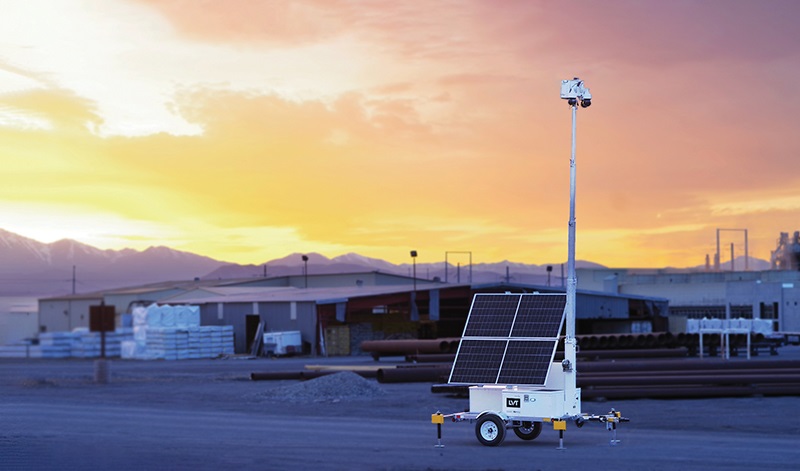
For outdoor security protection when and where you need it, these ready-to-go protection and detection solutions are portable—installing quickly for temporary and movable surveillance.
While they are affixed on trailers, don’t let the simple footprint fool you: mobile surveillance is a cloud-based platform with the latest technologies for proactive detection, including analytics, voice, audio and lighting. Solar-powered and equipped with cellular and satellite communications, they offer live-streaming and recording, with integration to popular video management systems.
For public safety, mobile surveillance units expand security to areas with higher crime rates or locations with heightened activity, such as parades or protests. San Francisco is piloting the deployment of mobile camera trailers following the passage of Proposition E, a measure designed to give the police department access to the newest technology, including surveillance, drones, automated license plate readers and facial recognition.
These mobile trailers protect construction sites, equipment and other high-value assets. In retail, they stake out perimeters to safeguard containers with merchandise, or stand guard over pop-up shops or markets. In critical infrastructure, they find a fit in ports, docks and utilities, and even remote substations and solar farms with no power or internet, leveraging off-grid capabilities to secure remote assets 24/7.
New projects and recurring revenue
For systems integrators, the competitive advantage is the speed of deployment.
“If a customer has a threat today, they can’t wait six months for trenching and cabling,” said Matt Kelley, senior vice president of business and market development for LiveView Technologies (LVT), American Fork, Utah. “You can roll a mobile unit onto their lot and have live-streaming video in under 30 minutes. That is a value proposition traditional fixed security cannot beat.” (LVT provides the mobile surveillance units to San Francisco for the police department’s new technology program.)
The market is shifting from reactive surveillance and recording evidence to proactive deterrence, stopping crime from escalating or happening altogether.
“The demand for mobile, solar-powered units is exploding because traditional infrastructure is too slow and expensive to deploy. We are seeing a massive force multiplier effect where organizations are using units to augment human guards, allowing them to cover more ground with fewer personnel. The trailer in a parking lot might look simple, but the tech stack inside is incredibly sophisticated, with the biggest innovations being agentic A.I. and power autonomy,” Kelley said.
Agentic A.I. directs actions
Agentic artificial intelligence is designed to act autonomously, set goals and execute tasks with minimal human supervision, according to IBM. The concept reinforces the shift from reactive systems to proactive A.I.—with systems acting independently in decision-making and execution for faster response.
“We aren’t just detecting a person,” Kelley said. “Agentic A.I. understands behavior. It can distinguish between a shopper walking to their car and someone loitering near a back entrance at 2 a.m. It automatically triggers talk-down or a voice warning to flush intruders out. This happens on the unit itself with edge processing, so response is immediate.”
Other factors influencing the growth of mobile surveillance include power management that combines solar and fuel cells, as well as the ability to fortify communications with multicarrier cellular transmissions and satellite backup. LVT leverages multicarrier cellular networks, with modems switching between major carriers to find the strongest signal. Satellite redundancy is also an option for remote critical infrastructure applications, where backhaul options keep communications up and running online, even if a cell tower goes down or there isn’t one in the location.
“Reliability is everything. We use high-efficiency solar panels [often about 800W] paired with deep-cycle battery banks [460 Ah range]. But the innovation is the hybrid approach and integrating smart EFOY fuel cells [methanol] as a backup. If there’s a blizzard and no sun for a week, the fuel cell kicks in to keep cameras and A.I. running,” he said.
Kelley said integrators need to stop selling cameras and start selling outcomes in a subscription-based model.
“The money isn’t in selling the hardware once; it’s in the recurring revenue,” Kelley said. “Integrators who adopt this model will experience a much healthier, more predictable business than those chasing one-off project fees.”
Mobile surveillance is becoming a standard in creating a complete security and perimeter protection solution. It’s no longer a temporary security fix, but part of a system integrator’s suite of products that together result in a fortified, more secure facility.
LiveView Technologies