In high-risk environments, or where workers need real-time security, duress and panic buttons trigger immediate silent alerts and audible alarms. A fixture in physical security protection for decades, the devices have evolved from single-function standalone products to integrated emergency notification systems that interface with other solutions such as access control, video surveillance, environmental sensors, gunshot detection and more.
The history of duress and panic buttons dates to the early 1900s when switchboard operators would manually operate buttons in an emergency. Banks adopted them in the 1960s, using hardwired units affixed beneath counters to silently signal a robbery. From there, the devices expanded to medical alert pendants and on to mainstream deployments for at-risk workers in retail, schools and hospitals.
Digital innovation continues to set product design on a new trajectory—incorporating signaling capabilities such as wireless, GPS Bluetooth location tracking and power over ethernet (PoE) connectivity. New devices include clip-mounted wearables, smartwatches, mobile phone apps and computer keyboards, leveraging cloud servers and interfacing with system-wide access control and video management platforms.
Duress compliance landscape
Growth in the product sector reflects an uptick in aggressive behavior, workplace violence and school shootings. At the federal level, several bills requiring panic buttons in schools have been introduced to Congress.
Healthcare, hospitality and retail may also now require panic buttons. In New York, the 2024 Retail Worker Safety Act was passed to protect employees from workplace aggression, requiring silent response buttons for employers with more than 500 employees. California, Oregon and Washington have introduced or passed legislation requiring panic buttons for hotel staff, especially housekeeping, to squelch harassment and assault.
Modern duress systems pinpoint emergency locations with the latest location services, ultra-wideband or 900 MHz, creating specific zones and work flows. Methods used to initiate panic or duress include wireless, PoE, hardwired, networked, APIs, URLs, RSS, emails, etc. Notifications to users can consist of computer pop-ups, emails, text messages and text-to-speech announcements to radio and PA systems.
“Software is the heart of the operation and systems are deployed with the cloud or on-premises servers,” said Fernando Esteban, national sales director for Lynx Systems, Richardson, Texas. “The devices are bi-directional, meaning they not only communicate information on their current status and operability, but can integrate to a door, camera, analytics, motion detection or other connected component.”
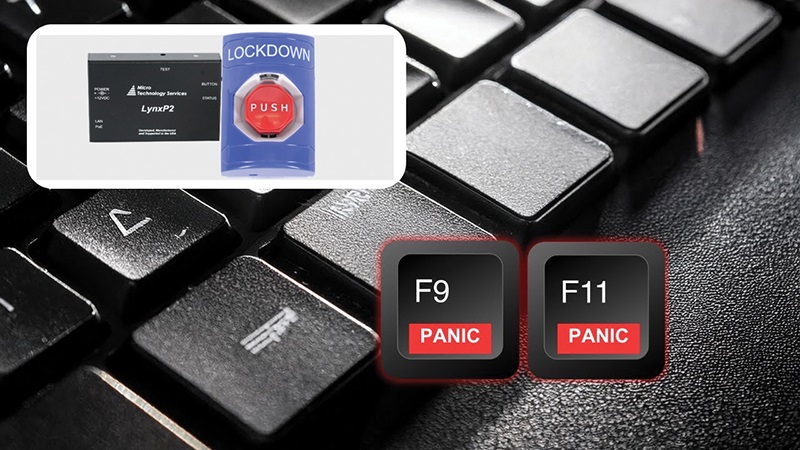
Lynx panic button hardware and duress and mass notification software interfaces with the application server to provide inputs and outputs to achieve bidirectional communications.
Getting the message out
“We can deploy HTTP requests to tie into other systems, utilize RSS and even email to trigger alarms,” Esteban said.
Lynx integrates to existing PA systems and transmits prerecorded messages or built-in text-to-speech. Alarms are preprogrammed or populated with dynamic text that the text-to-speech engine converts at alarm activation.
Leveraging the cloud, these products provide data and information that ties into and fortifies facility-wide safety and security risk management.
“Let’s say there’s an active shooter and the panic button is pushed. It sends a notification to the doors to validate credentials. If determined invalid, the doors will lock down and software begins camera recordings, marking the video so it can’t be deleted,” Esteban said.
Panic alarm functionality on computer keyboards connected to the network is another trend that keeps safety closer to the worker and installs simply with software.
Keyboard-based panic buttons designate a specific function key to trigger an alert. These devices send customizable silent alarms with one or several two-key combination panic button that works when logged on, logged off or locked. A computer can have different key combinations.
“A professional duress system should always include supervision and testing capabilities,” Esteban said.
The capabilities of duress and panic devices have changed dramatically with improvements in communication technology and signaling. While still deployed regularly as a standalone device, duress and panic buttons now integrate to video surveillance to trigger camera recordings, communicate through public address systems or radio and initiate access control lockdown as part of a complete physical security solution.
lynx systems