Most are familiar with the sign in an elevator lobby that says, “In case of fire, do not use the elevators. Use exit stairs.” Most individuals can easily comply with this requirement. However, if your mobility is impaired, taking the stairs may not be a viable option. Then what? How do you get the help you need to exit the building safely?
This scenario led to the creation of the two-way emergency communications system. In the past, contractors installed basic intercom systems or even plain old telephones so that individuals could call for help from elevator lobbies or at stair entrances. Over the last few years, these systems have evolved greatly.
In June 2020, the UL 2525 Two-Way Emergency Communications Systems for Rescue Assistance product standard was approved. NFPA 72 followed this naming convention in its 2022 edition when it renamed Section 24.10 as Two-Way Emergency Communications Systems for Rescue Assistance. Starting with the 2024 edition, the International Building Code (IBC) requires compliance with this new product standard and the highly revised installation standard.
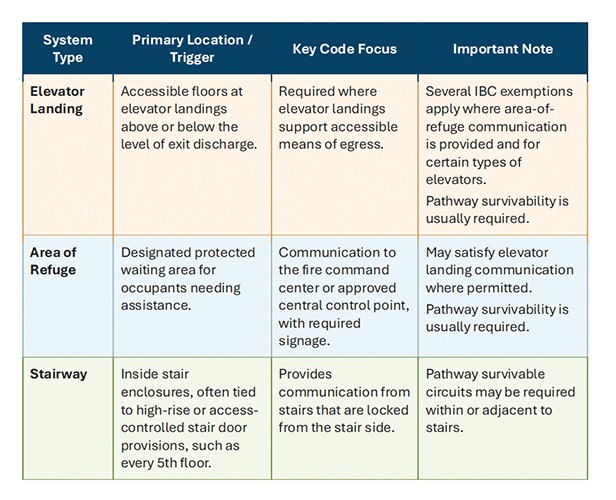
The 2024 IBC does not use the term “systems for rescue assistance.” Rather, it generally calls these systems “a two-way communication system” and then dictates the spaces that should be provided with communication stations. Required locations can include areas of refuge (Section 1009.6.5), stairways (Section 403.5.3.1), elevator landings (Section 1009.8), occupant evacuation elevator lobbies (Section 3008.6.6) and other locations where locked egress doors must be provided with communication (e.g., Section 1010.2.4 item 8.2 and 1010.2.14 item 6). These systems are separate from the emergency communications system that is provided within elevator cars, as addressed by Section 3001.
See the chart for a comparison of the three most common types of these systems.
The key is that the building code requires two-way communication at specific building locations based on the building configuration, egress methods and accessibility provisions. It specifies where remote communication stations must be provided, where that communication terminates at master control stations and the required audible and visual operational features.
Communication stations
All communications are required to terminate at a master control station located in the fire command center or at another approved central control point within the building. When that central control point is not constantly attended, the system must be provided with a timed, automatic telephone dial-out capability that provides two-way communication with an approved supervising station or directly to emergency services.
Each communication station must include proper signage, directions on the use of the system, instructions for summoning assistance through the system and written identification of the exact location of the station being used. Any system installed by an electrical contractor must be listed in accordance with UL 2525 and installed in accordance with NFPA 72.
It is critical that an electrical contractor or installer understand these installation requirements, as the changes in the 2022 edition of NFPA 72 are significant. For example, an adequate secondary power source must provide 24 hours of standby power and then an additional 4 hours of secondary power during a fire or other emergency conditions. The additional 4 hours of secondary power capacity must be calculated assuming all remote call stations are activated and all master control stations are annunciating the calls. This is because occupants using these systems are unable to evacuate a building on their own and will often need to communicate with emergency personnel for a longer period until help is rendered.
Importantly, when individuals are in an area of refuge location, they must wait for instructions and assistance from first responders. Accordingly, the circuit(s) connecting communication stations must be designed to withstand the attack of fire. The use of pathway survivable cable or alternate provisions in accordance with NFPA 72 Section 24.3.14 is very important for an electrical contractor to understand.
When compared to other electronic systems within a building, these rescue assistance systems are relatively small. However, if an electrical contractor or installer does not account for the systems’ unique installation aspects based on recent code changes, they could be in for a costly surprise when the time for final inspection occurs.
larry rietz