According to the National Elevator Industry Inc., there were more than 1.03 million elevators in the United States as of 2023. The average elevator serves four landings and carries an average of 20,000 people each year, meaning U.S. elevators make some 20.6 billion passenger trips per year. That equates to more than 2.55 billion miles, which is more than five round trips to the moon!
The safety record for elevators is unsurpassed, which makes them the safest form of transportation in the world. Perhaps this is because of the abundance of safety requirements that apply to elevators.
The American Society of Mechanical Engineers (ASME) issued its first A17 Safety Code for Elevators in 1921, and it was just 25 pages long. The 2025 edition of ASME A17.1/CSA B44, Safety Code for Elevators and Escalators, is a binational code, jointly developed by ASME and the Canadian Standards Association, and contains more than 350 pages of rules and guidelines.
Electrical contractors and installers face many installation requirements when it comes to elevators because the interface means compliance with a variety of codes. Your locally enforced building code, the International Building Code (IBC) or NFPA 1, will have elevator installation requirements and necessitate adherence to the adopted version of ASME A17.1, which applies to all new elevators. In turn, ASME A17.1 requires compliance with NFPA 13, Standard for the Installation of Sprinkler Systems, and NFPA 72, National Fire Alarm and Signaling Code. Local amendments and rules often apply or change the way the above codes are interpreted.
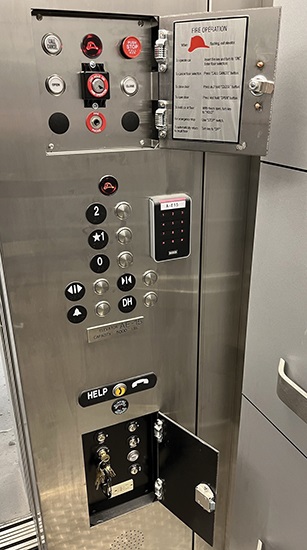
Electrical contractors must provide primary power, lighting and ventilation to elevators. Additionally, under most circumstances, a standby form of power from an emergency generator or battery energy storage system must be provided. However, elevators require other important electrical interfaces that can become the responsibility of electrical contractors and their subcontractors. These interfaces can be grouped into two general categories: emergency communication and emergency operation.
Emergency communication interfaces
Since the 1930s, ASME A17.1 has required elevator car emergency communication, which allows trapped passengers to pick up a telephone or press a button inside the elevator car and be connected to a call center, which could take appropriate action to dispatch help.
In the past, this was as simple as connecting a phone line to the elevator controller. However, just as telephone connections have changed, so have elevator communication systems. Additionally, the 2018 IBC and the 2019 edition of ASME A17.1 introduced new components to elevator communication systems. These changes were added to address communication challenges for those who are deaf, hard of hearing or with a speech condition. The 2019 requirements provide enhanced functionality beyond just voice communication and include video, text notifications and visual messages. The electrical installer must now coordinate closely with the elevator provider to ensure appropriate communication cabling is provided to communicate with selected call centers.
The IBC requires voice speakers to be provided in each elevator car in high-rise buildings. This allows for delivery of manual one-way announcements to elevator groups sharing common call buttons. This normally means a fire alarm speaker circuit must be provided from the fire alarm system to the elevator controller location. That circuit is then landed on an elevator travel cable circuit, which the installer provides to the elevator car. That circuit then terminates at a fire alarm speaker located in the car. This again requires coordination between trades.
In some cases, high-rise buildings still have a two-way, in-building wired emergency services communication system, also known as a firefighter telephone system or fire department communication system. These systems are provided by the fire alarm system and require fire warden phones or plug-in jacks to be installed in elevator cars and at elevator lobbies, among other locations. This requires circuiting from the fire alarm system to the elevator controller, much like that described in the paragraph above.
Finally, most of us are familiar with the sign that says, “In case of fire, use stairs. Do not use the elevator.” The model building codes require that elevator landings on accessible floors located above or below the level of exit discharge, usually the ground floor, be provided with an elevator landing communication system. These two-way emergency communication systems for rescue assistance carry many installation requirements from the model building code and must be installed per NFPA 72.
All the systems described above involve the same core function: providing a reliable way for building and elevator occupants to summon rescue assistance and exchange information with responders and command personnel. Ensure installing contractors know these requirements and coordinate with other trades and designers.
Larry Rietz