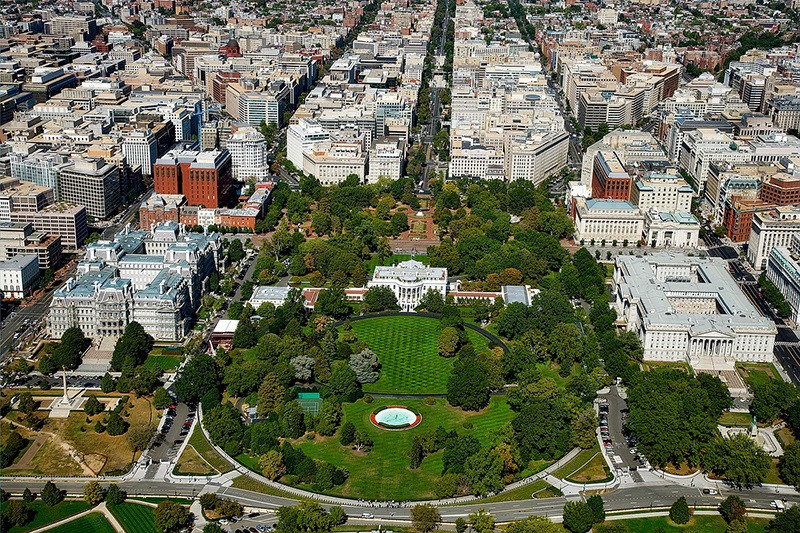
A report published in December 2016, "Achieving Urban Resilience: Washington DC," documents how the District of Columbia could save $5 billion over 40 years with smart surface technologies, such as cool roofs, green roofs, solar PV, bioretention, rainwater harvesting, reflective pavements, permeable pavements and urban trees.
The report was written by Capital E, an early-stage investor in low carbon and clean energy companies, and is the result of a partnership with the U.S. Green Building Council, Global Cool Cities Alliance, National Housing Trust, Chesapeake Bay Foundation, American Institute of Architects, National League of Cities, and others.
The report notes that cities and city planners undermanage rainfall and the effects of sunlight, costing cities billions of dollars from avoidable health-, energy-, and stormwater-related costs, while undermining livability and resilience, and contributing to climate change.
In specific, the report focuses on eight areas: energy, water, climate and environment, built environment, nature, jobs and economy, equity and diversity, and health and wellness.
As relates to energy in specific, the report claims D.C. could reduce electricity purchases from the grid by 8.5 percent, relative to 2013 consumption levels.
It notes that "urban resilience necessarily also means sharply reducing the causes of climate change - specifically reducing greenhouse gas emissions. This includes increased energy efficiency and generating renewable energy to displace fossil fuel usage."
The report continues, noting the value of taking the interaction of solar photovoltaics (PV), cool roofs, and green roofs into account, rather than focusing on just one or two of these. It notes that "high albedo [a reflection coefficient based on the whiteness of a surface] surfaces bounce incoming heat/sunlight back into space, both reducing global warming and reducing urban temperature directly. Lower urban temperature increases electricity output from solar PV panels. PV panels on roofs shade roofs, so less heat reaches buildings, reducing air conditioning-related energy use and improving indoor comfort. Locating PV systems on green roofs reduces PV panel temperature, thus increasing output of renewable electricity, while partial shading of green roofs by PV panels improves growth of green roofs, in turn making green roofs work better at water management and lowering risk and cost of extreme rain events."
"This report represents a major step in understanding and quantifying the benefits of adopting cost-effective strategies to manage sun and rainfall at a city level," writes Greg Kats, lead author of the report.
About The Author

ATKINSON has been a full-time business magazine writer since 1976. Contact him at [email protected].