You're reading an older article from ELECTRICAL CONTRACTOR. Some content, such as code-related information, may be outdated. Visit our homepage to view the most up-to-date articles.
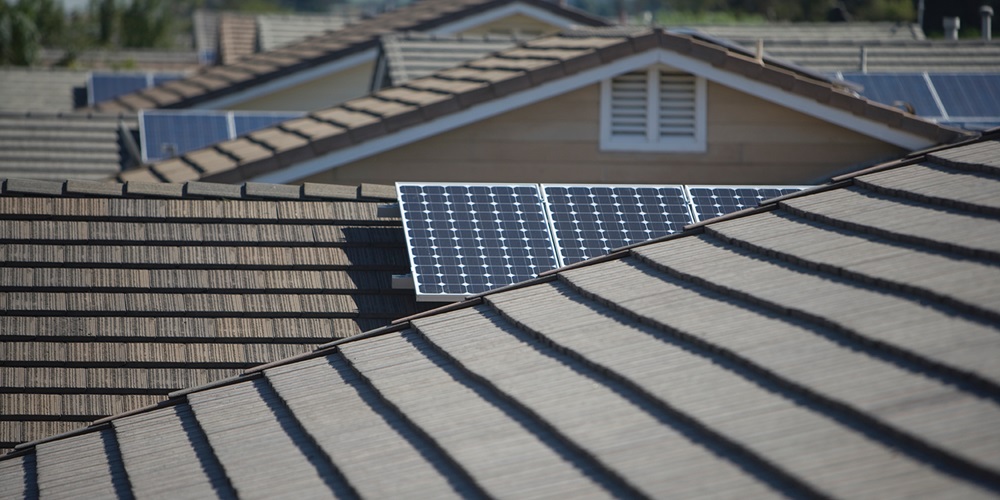
Rooftop photovoltaic (PV) panels might not yet be a standard home appliance, but they could be on their way if current growth rates keep up. Even after several record years, installation figures continue to climb. The first quarter of 2014 saw installed solar capacity increase 79 percent over 2013’s first-quarter results, and residential projects topped commercial installations for the first time since 2002 among distributed (i.e., nonutility) installations.
As these figures from the Solar Energy Industries Association’s (SEIA) Solar Market Insight Report show, more PV systems will be coming to rooftops near you—and soon. Homeowners are seeing value in PV panels, even as some states are winding down tax incentives, with more than one-third of this year’s first-quarter installations coming online without any state incentives.
However, utility incentives may still be part of homeowners’ financial decisions, and large, production-style homebuilders are starting to create entire communities in which solar panels are standard features rather than upgrades.
“At the core, there’s an interest in environmentalism,” said Kevin Morrow, director of sustainability and green building for the National Association of Home Builders (NAHB).
No longer viewed as eccentric science projects, rooftop PV installations are proving their economic value.
“There used to be almost a stigma attached to solar, but now it’s becoming more mainstream. [It is] almost at a tipping point,” Morrow said.
The NAHB and McGraw-Hill Construction documented the trend that is approaching this tipping point in a May report, which notes that 65 percent of the 116 single-family and 38 multifamily builders surveyed are incorporating renewable technologies (including heat pumps and solar water heaters) in at least some of their projects. Ten percent of single-family builders are now offering solar on all their projects, and 20 percent of single-family and multifamily builders and developers anticipate reaching that status in just the next two years.
Some of the nation’s biggest builders are among the companies pursuing solar-standard business. For example, Meritage Homes, Scottsdale, Ariz., recently reported installing some 500 solar-power systems per year on the houses it builds in the South and Southwest, and the company recently announced a partnership with PV manufacturer SunPower, San Jose, Calif., to offer solar options to all of its buyers. Also, PulteGroup’s Dell Webb subsidiary is in the process of building two enormous solar-standard communities—totaling more than 11,000 homes—in new Sun City developments in Nevada and Arizona.
Meritage estimates its systems run about $4 per watt to install (comparable to the latest SEIA figures) and add $40 to $80 a month to a mortgage, depending on system size. In return, homeowners likely enjoy significantly lower utility bills, especially since homes with added PV also are designed to operate more efficiently.
Morrow noted that interest in rolling PV into standard home offerings is becoming prevalent throughout the construction industry. Even the smaller volume builders are looking to build homes with solar-power systems, he said.
While owners of existing homes often appreciate the lack of upfront costs involved in leasing a solar-power system, it can make sense for new home buyers to roll the cost of purchasing solar into a mortgage, especially when resale value is considered. Lawrence Berkeley National Laboratories’ studies have shown returns of up to $5,900 per kilowatt in added resale value in California markets. Researchers at the Sandia National Laboratories have an interactive tool, PV Value, to help appraisers incorporate a fully owned system into property valuations undertaken for mortgage lenders. The results contrast with a recent Bloomberg report highlighting difficulties that some sellers have had attracting buyers when the transfer of a solar lease has been required.
With or without solar, selling a home is a marketing effort. The NAHB and McGraw-Hill researchers found a variety of messages to be effective in promoting renewable-energy features in new homes, with three of those messages—energy independence and resilience, concern for the environment, and utility savings—drawing approximately 60 percent of builders’ interest each, as either somewhat or very effective with potential buyers.
Interestingly, slightly more of the surveyed builders found the energy independence argument to be “very effective” than thought the same about possible energy savings. Builders need to be careful with this message, since the vast majority of installed PV systems do not allow for independent operation in the case of an outage in the utility grid.
However, the next big home-energy appliance could help make such grid-independence a reality. In late June, SunPower and KB Home announced a joint pilot program to include battery-based energy-storage systems along with rooftop PV in a limited number of KB Home communities in California. Unlike a separate pilot, these batteries will be installed behind the customer meter, enabling off-grid operation.
If such grid-independent combo PV/storage systems expand beyond small-scale pilot efforts, new-home marketers could add another marketing message to their sales pitches: “Buy this house, and we’ll throw in an electric utility for free.”
About The Author

ROSS has covered building and energy technologies and electric-utility business issues for more than 25 years. Contact him at [email protected].