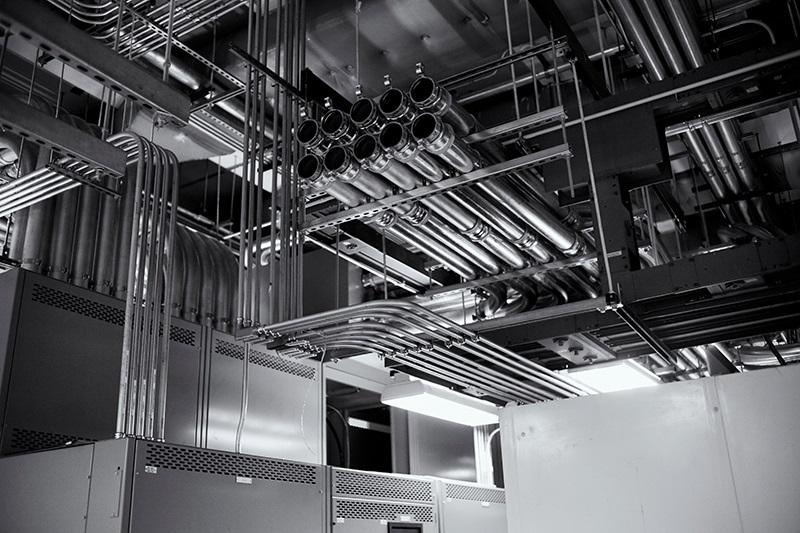
This month’s article will shift gears and move up the infrastructure chain from branch circuits to feeders. While many of the requirements for feeders look very similar to branch circuits, this will be a much simpler conversation since there are no outlets on a feeder.
The National Electrical Code defines a feeder as, “all circuit conductors between the service equipment, the source of a separately derived system, or other power supply source and the final branch-circuit overcurrent protective device (OCPD).” In other words, “feeder” applies to all the conductors downstream in the system from the service but upstream from the OCPD the branch circuit gets its supply from. This means that the rules for feeders are going to focus only on the conductors since there are no outlets or utilization equipment connected to a feeder.
Starting with Article 215
Let’s start by heading to Article 215. Of course, there are other articles that contain requirements for feeders, such as Article 225 for outside feeders and articles 266 and 267 for feeders above 1,000V AC or 1,500V DC, but we’ll start with the basics. Remember that the NEC’s purpose is to safeguard people and property from the hazards arising from the use of electricity. So, requirements for feeders are going to fall into two basic categories: prevent feeders from starting fires and protect occupants from electric shock and arc flash.
The first requirement in Article 215 is for the minimum size of feeder conductors, which is very similar to the way the NEC sizes branch circuit conductors. Just as with branch circuits, we compare the required size wire based on continuous loading and on feeding the load under specific use conditions. Whichever method requires the larger conductor, that is the minimum size conductor required for the feeder. But wait—theres a catch!
Unlike with branch circuits, feeders aren’t simply supplying one item of utilization equipment or a few receptacle outlets and lighting fixtures. Feeders are often supplying entire areas of a building or multiple large loads such as motors or HVAC equipment. This means that often there is more complexity to determining the load a feeder will need to be sized to supply.
The major source of this information is found in Article 120. However, this is a good thing. If we were to simply add up all the full-load current values of the equipment being fed, it is likely the feeder conductors would be much larger than necessary to supply the connected load.
This is where the demand factors in Article 120 play a critical role in helping us build a more realistic system. Sure, there might be 100 items fed by a given feeder, but it is likely that not all 100 will be operating at full capacity at any given time. The demand factors in Article 120 help users account for load diversification. Of course, having oversized conductors is not a hazard necessarily, but it could certainly be the reason a contractor is not competitive during the bidding process.
Load considerations
Certain types of loads, however, will be determined using specific calculation methods in other articles. Table 120.4 lays out where to find those articles and sections where a specific load calculation is required. Motors and HVAC equipment have entries in this table pointing us to specific places in articles 430 and 440, respectively. However, if the equipment being supplied by a feeder is not found in Table 120.4, then we look in Part III of Article 120 for guidance.
In Part III, we will find lighting loads based on volt-amperes per square feet of area, receptacle loads based on device counts or floor area, show window and track lighting loads, and other items commonly found in dwelling and nondwelling occupancies. But perhaps the most beneficial sections in Part III are the demand factors. Take, for instance, lighting loads. In certain types of occupancies, the chance that all the lighting is on at the same time is different than in other occupancies. Table 120.45 allows us to determine an occupancy-based demand factor we can apply to the calculated load based on volt-amperes per square foot of floor space.
Probably the most generous demand factor is in dwelling units. Take the first 3,000 VA at 100% of the calculated number, and then from 3,001 VA to 120,000 VA, we take it at 35%. Above 120,000 VA, we only use 25% of the calculated load. Essentially, the NEC is saying that a feeder supplying a large lighting load in a dwelling need only be sized for a fraction of the calculated load. For example, if a massive mansion had a calculated lighting load of 150,000 VA (75,000 ft2 at 2 VA/ft2) the feeder would only need to supply:
- First 3,000 VA at 100% = 3,000 VA
- 3,001 – 120,000 at 35% = 117,000 x 35% = 40,950 VA
- 120K – 150K at 25% = 30,000 x 25% = 7,500 VA
- Grand total: 51,450 VA, or about 34% of the total calculated load
Consider the occupancy
Other occupancies are going to take a much different approach due to the type of use the space gets. A warehouse has the first 12,500 VA at 100% and the rest at 50%, whereas office space, which is likely to have all the lights on all day long, gets no reduction. Therefore, this makes understanding the type of equipment and occupancy very important in determining the size of feeder conductors.
When it comes to the specific loads mentioned earlier, the rules get spelled out a little better. If we examine the rule for a feeder supplying multiple motors, for example, we can see that Article 430 doesn’t rely so much on volt-amperes per floor area and uses the actual size of the equipment. For a single motor supplied by our feeder, we would obtain a load value based on Section 430.22, but if the feeder is supplying multiple motors, look to Section 430.24 for guidance. Here are four items for consideration:
- The largest motor full-load current at 125%
- All other motor full-load currents at 100%
- All continuous nonmotor loads at 125%
- All noncontinuous, nonmotor loads at 100%
However, when we come back to determining the feeder conductor ampacity, the motor loads will be combined with the noncontinuous loads since they already have the 125% factor, and there is no need to factor in another 125% for continuous loading.
All this bouncing around in the NEC to this point has only been to determine what load to base the size of the feeder conductors on when making the comparison required by Section 215.4. Next month’s article will walk through the process of taking all this information gathered in other parts of the NEC and putting it to work in determining the minimum required ampacity of the feeder conductors.
Until next time, stay safe and always remember to test before you touch!
stock.adobe.com / jaypetersen
About The Author

Vigstol is an electrical safety consultant for E-Hazard, a provider of electrical safety consulting and training services. He is also the co-host of E-Hazard’s electrical safety podcast “Plugged Into Safety.” For more information, check out www.e-hazard.com.